
After you repay your home loan with LIC Housing Finance Ltd. (LIC HFL), it is important to collect all your original property documents and obtain a No Dues Certificate to ensure that your loan account is formally closed and your property is free from any encumbrances.
STEP 1: WRITE TO LIC HFL FOR DOCUMENT COLLECTION
Once your loan is closed, you need to write an email to LIC HFL from your registered email ID, requesting the release of your property documents.
LIC HFL will reply with an appointment date, time, and location for collection. Usually, appointments are provided within 15 working days from the date of request. Refer to below response from LIC HFL

STEP 2: COLLECT THE FOLLOWING DOCUMENTS FROM LIC HFL
On the appointment date, you will be required to collect the following documents:
- No Dues Certificate (NOC) on LIC HFL letterhead
- Original Property Documents submitted at the time of availing the loan, such as:
- Sale Deed
- Encumbrance Certificate (EC)
- Sale Agreement
- Loan Agreement (MODT)
- Power of Attorney (if submitted)
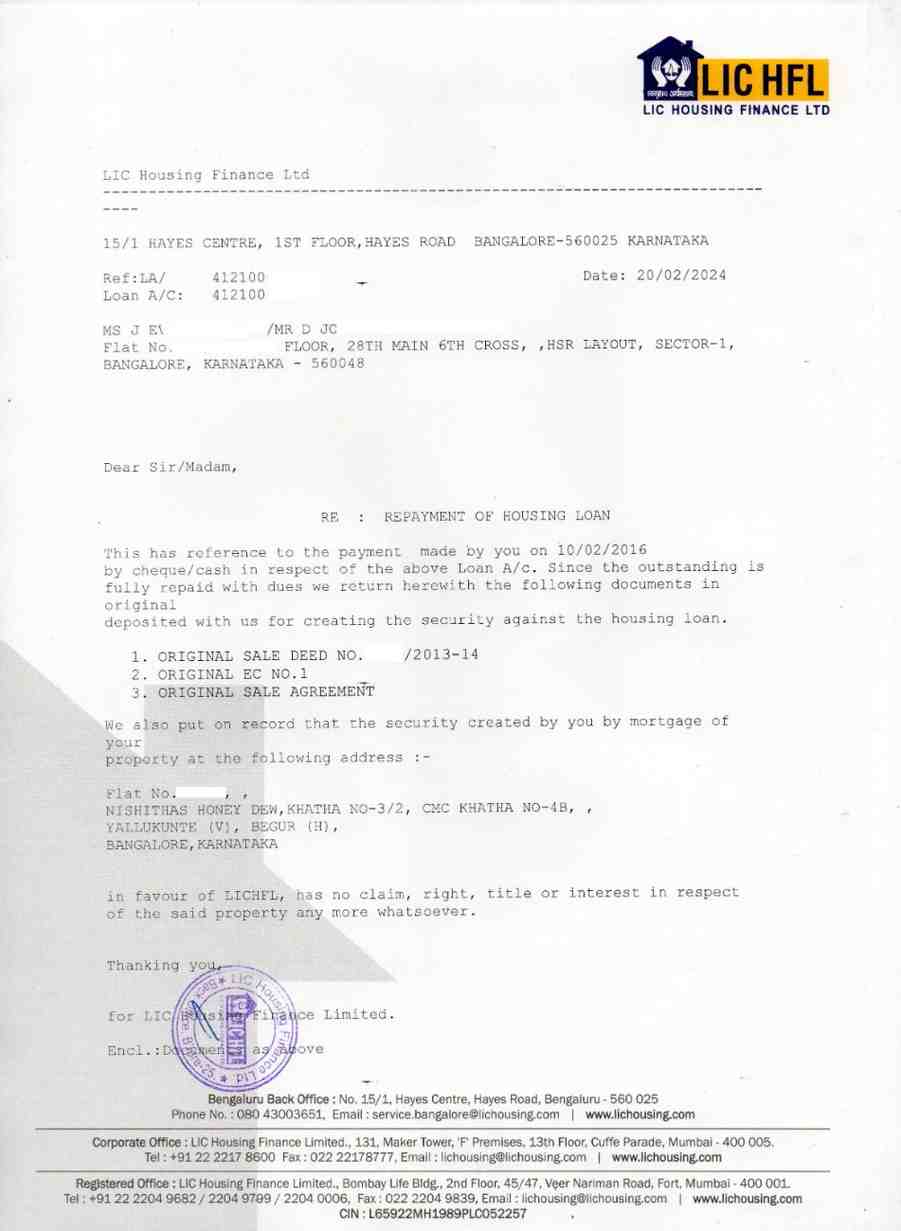
Sharing the “No Due Certificate” below for your reference.
IMPORTANCE OF THE NO DUES CERTIFICATE
The NOC (or Loan Closure Certificate) is the most crucial document to collect. It confirms that:
- All outstanding dues are cleared.
- LIC HFL has no claim, right, title, or interest in your property.
- Your property is debt-free and fully belongs to you.
The certificate generally includes the following details:
- Loan Account Number
- Applicant(s) Name
- List of property documents returned
- Property Address
- Seal and signature of the authorized signatory
REAL EXAMPLE: MY EXPERIENCE WITH LIC HFL
My client availed a loan of Rs.45 lakhs in April 2013, depositing Sale Deed, Encumbrance Certificate, and Sale Agreement as security.
The loan was fully repaid in 2016, since my client was in abroad, we could not collect the documents immediately.
Finally, in February 2024, we collected the following documents from LIC HFL:
- Sale Deed
- Encumbrance Certificate
- Sale Agreement
We ensured that all documents were in good condition with every page intact.
EQUITABLE VS. REGISTERED LOAN
In our case, the loan was an Equitable Mortgage, meaning the property documents were deposited with LIC HFL, but the loan was not registered with the Sub-Registrar’s office. Hence, there was no requirement to register a Discharge Deed for lien removal.
REAL EXAMPLE: HELPING AN NRI CLIENT
One of my clients, who resides in Washington, USA, wanted to sell his 2BHK flat in Bangalore. During the sale process, we realized that his original documents were still with LIC HFL.
To resolve this:
- He executed a General Power of Attorney (GPA) in my name, limited to collecting the property documents. Refer to below GPA image
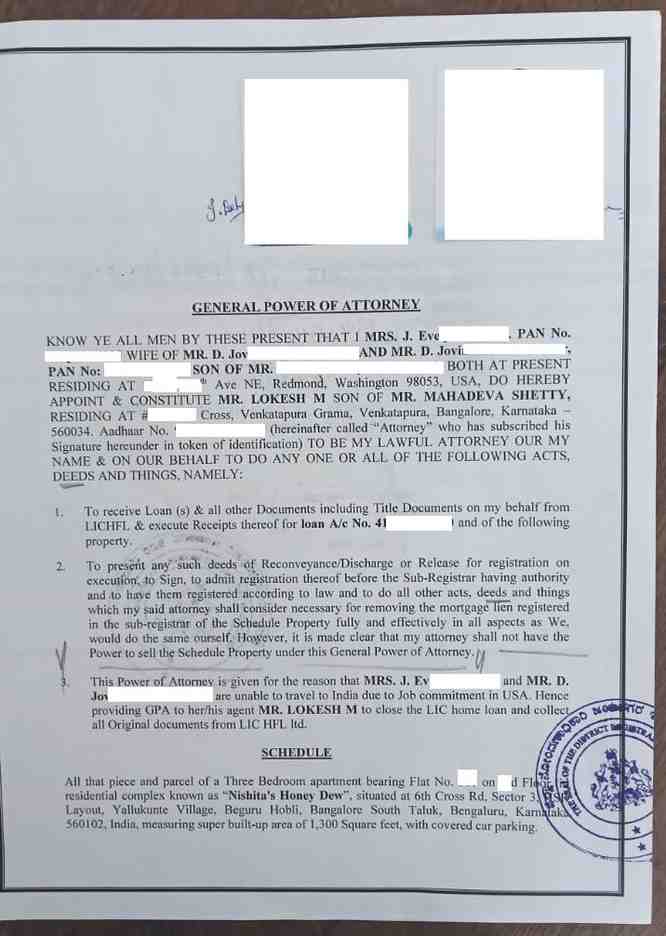
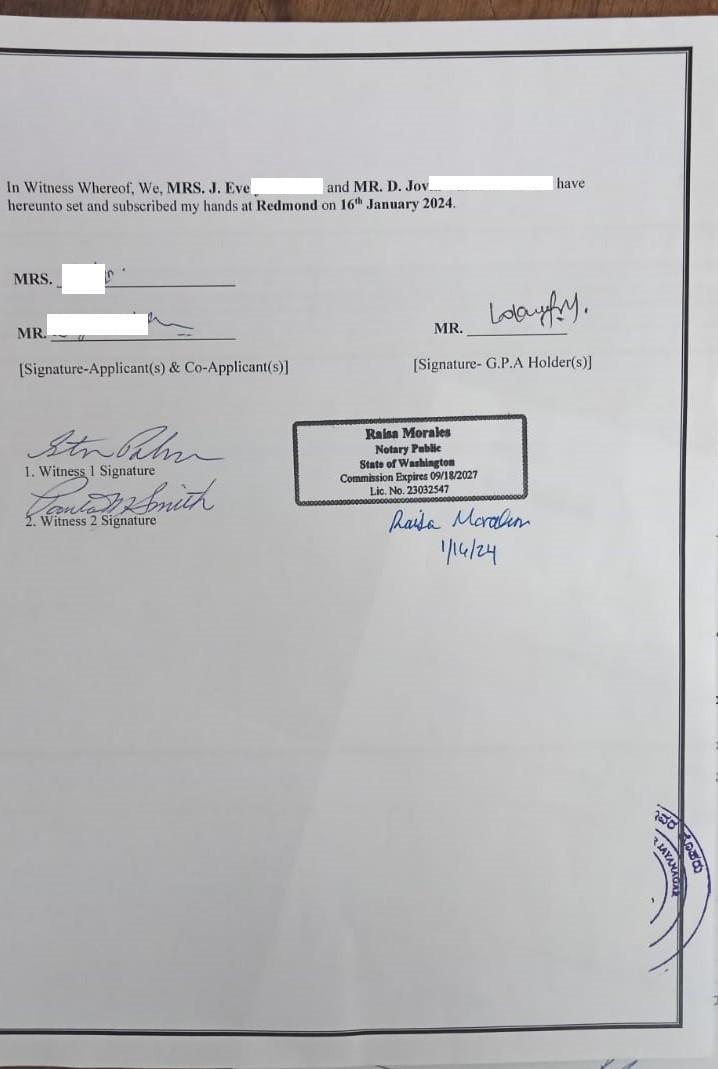
- With this GPA, I collected the documents from LIC HFL and dispatched them to him in Washington.
- He received the originals safely within 5 working days through international courier
OUR ASSISTANCE
We provide end-to-end support in collecting property documents from banks and registration of Discharge Deed
- Email: pgnproperties@gmail.com
- WhatsApp: +91-97424-79020