
When dealing with property transactions, one of the most important documents you will come across is the Parent Deed, also known as the Mother Deed. This document plays a critical role in establishing ownership history and ensuring that the title of the property is clear and marketable.
WHAT IS A PARENT DEED?
The Parent Deed is the foundational document that traces the history of ownership of a property. It records how ownership has passed from one person to another through a series of lawful transactions.
Ownership of property may change hands through:
- Sale
- Partition
- Inheritance
- Settlement
- Gift
- Release
Each of these transfers must be documented in chronological order without any gaps. This continuity of ownership is what makes the Parent Deed so vital in property transactions.
Important Note: Power of Attorney is not considered Parent Deeds.
WHY IS A PARENT DEED IMPORTANT?
- Proof of Ownership: Confirms that the seller has a valid and unbroken chain of ownership.
- Mandatory for Transactions: Banks and financial institutions insist on it when the property is used as collateral.
- Legal Protection: Essential during disputes or court cases to establish rightful ownership.
- Due Diligence: A buyer should always begin property verification by checking the earliest available Parent Deed.
WHAT INFORMATION DOES A PARENT DEED CONTAIN?
A Parent Deed typically includes:
- Seller and buyer details
- Property schedule (location, boundaries, dimensions, etc.)
- Consideration value (sale price)
- Terms of payment (transaction number, bank details, date)
- Government charges (stamp duty and registration fee)
- Terms and conditions of the sale
- Signatures of witnesses
The Parent Deed must always be registered at the jurisdictional Sub-Registrar’s Office.
WHAT TO DO IF THE PARENT DEED IS LOST?
If the original Parent Deed is lost, you can still obtain a certified copy either offline by visiting the Sub-Registrar Office or online through the Department of Stamps & Registration portal.
Steps to Obtain a Certified Copy of the Parent Deed:
Option 1: Offline (Visit the Sub-Registrar Office)
- Visit the jurisdictional Sub-Registrar Office where the property was originally registered.
- Fill out an Application Form for a certified copy.
- Attach a photocopy of the Parent Deed (if available).
- Pay the prescribed application fee (generally around Rs.250).
- Collect the certified copy within 3–7 working days after verification.
Option 2: Online (Apply through Stamps & Registration Department)
- Visit the official Kaveri Online Services portal of the Department of Stamps & Registration, Karnataka.
- Register or log in with your credentials.
- Select Certified Copy Application from the services menu.
- Enter property details (registration year, document number, office name, etc.).
- Pay the application fee online.
- Download the certified copy once it is processed
·
REAL-LIFE EXAMPLE: HOW I OBTAINED A CERTIFIED COPY
We recently wanted to sell a property, and the buyer insisted on reviewing the Parent Deed. Unfortunately, the original was lost many years ago, though we had a photocopy.
The buyer’s bank required either the original Parent Deed or a certified copy. Therefore, we applied for a certified copy at the Shivaji Nagar Sub-Registrar Office, Bangalore, where the property was registered in 1995. Refer to the below Sale Deed copy
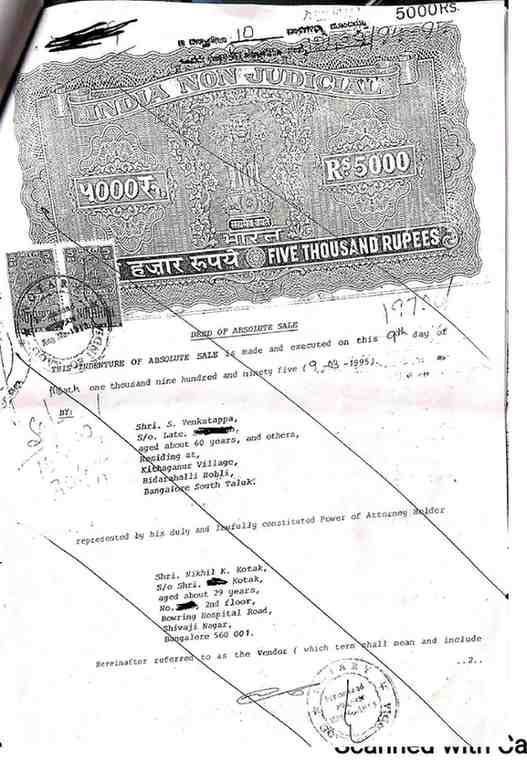
Here’s what we did:
- Submitted the application form
- Attached the photocopy of the Parent Deed
- Paid around Rs.350 as the application fee
- Within 4 working days, we downloaded a certified copy.
Refer to the below Certified copy

NEED ASSISTANCE?
If you are facing challenges in obtaining a certified copy of your Parent Deed, we provide end-to-end assistance
- Email: pgnproperties@gmail.com
- WhatsApp: +91-97424 79020
FREQUENTLY ASKED QUESTIONS (FAQ) ON PARENT DEED
Q1. What is a Parent Deed in property transactions?
A Parent Deed (also called Mother Deed) is the primary document that traces the ownership history of a property. It shows how ownership has changed hands over time through sale, inheritance, gift, release, or settlement.
Q2. Is a Power of Attorney considered a Parent Deed?
No. A Power of Attorney (POA) is not considered a Parent Deed because it does not transfer ownership, it only authorizes someone to act on behalf of the property owner.
Q3. Why is a Parent Deed important when buying or selling property?
A Parent Deed ensures that the property has a clear and unbroken ownership chain. It is required for legal verification, bank loan approval, and to safeguard against disputes.
Q4. What details are included in a Parent Deed?
A Parent Deed typically includes:
- Seller and buyer details
- Property schedule (location, boundaries, dimensions)
- Sale consideration (price)
- Payment terms and transaction details
- Stamp duty and registration charges
- Terms and conditions of sale
- Witness details
Q5. How can I get a certified copy of a lost Parent Deed?
You can obtain a certified copy in two ways:
- Offline: By visiting the jurisdictional Sub-Registrar’s Office where the property was registered.
- Online: By applying through the Kaveri Online Services portal of the Department of Stamps & Registration, Karnataka.
Q6. How long does it take to get a certified copy of the Parent Deed?
Typically, it takes 3 to 5 working days to receive the certified copy after submitting the application and paying the required fee.
Q7. What is the fee for obtaining a certified copy of the Parent Deed?
The application fee is generally around Rs.250, though the amount may vary depending on the document length and Sub-Registrar’s Office.
Q8. Can I sell a property without a Parent Deed?
No, you cannot complete a property sale without providing the Parent Deed (or a certified copy). Buyers and banks require it to verify ownership history before proceeding with the transaction.
Q9. Can I apply for a certified copy without a photocopy of the Parent Deed?
Yes. Even if you don’t have a photocopy, you can still apply by providing key property details (registration number, year, and Sub-Registrar office). However, having a photocopy makes the process quicker.
Q10. Who can help me in obtaining a certified copy of the Parent Deed?
You can approach the Sub-Registrar’s Office directly, apply online via the Kaveri portal, or seek professional assistance from property consultants who provide end-to-end support.