
Transferring property ownership after the death of a joint co-owner is a critical legal process. The BBMP e-Aasthi system allows surviving co-owners or legal heirs to update property records efficiently, provided the correct documentation is submitted.
The procedure varies depending on whether the deceased co-owner left a Will and whether the claimant is a family member or non-family member.
1. E-KHATA TRANSFER WHEN THERE IS A WILL
If the deceased co-owner has left behind a Will, Irrespective of whether the beneficiary is a family member or an outsider, you need to:
- Death Certificate of the deceased co-owner.
- Copy of the registered Will.
Based on these documents, the BBMP (Bruhat Bengaluru Mahanagara Palike) will process the e-Khata transfer to the beneficiary’s name.
2. e-Khata Transfer Without a Will (Family Member Case)
If the deceased co-owner has not left behind a Will, and the surviving claimant is a family member (spouse, children, or legal heir), then additional documentation is required. The following documents must be obtained:
- Death Certificate of the deceased co-owner.
- Family Tree Certificate (issued by the Tahsildar through the Nadakacheri office or portal).
REAL CASE STUDY: TRANSFERRING E-KHATA AFTER DEATH OF A JOINT OWNER
To explain this better, let me share a real case I handled.
Case Background
My client, Mrs. Mallika, and her husband, Mr. Unnikrishnan, had jointly purchased a 3BHK flat in Bangalore in February 2011. Sadly, Mr. Unnikrishnan passed away in September 2024.
They had three adult children (aged 46, 42, and 37). The children did not wish to claim their father’s share in the property. Therefore, we decided to transfer the deceased husband’s share entirely to Mrs. Mallika, making her the sole owner.
Documents Required for e-Khata Transfer After the Death of a Joint Property Owner
When one of the joint property owners passes away, BBMP requires a specific set of documents to process the e-Khata transfer. Below is a detailed explanation of each document and its purpose:
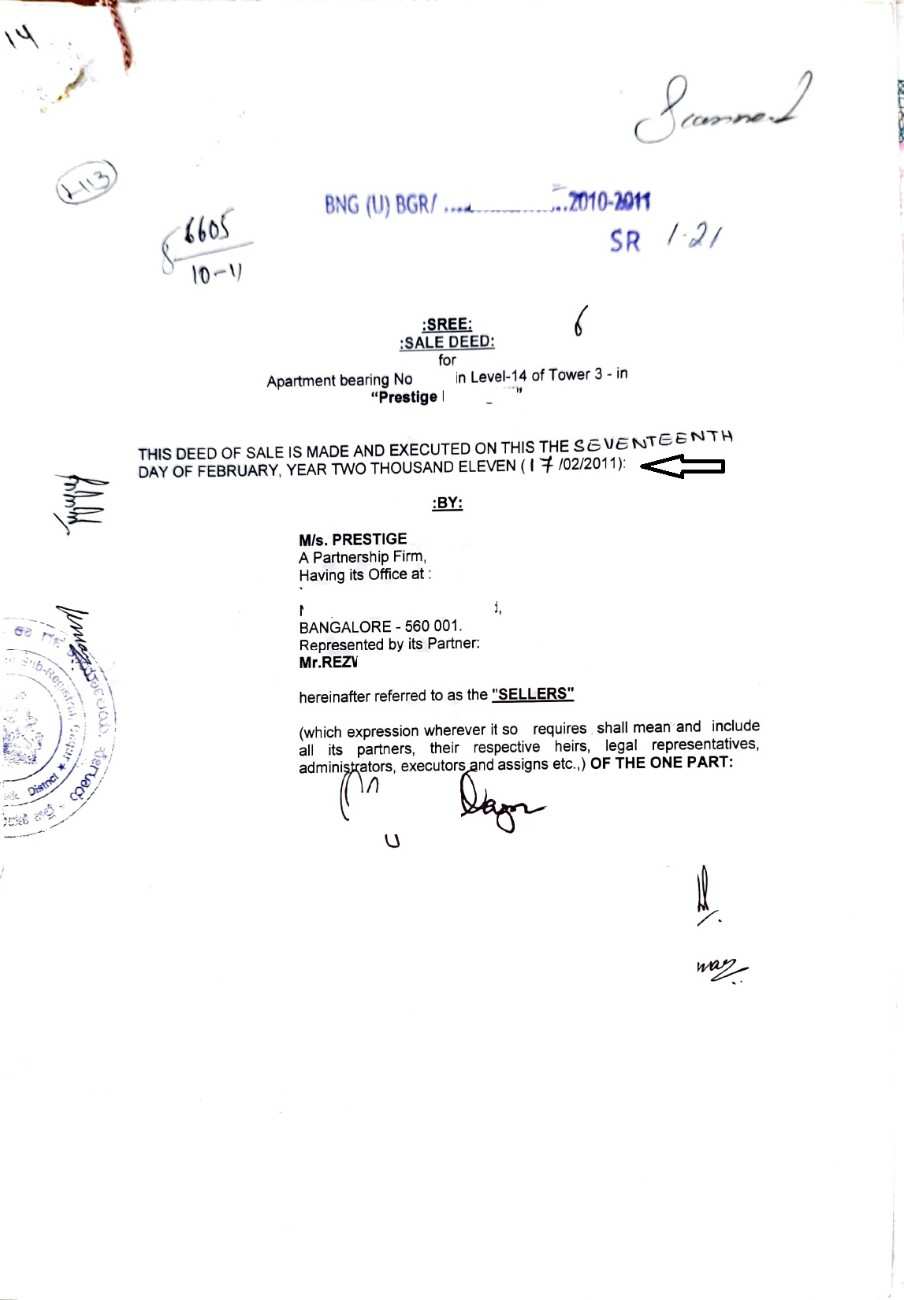
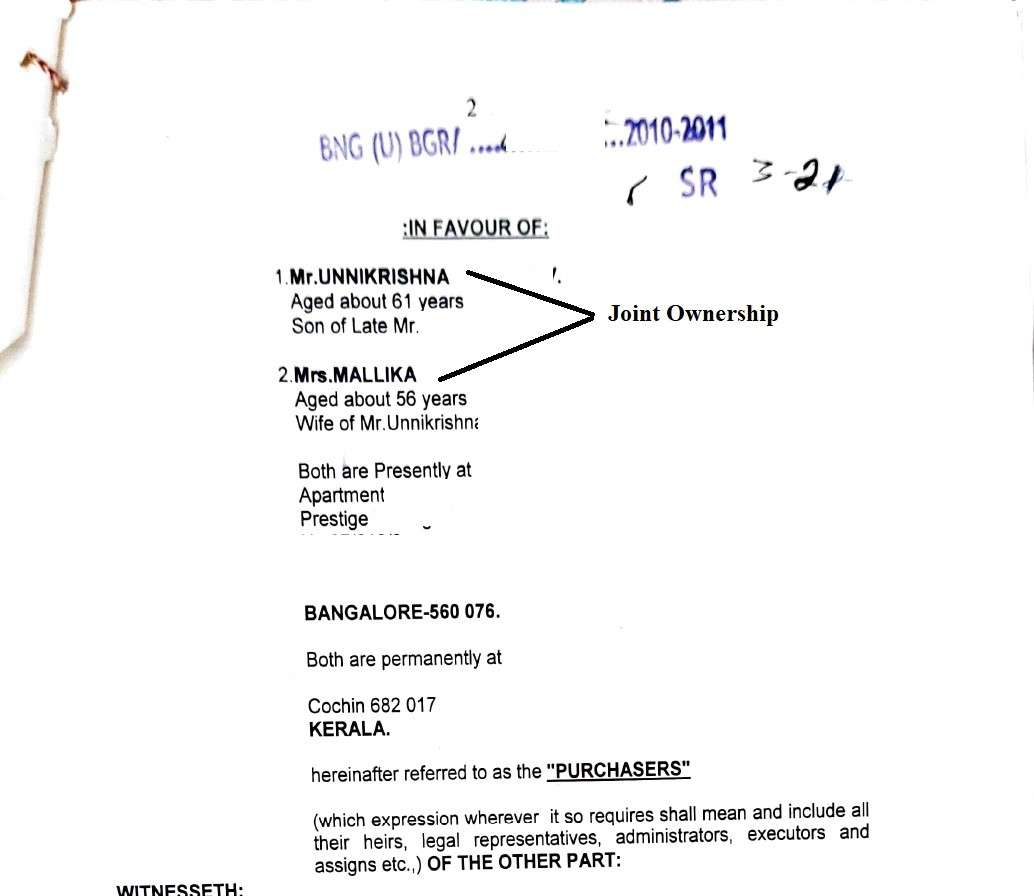
Registered Sale Deed
- This is the primary proof of ownership. In our case, the husband and wife jointly purchased the 3BHK flat in February 2011, and the registration date was clearly highlighted in the deed.
- The sale deed establishes the original ownership structure and is mandatory for e-Khata transfer.
Death Certificate
- Issued by the municipal authority, the death certificate officially records the death of the co-owner.
- In this case, the husband (co-owner) passed away in September 2024, and my client obtained the death certificate to initiate the transfer.
- This document is essential to establish the claim for inheritance.
Family Tree Certificate
- A Family Tree Certificate issued by the Tahsildar is mandatory for e-Khata transfer.
- It lists the surviving legal heirs of the deceased co-owner, ensuring that all family members are accounted for in the inheritance process.
- In our case, we obtained this certificate from the Nadakacheri office, Begur.

Manual Khata (if already available)
- Since the property already had a manual khata in the joint names of the husband and wife, the e-Khata draft was available in the e-Aasthi system. ePID Number is located in your e-Khata Draft
- This eliminated the need to apply for a fresh e-Khata

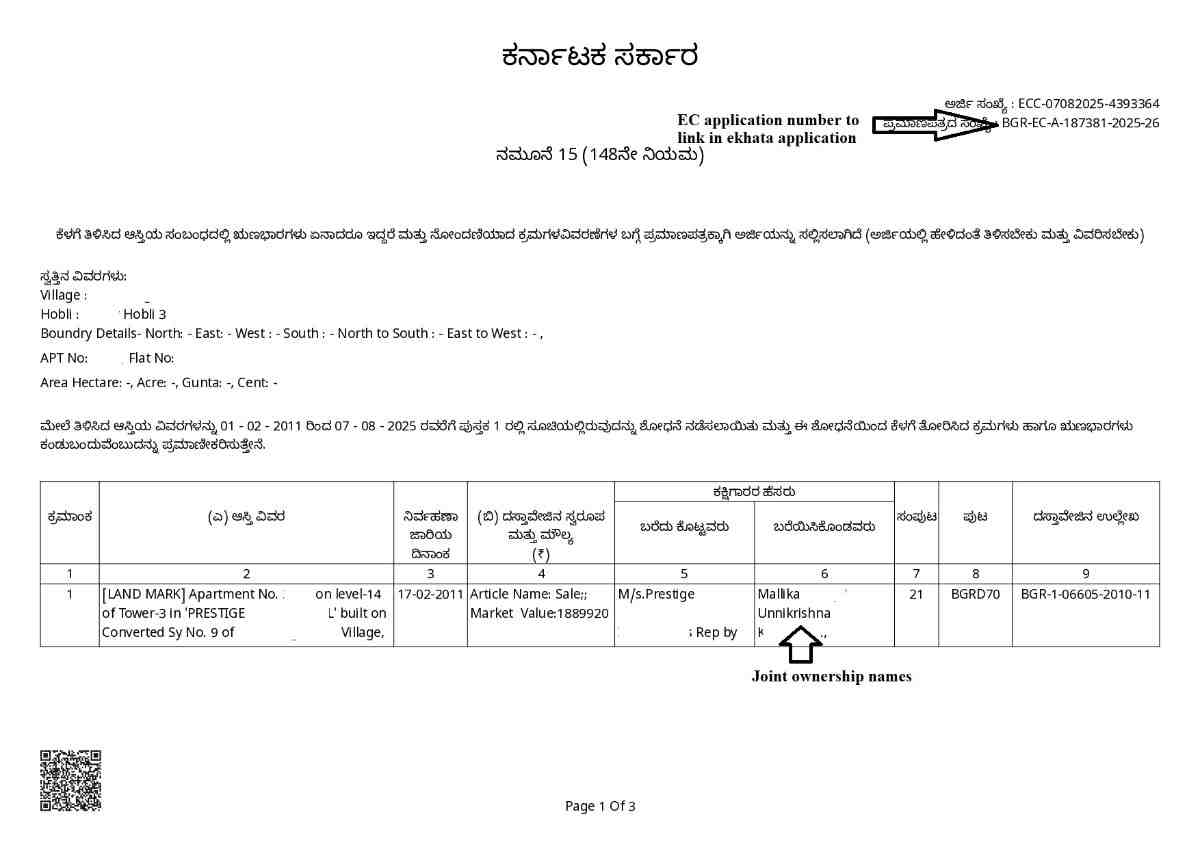
Encumbrance Certificate (EC)
- The EC was obtained starting from the property’s registration in 2011.
- This document confirms the property’s title history and certifies that it is free from legal or financial encumbrances.
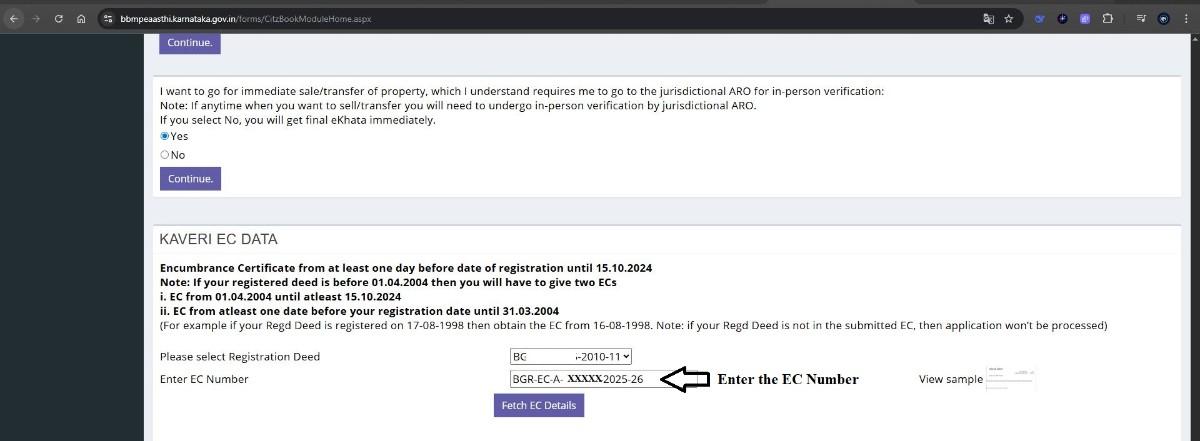
- In the application, the EC application number must be linked, and we highlighted the same in our records for easy reference.
Applicant’s Aadhaar Number
- The Aadhaar of the surviving co-owner (wife) is mandatory for completing the e-KYC process.
- Authentication is done through OTP-based verification, which links the Aadhaar to the application securely.
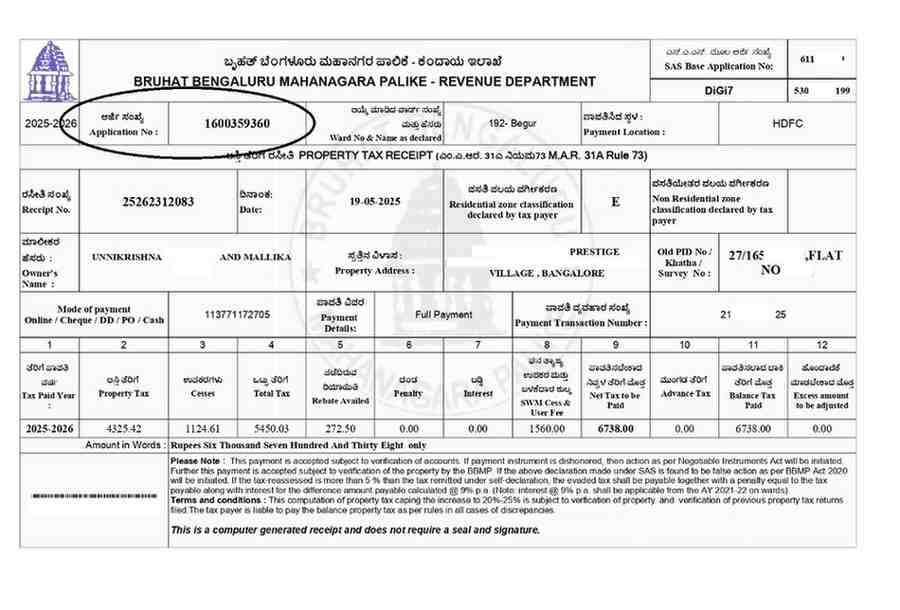
Property Tax Application Number:
- Pay the property tax up to the current financial year, as it is mandatory for downloading the e-Khata once approved.
- The property tax application number must be linked in the e-Aasthi system to validate tax records. We highlighted the application number
Supporting Property Details
Apart from ownership and identity documents, BBMP also requires additional property details, such as:
- Building photograph
- Geo-location of the property
- Flat number and measurements
- Parking details
- BESCOM electricity bill number
These details help BBMP map and verify the property in their records.
Step-by-Step e-Aasthi Application Process
After gathering all required documents, the e-Khata transfer can be completed on the BBMP e-Aasthi portal by following these steps:
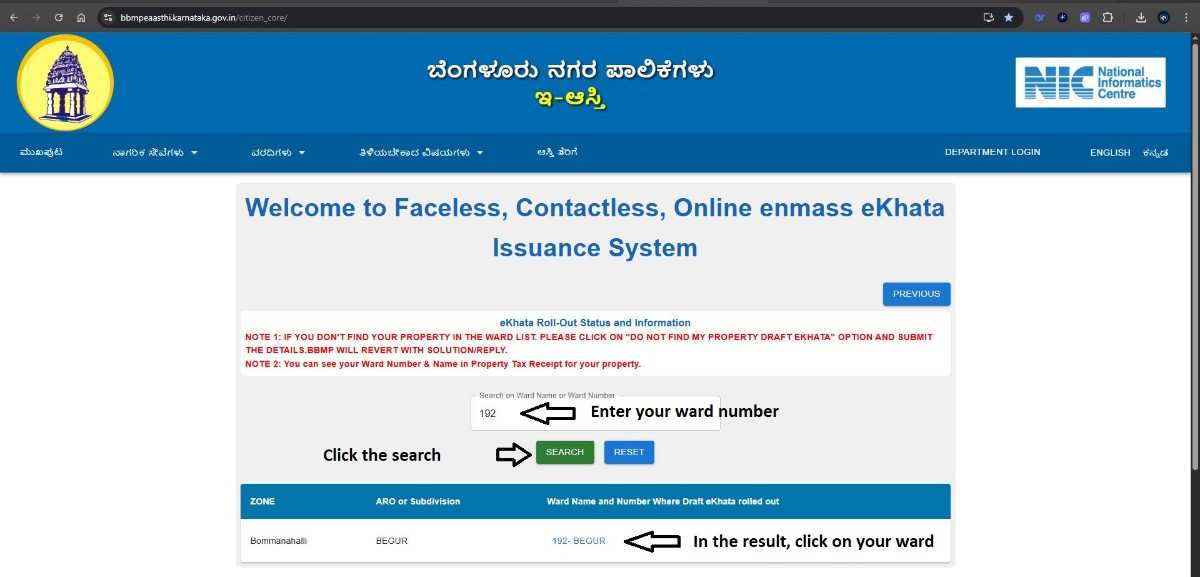
- Entered BBMP Ward Number: We entered the BBMP ward number (192) to locate the property within the portal.
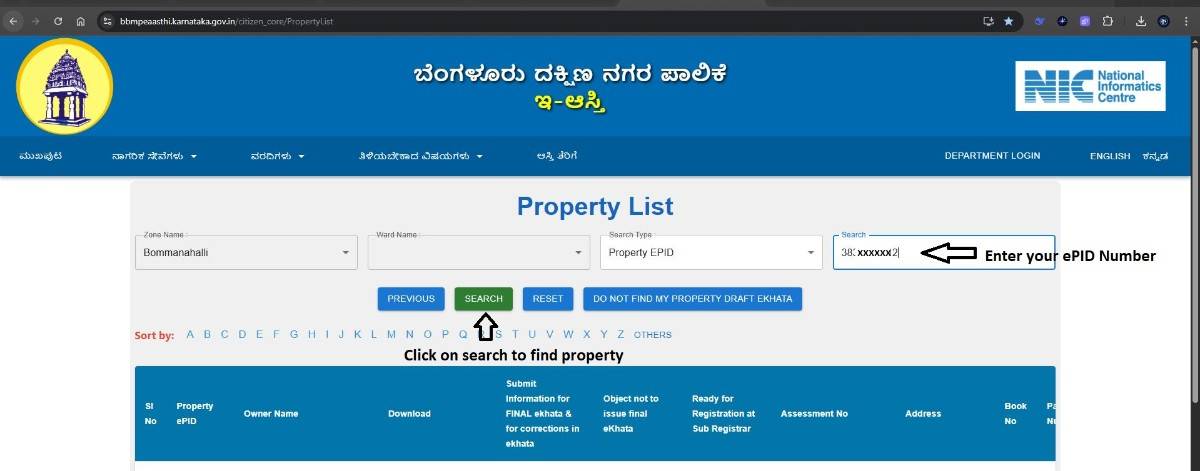
- Entered ePID Number: The ePID Number was entered to retrieve the specific property details in the system. (Refer to the image below.)
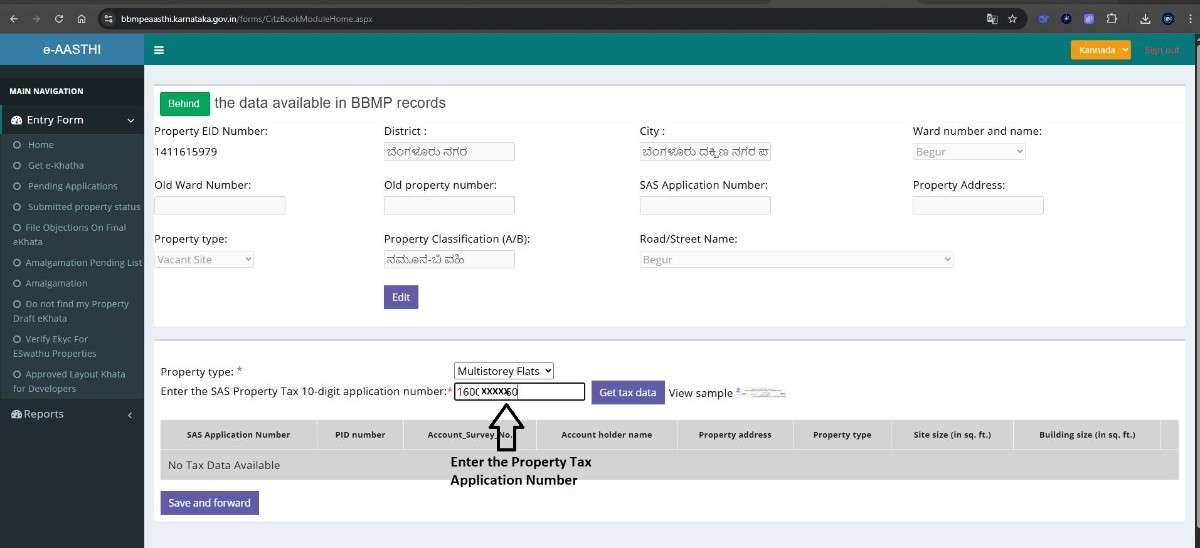
- Entered Property Tax Application Number: This links the property’s tax records to the application.
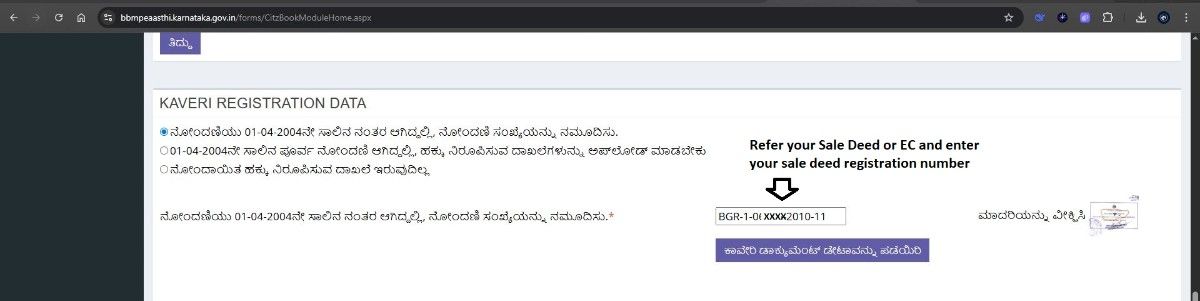
- Entered Deed Registration Number: The sale deed registration number was provided to validate ownership
·
Update Ownership - Remove Deceased Co-Owner
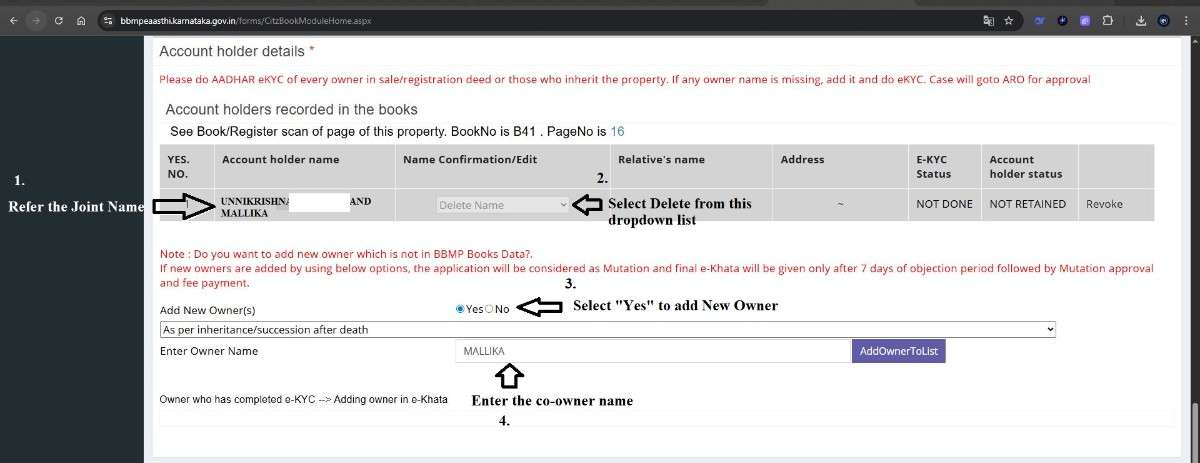
The most critical step in the application is to remove the deceased co-owner’s name from the property records and retain only the surviving co-owner’s name. In our case, we deleted the joint ownership entry and added the surviving co-owner (wife) as the sole owner. Additionally, the system requires a reason for this change; we selected “Inheritance” to reflect the legal transfer of ownership. (Refer to the 4-step visual in the image below for a clear illustration.)
Aadhaar-Based e-KYC
- Enter the surviving co-owner’s Aadhaar number.
- Complete the OTP-based verification to authenticate identity.
- Once verified, the Aadhaar is linked to the e-Khata application.
Providing Property Details:
We provided comprehensive information about the property to complete the e-Khata application, including:
- Geo-location of the apartment
- Building photograph
- Property description, such as flat number, measurements, and parking details
- BESCOM electricity bill number
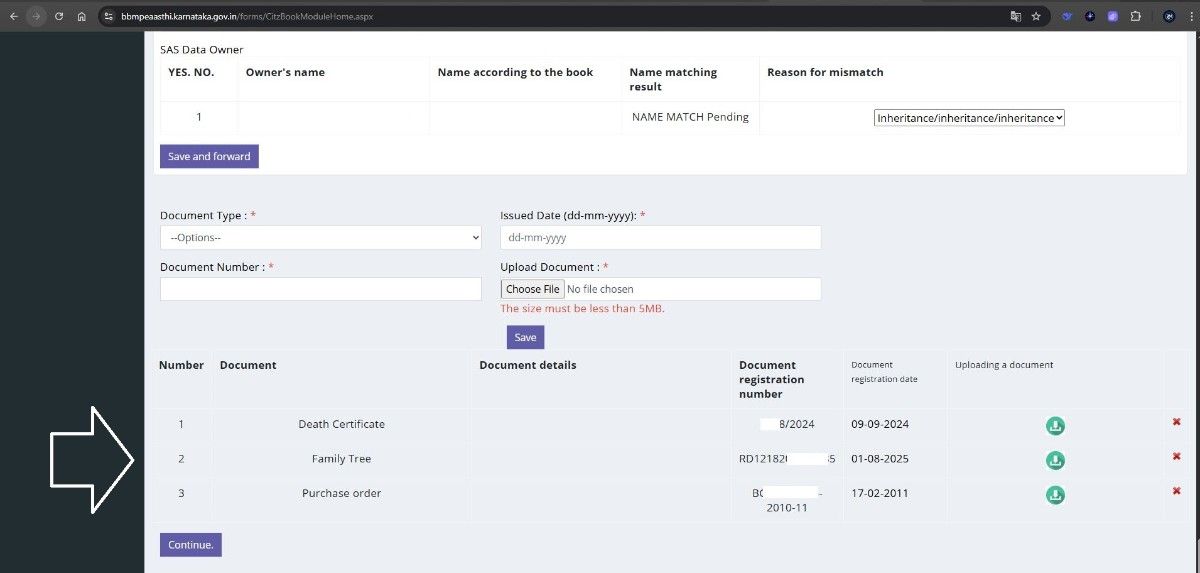
Upload Supporting Documents
Upload scanned copies of the following documents:
- Death Certificate of the deceased co-owner
- Family Tree Certificate
- Registered Sale Deed
Refer to image below
And link the EC Application Number. Refer to image below
Submit Application and Approval
- Review all entered details carefully before submission.
- Submit the application.
- In our case, we submitted on 14th August 2025 and received SMS confirmation of approval on 18th August 2025, taking just 4 days.
Payment of Government Fee and e-Khata Download
After approval, pay the government fee of Rs.625 through the online portal. This government fee for inheritance is fixed irrespective of the location and dimension of the property. We highlighted the fee in screenshot below
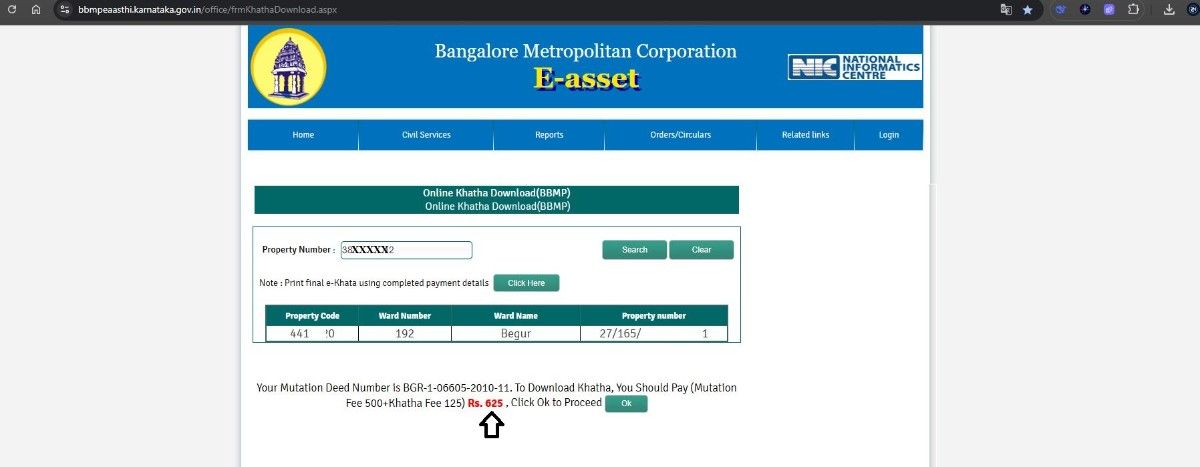
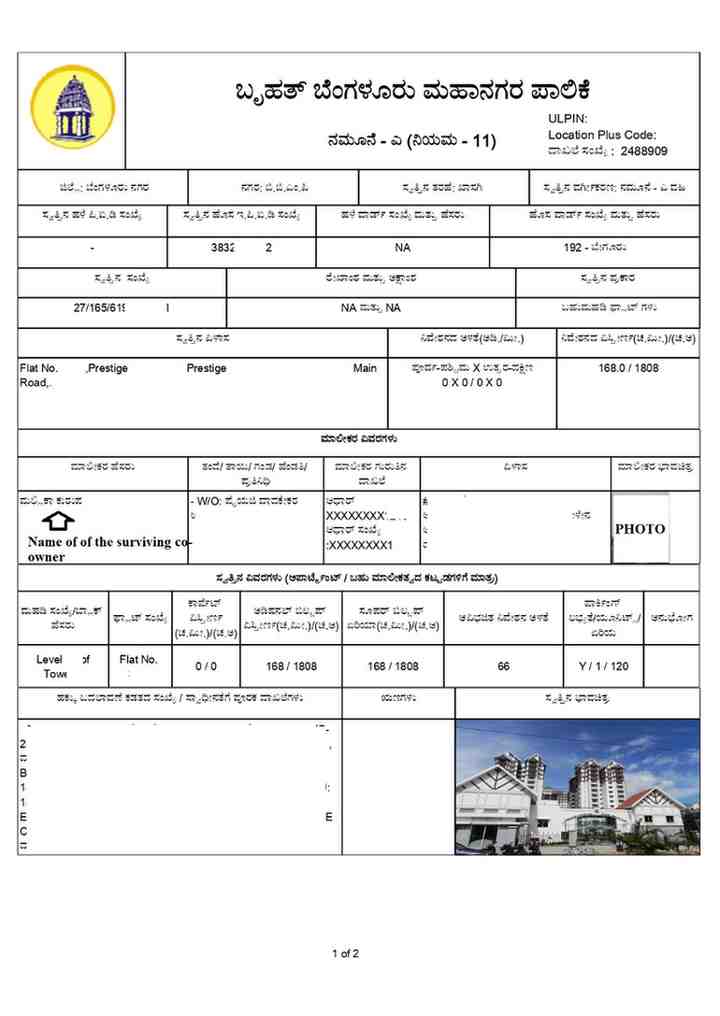
Download the updated e-Khata, which now reflects only the surviving co-owner’s name. We highlighted below
KEY OBSERVATIONS AND INSIGHTS ON E-KHATA TRANSFER
Simplicity of the Process for Surviving Co-Owners
- The e-Khata transfer process is simple and straightforward when transferring ownership from a deceased co-owner to a surviving co-owner who is also a family member.
- With the correct documentation, such as the Death Certificate, Family Tree Certificate, Encumbrance Certificate, and Aadhaar-based e-KYC, the surviving co-owner can complete the process efficiently through the BBMP e-Aasthi portal.
- This streamlined procedure minimizes delays and ensures the property record is updated legally without unnecessary complications.
Scenario: Deceased as Sole Owner
- If the deceased had been the sole owner of the property, the e-Khata transfer would need to include all legal heirs. Typically, this includes the spouse and children.
- In such cases, any heir not interested in claiming their share must provide a No Objection Certificate (NOC).
- The NOC must be uploaded during the application process to formally indicate that the heir waives their claim to the property, ensuring that ownership can be transferred smoothly to the intended beneficiary(ies).
Scenario: Deceased as Joint Owner
- In our case study, Mr. Unnikrishnan and Mrs. Mallika were joint owners.
- Since the surviving co-owner (Mrs. Mallika) was already a co-owner and the children were not claiming their shares, we were able to transfer the entire share of the deceased to Mrs. Mallika without requiring NOCs from other family members.
- This illustrates the advantage of joint ownership: the surviving co-owner can inherit the deceased’s share directly and quickly.
Optional Update in Sub-Registrar Records
- While the e-Khata transfer updates BBMP records, it is often recommended to update the property ownership at the Sub-Registrar’s office as well for additional legal security.
- This can be done by registering a Relinquishment Deed, wherein the co-owners or legal heirs formally relinquish their share to the surviving co-owner.
- Presence Requirement: The surviving co-owner and other family members (if involved) must be present at the Sub-Registrar office during the registration of the Relinquishment Deed.
- This ensures that the property records at the sub-registrar level are consistent with the BBMP e-Khata, which helps prevent future disputes or complications during resale or further inheritance.
FREQUENTLY ASKED QUESTIONS (FAQ) – E-KHATA TRANSFER AFTER DEATH OF A JOINT PROPERTY OWNER
1. What is e-Khata and why is it required?
e-Khata is the digital version of the property record maintained by BBMP. It is mandatory for property registration, sale, or transfer, and ensures the property details and ownership are legally recognized.
2. Can e-Khata be transferred after the death of a joint property owner?
Yes, BBMP allows e-Khata transfer to the surviving co-owner or legal heirs after the death of a joint property owner, provided all required documents are submitted.
3. What documents are needed if the deceased co-owner has left a Will?
- Death Certificate of the deceased co-owner
- Copy of the registered Will
The transfer can be done irrespective of whether the beneficiary is a family member or an outsider.
4. What documents are needed if the deceased co-owner did not leave a Will and the claimant is a family member?
- Death Certificate of the deceased co-owner
- Family Tree Certificate issued by the Tahsildar through Nadakacheri
5. Is a manual khata required for e-Khata transfer?
If the property already has a manual khata in joint names, the e-Khata draft is available in the system, eliminating the need to apply for a new e-Khata.
6. What other documents are mandatory for e-Khata transfer?
- Registered Sale Deed
- Encumbrance Certificate (EC)
- Applicant’s Aadhaar Number (for e-KYC)
- Property Tax Application Number
- Supporting property details (building photo, geo-location, flat number, measurements, parking, BESCOM bill)
7. How do I remove the deceased co-owner’s name from e-Khata?
While submitting the e-Khata application, delete the deceased co-owner’s name and retain only the surviving co-owner’s name. Specify “Inheritance” as the reason for the change.
8. How long does the e-Khata transfer process take?
In most cases, if documents are complete, the process is completed within a few working days. In our case study, it took 4 working days from submission to approval.
9. Is property tax payment mandatory for e-Khata transfer?
Yes, property tax must be paid up to the current financial year. The property tax application number is linked in the e-Aasthi system to validate tax records.
10. Can NOCs from other heirs be avoided in case of joint ownership?
Yes. If the surviving co-owner is already a joint owner and other heirs are not claiming the property, NOCs are not required.
11. Should I update the Sub-Registrar records after e-Khata transfer?
It is recommended to update the Sub-Registrar records by registering a Relinquishment Deed for additional legal security. The surviving co-owner and other family members (if applicable) must be present during registration.
12. What is the government fee for e-Khata transfer after death?
The government fee is fixed at Rs.625 for inheritance-based e-Khata transfers, regardless of the property location or dimensions.