
Closing your SBI home loan is a moment of great relief after years of EMI payments. However, even after the final installment is cleared, there are a few crucial steps before you can fully close the account and collect your original property documents, especially if you are residing abroad.
This guide explains a six-step process specifically designed for Non-Resident Indians (NRIs) and overseas residents, supported with real-life examples for better clarity.
OVERVIEW OF THE PROCESS
- Loan Account Closure
- Execution of General Power of Attorney (GPA)
- Collection of Original Documents
- Reconveyance Deed Registration
- Encumbrance Certificate (EC) Verification
- Document Dispatch
1. LOAN ACCOUNT CLOSURE
In your SBI Mobile Banking or Internet Banking portal, you will find an option titled “Closure of Loan A/C.”
- Select the loan account you wish to close.
- Pay the final outstanding amount as shown in the account.
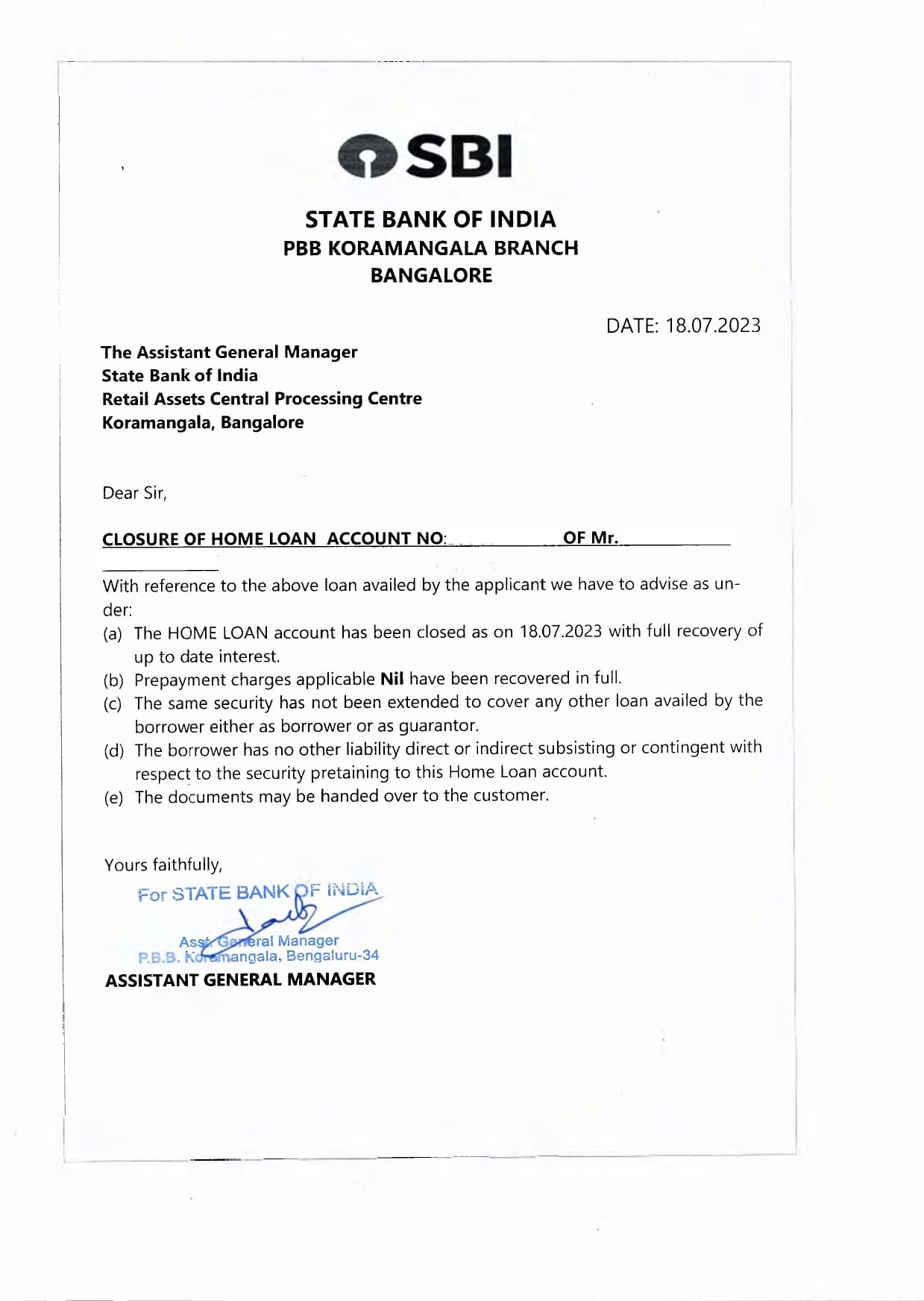
- Immediately download the Loan Closure Letter if the option is available.
If the download option is not available, you can write an email to your SBI branch requesting the closure confirmation and stating your intention to collect the original property documents.
The bank will then issue a Loan Closure Letter, usually by email. This letter officially confirms the closure of your loan account.
The Loan Closure Letter typically includes:
- Loan account number
- Borrower’s name
- Date of closure
- Confirmation of “No Dues”
Along with the closure letter, SBI also specifies the date, time, and RACPC address where the original property documents can be collected.
(Insert sample Loan Closure Letter image here for reference.)
2. EXECUTION OF GENERAL POWER OF ATTORNEY (GPA)
To collect the original title documents, you must normally visit the RACPC (Retail Asset Central Processing Centre).
However, if you are living abroad and cannot travel to India, you can authorize a trusted person in India through a General Power of Attorney (GPA). This allows your representative to collect the documents on your behalf.
STEPS TO EXECUTE GPA FROM ABROAD
Write to SBI
- Send an email to your SBI branch explaining that you are residing abroad and wish to authorize a GPA holder.
- Mention clearly that you are an overseas resident, as the GPA template differs for Indian residents and NRIs/OCIs.
- SBI will then share the correct GPA and Affidavit templates in Word format.
Fill in the Templates
Enter details such as:
- Your name, age, and current overseas address
- Loan account number
- Address of the mortgaged property
Print the GPA and Affidavit on A4-size paper.
Execution & Attestation
- Sign the GPA and Affidavit in the presence of a notary public in your country of residence.
- Obtain notary attestation on both documents.
Courier Documents to India
Send the following to your GPA holder in India:
- Signed and notarized GPA
- Signed and notarized Affidavit
- Self-attested PAN card copy
- Self-attested Passport/OCI card copy
Adjudication in India
- The GPA holder must get the GPA adjudicated at the District Registrar’s Office.
- Applicable stamp duty must be paid at the time of adjudication (varies based on the number of executants).
REAL-LIFE EXAMPLE
One of my clients, residing in Virginia, USA, had jointly taken a home loan of Rs.54,27,000 with his wife in 2020 for a property purchase in Bangalore.
Recently, they closed the loan and obtained the Loan Closure Letter from SBI via email. Since they could not travel to India, both husband and wife executed a General Power of Attorney (GPA) in favor of their trusted friend in Bangalore, authorizing him to collect the original property documents from SBI.
IMPORTANT POINTS:
- The executant is the person who grants the GPA.
- At the time of adjudication in the District Registrar’s office, stamp duty is payable per executant.
- In this case, since both husband and wife were executants, the stamp duty was:
Rs.200 × 2 = Rs.400.
(Update on 2nd Sep 2025: the stamp duty has been revised to Rs.500 per executant.)
Below are the images for reference:
- Sample GPA Document
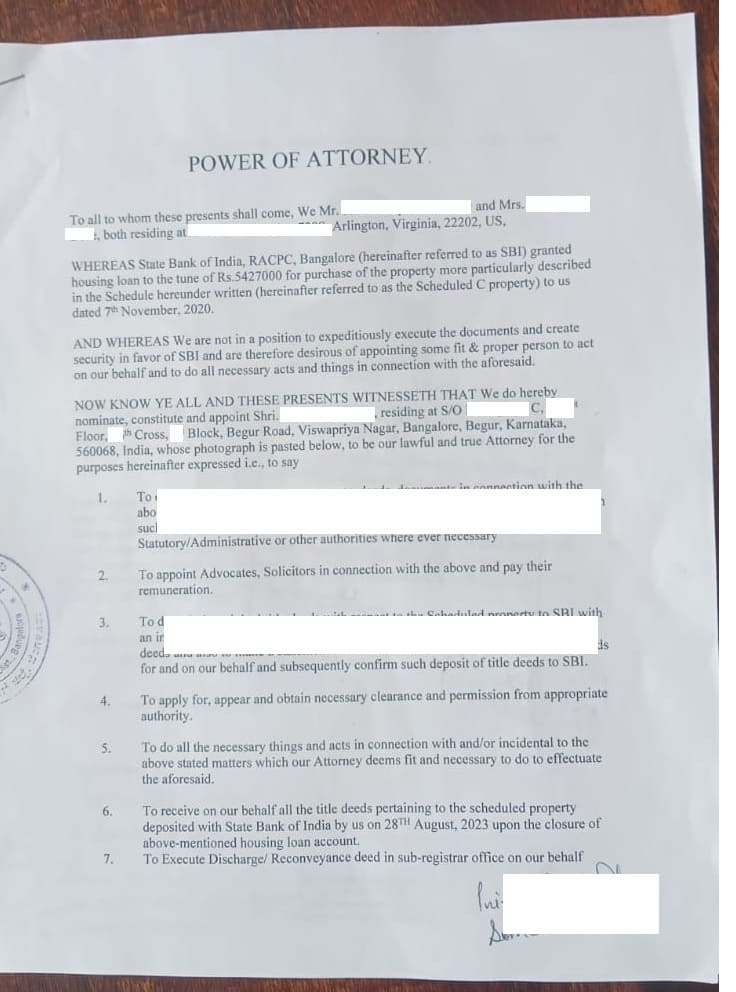
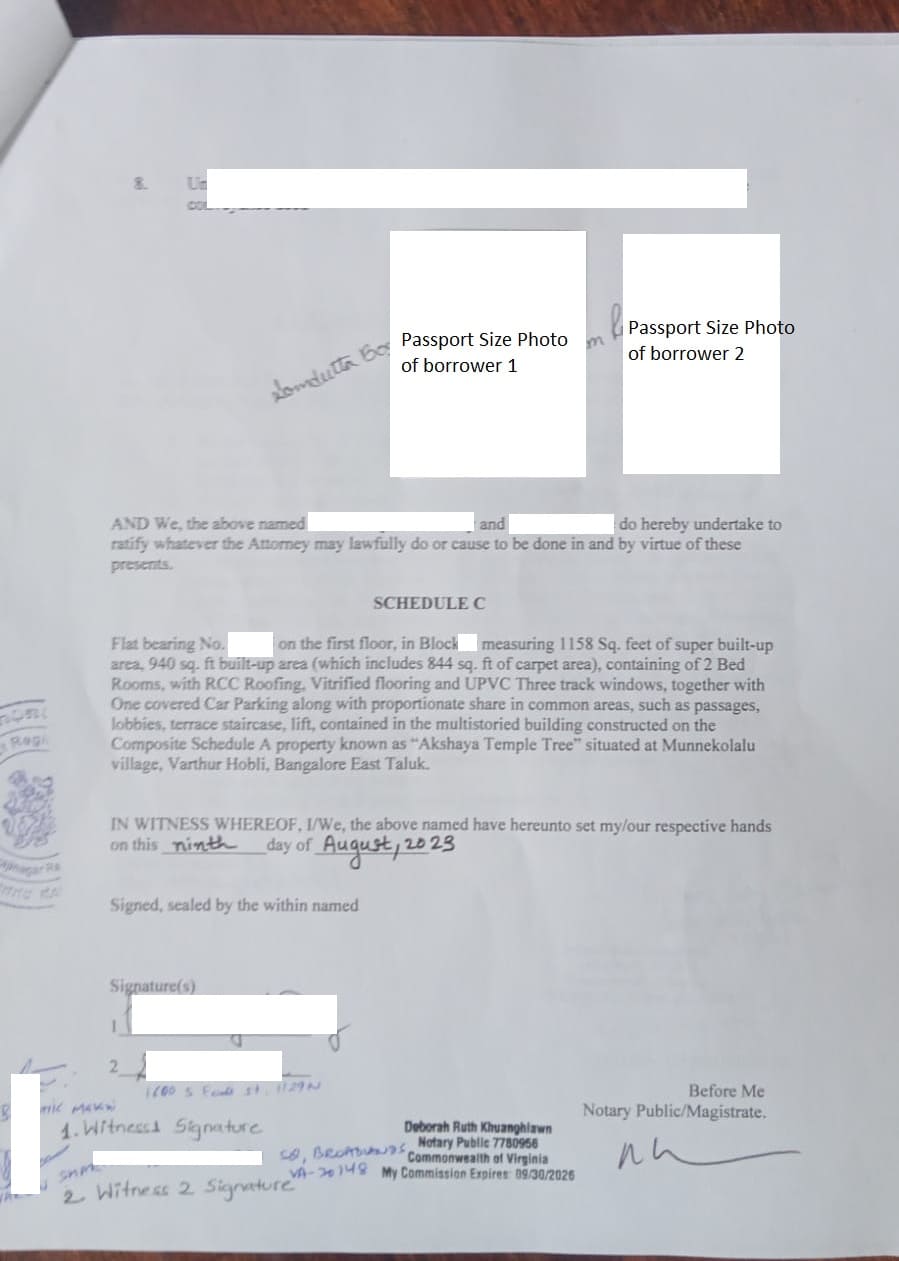
- Adjudicated GPA from District-Registrar’s office
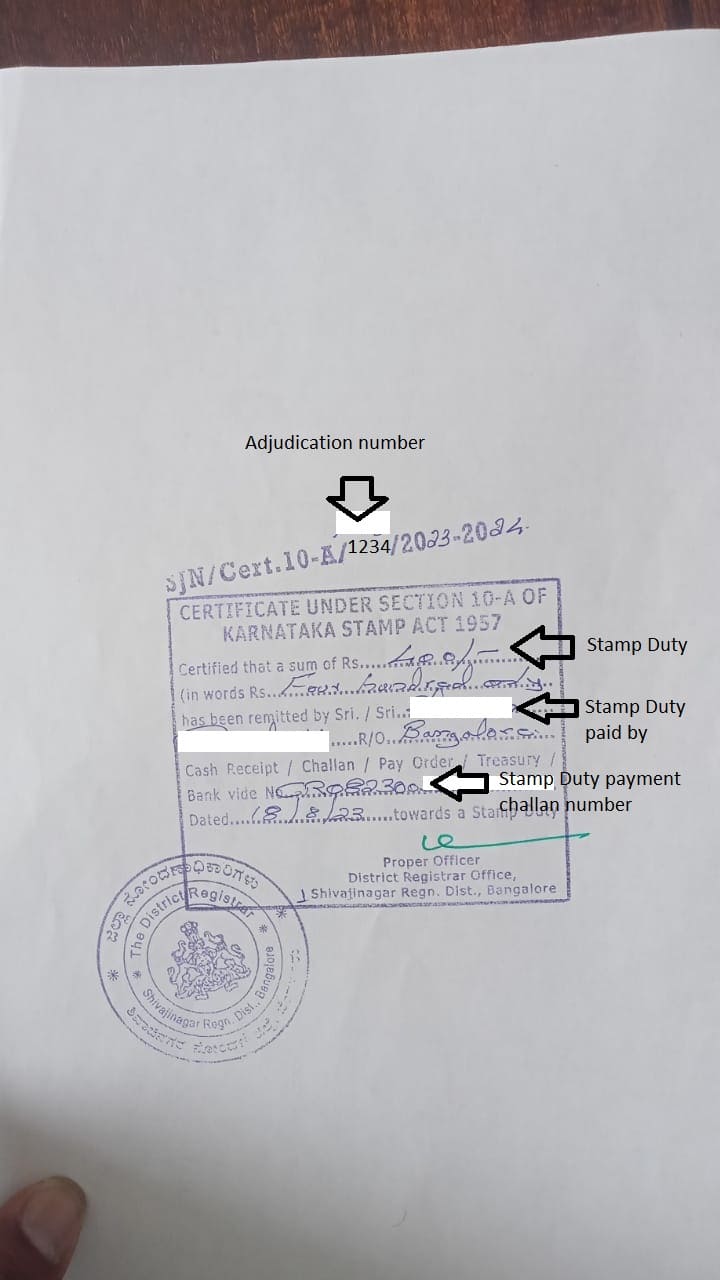
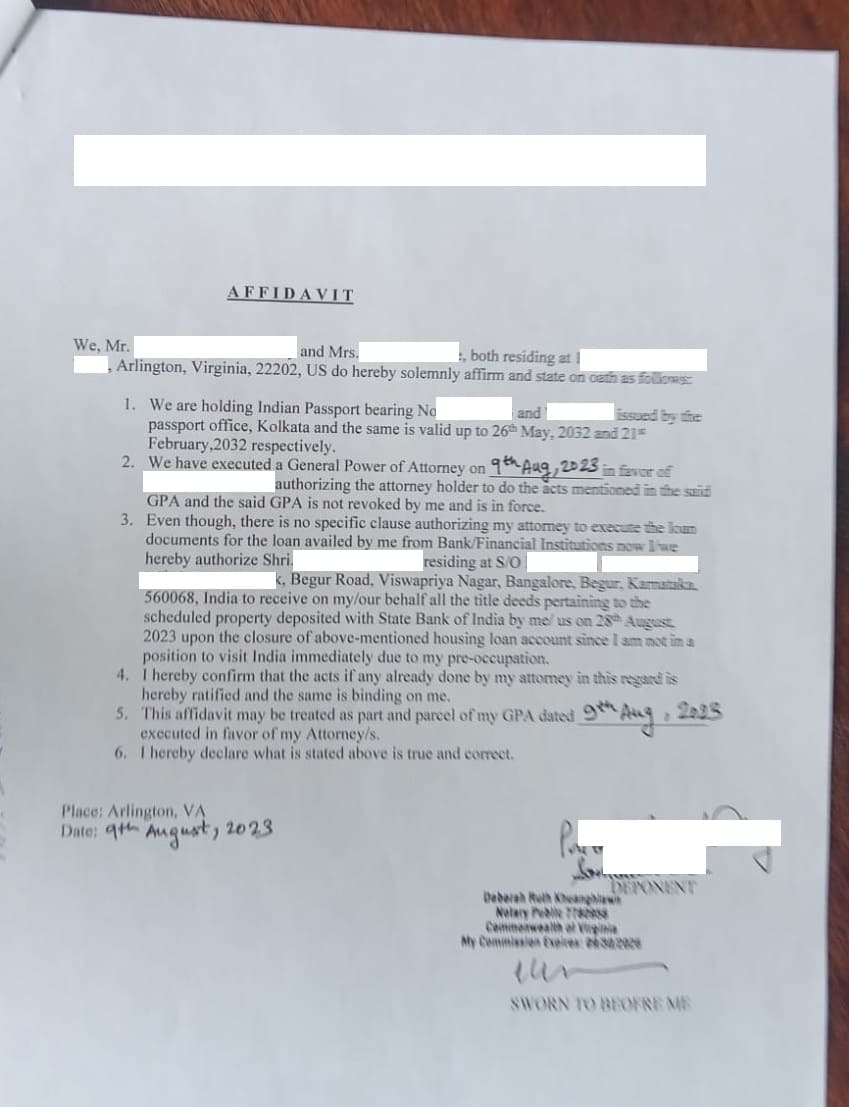
- Affidavit executed by the borrowers
3. COLLECTION OF ORIGINAL DOCUMENTS
As per the appointment scheduled by SBI, the GPA holder must visit the RACPC to collect the borrower’s original property documents.
DOCUMENTS TO BE CARRIED BY GPA HOLDER:
- Loan Closure Letter
- Original GPA (executed and adjudicated)
- Affidavit
- Self-attested ID proof of the executant (the borrower who granted GPA)
- Self-attested ID proof of the GPA holder (the person authorized to collect documents)
At the RACPC, SBI staff will:
The bank staff verify all the above documents and retain the original GPA, affidavit, and ID proofs submitted.
Important: These originals will not be returned. Borrowers should keep a soft copy or photocopy of the GPA for future use, especially during Reconveyance Deed registration at the Sub-Registrar’s office.
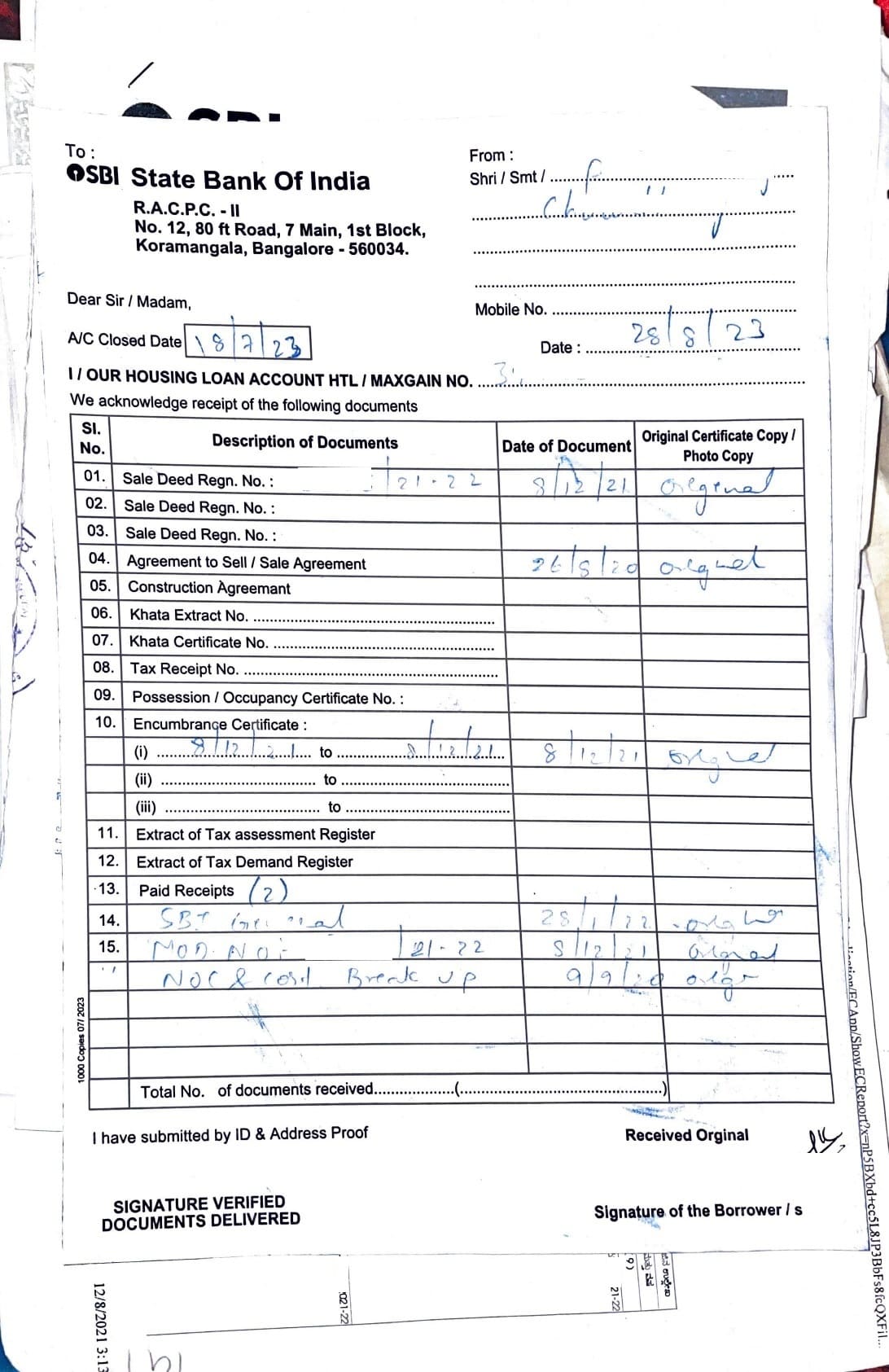
Bank staff prepare a Checklist of Title Documents and obtain the GPA holder’s signature on it.
(Insert sample checklist image here for reader reference.)
DOCUMENTS HANDED OVER BY SBI TO GPA HOLDER
After verification, the SBI staff will hand over the following documents to the GPA holder:
- Title Documents including registered Deed (as listed in the checklist)
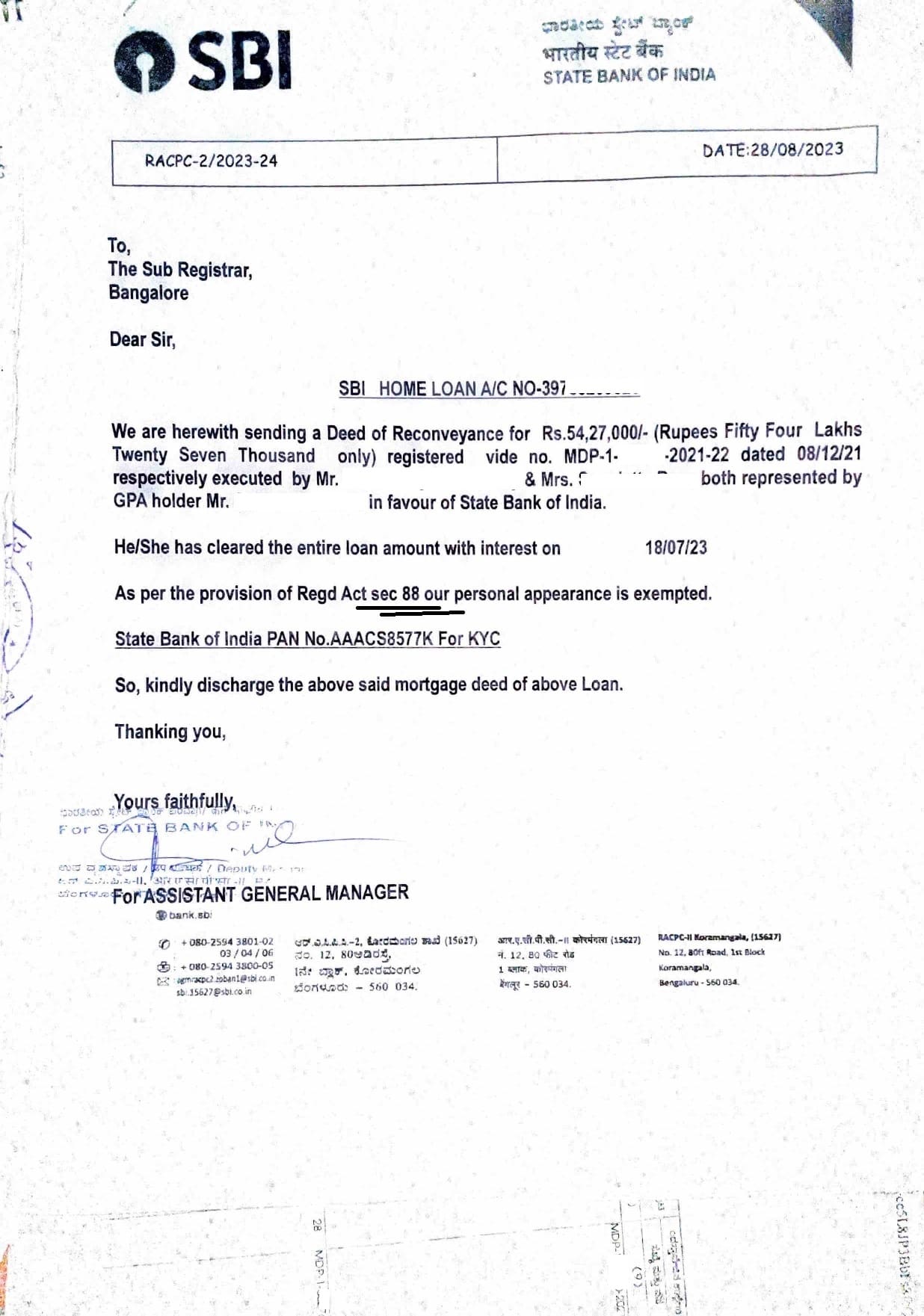
- Exemption Letter (under Section 88, which exempts SBI officials from personal appearance at the Sub-Registrar’s office)
- Reconveyance Deed
- Self-attested ID proof of the bank’s authorized signatory
IMPORTANT DETAILS TO VERIFY IN THE RECONVEYANCE DEED
The Reconveyance Deed should include:
- Borrower’s name
- GPA holder’s name
- Loan amount
- MODT document number
- Complete property schedule, including:
- Flat number
- Survey number
- Apartment name
- Village name
- Taluk
- Hobli
- District
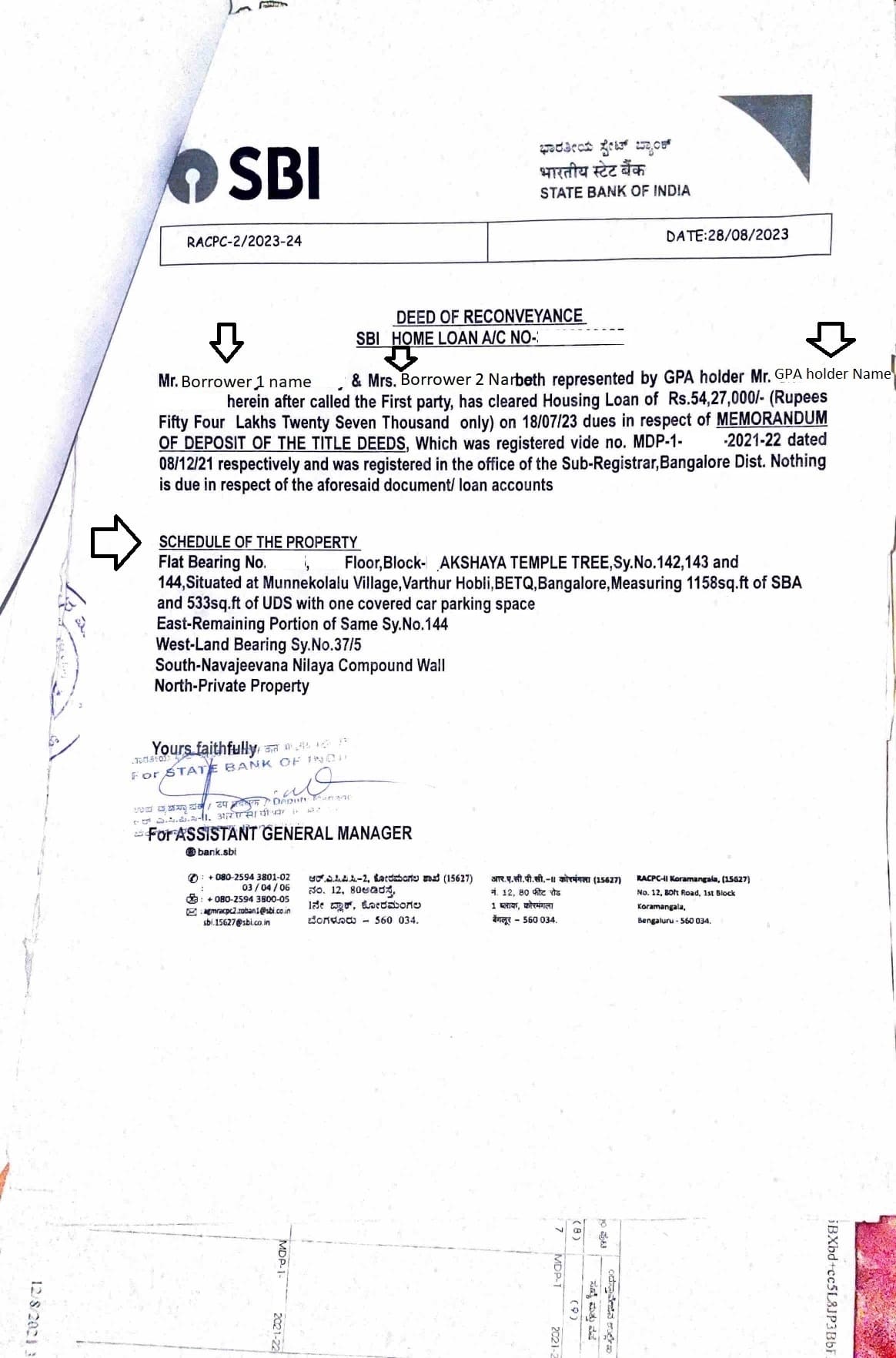
Based on personal experience, SBI may sometimes omit the GPA holder’s name or provide an incomplete property schedule in the Reconveyance Deed. Such errors can lead the Sub-Registrar’s office to reject the registration, requiring an additional visit to RACPC for corrections.
Best Practice: Always cross-check all details in the Reconveyance Deed at the time of document collection to avoid delays.
4. RECONVEYANCE DEED REGISTRATION
When a home loan is borrowed, a Memorandum of Deposit of Title Deed (MODT) is registered at the Sub-Registrar’s office, creating a mortgage lien against the property.
To remove the mortgage lien, the Reconveyance Deed must be registered at the same Sub-Registrar office where the MODT was originally registered.
DOCUMENTS REQUIRED FOR REGISTRATION
To register the Reconveyance Deed, you will need:
- Exemption Letter issued by SBI
- Reconveyance Deed issued by SBI
- Photocopy of GPA (the original GPA is retained by SBI)
- ID proof of SBI’s authorized signatory
- Your own ID proof
(Insert image of Exemption Letter highlighting Section 88 here for reference.)
KEY POINTS TO CHECK
Ensure that the Reconveyance Deed accurately reflects:
- Borrower’s name
- GPA holder’s name
- Complete Property Schedule
(Insert image of the registered Reconveyance Deed highlighting borrower’s name, GPA holder, and property schedule.)
5. ENCUMBRANCE CERTIFICATE (EC) VERIFICATION
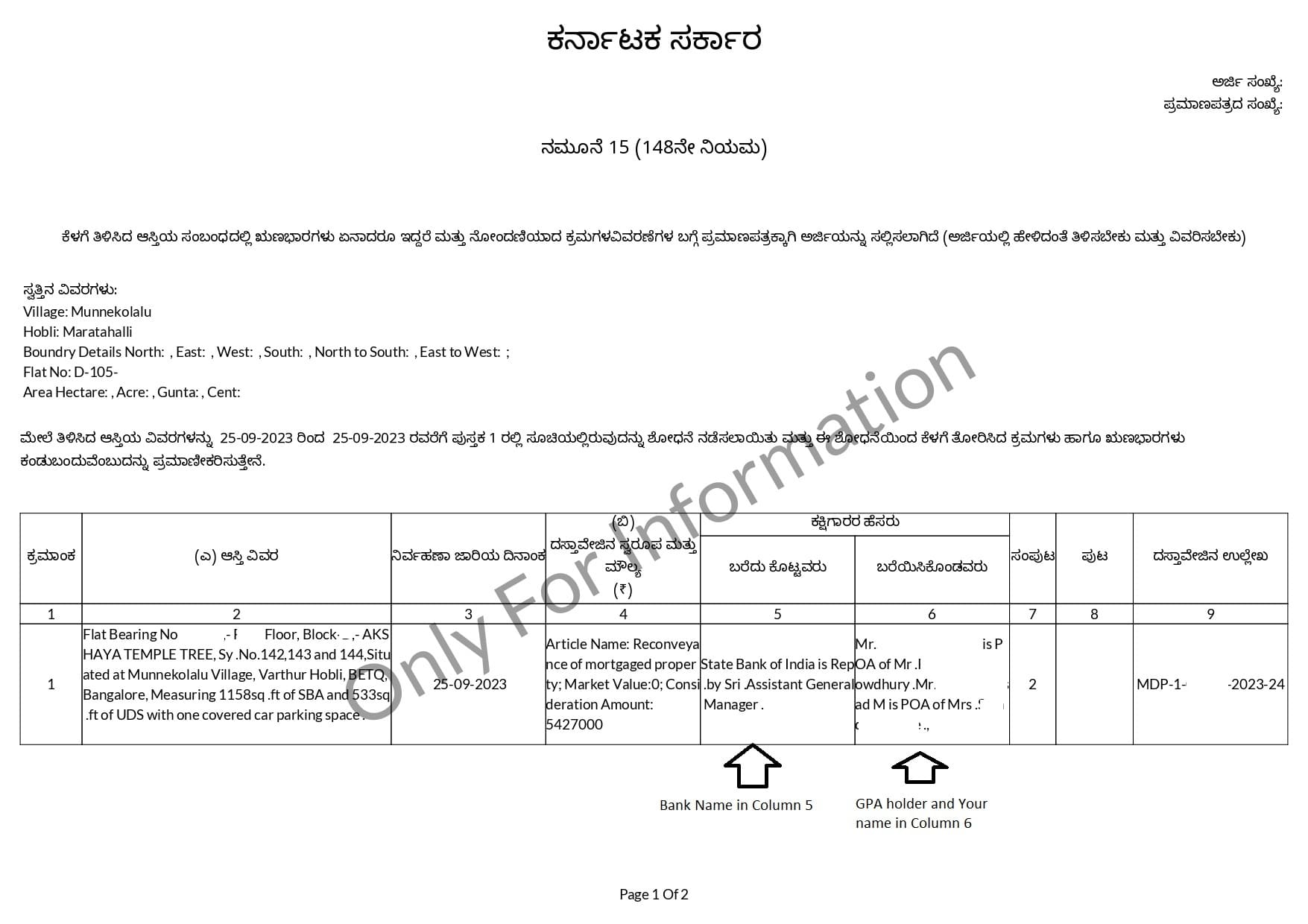
Once the Reconveyance Deed has been registered, it is important to verify that the mortgage lien has been removed from the property records. This is done by extracting the latest Encumbrance Certificate (EC).
STEPS TO VERIFY
- Obtain the latest EC through online property portals (if available).
- Cross-check the entries to ensure that the bank’s mortgage lien has been removed.
REAL-LIFE EXAMPLE
Immediately after registering the Reconveyance Deed, we extracted the EC for our client.
- In the EC, the bank’s name appeared in Column 5 and the borrower’s name appeared in Column 6.
- This confirms that the mortgage lien against the property has been successfully removed.
(Insert sample EC image here for reference.)
6. DOCUMENT DISPATCH
Once all documents have been collected, your GPA holder can securely dispatch them internationally or domestically.
DOCUMENTS TO BE DISPATCHED
- Original Title Documents
- Registered Exemption Letter and Reconveyance Deed
- Latest Encumbrance Certificate (EC)
- Photocopy of GPA
PACKAGING & DISPATCH
Secure Packaging:
- Wrap all documents in bubble wrap for protection.
- Place the documents in a thread-lined envelope or an international courier envelope.
Courier Options:
- Use reliable international couriers such as DHL, FedEx, or BlueDart.
- Estimated international shipping cost: ~Rs.3,000 (for packages under 1 kg).
Example
In one instance, my client’s parents were living in Kolkata, while the client resided in Virginia, USA. AS per my client instructions, we dispatched the documents to Kolkata instead of Virginia.
- Documents were wrapped in bubble wrap, sealed in a thread-lined envelope, and dispatched via BlueDart.
- The package reached its destination within 1 day, in good condition.
- Courier cost: Rs.250 (for a package under 1 kg).
FREQUENTLY ASKED QUESTIONS (FAQS)
1. How soon can I execute the GPA after receiving the loan closure letter?
SBI usually provides an appointment within 15 days of issuing the Loan Closure Letter. You can use this time to prepare and execute the GPA so that your authorized person is ready to collect the documents on the scheduled date.
2. What if I cannot collect the documents on the appointment date given by SBI?
- SBI provides a tolerance of 30 days from the scheduled appointment date. You can approach the RACPC on the next working day for collection.
- If 30 days pass without collecting the documents, you may need to request a new appointment from your SBI branch.
3. How long do I have to register the Reconveyance Deed?
The Reconveyance Deed should ideally be registered within 90 days of collection from SBI. If this period has passed, you can coordinate with SBI to rectify the date and proceed with registration.
4. Do I need separate GPAs for document collection and reconveyance deed registration?
No. One GPA is sufficient for both purposes. You may authorize any trusted person, including family members or friends, to act as your GPA holder.
5. Will SBI contact me before handing over documents to my GPA holder?
Yes. SBI may:
- Call you on your registered mobile number, or
- Ask you to send an email to RACPC for verification.
This is common for overseas clients (e.g., in the USA). Make sure you are available for quick confirmation to avoid delays in document collection.
6. What if SBI is unresponsive or slow to respond?
Some SBI branches may not respond promptly to calls or emails. In such cases, it is advisable to have a local guide or trusted person in India to liaise with SBI and expedite the process.
We offer end-to-end ground assistance for NRIs and overseas clients, including:
- Bank liaison and coordination
- GPA drafting and adjudication
- Document collection
- Reconveyance deed registration
- EC verification
- Secure international dispatch
7. Where can I find detailed guidance for Reconveyance Deed registration in Karnataka?
You can refer to our detailed guide here: How to Register Discharge or Reconveyance Deed through Kaveri Online Services
8. Can I authorize someone outside my family to be the GPA holder?
Yes. The GPA can be given to any trusted individual, including friends or professional representatives. Ensure that they are reliable and available for document collection and follow-up.
9. Is notarization required for GPA and affidavit executed abroad?
Yes. The GPA and affidavit must be notarized in your country of residence. Notarization ensures that SBI recognizes the documents for adjudication in India.
10. How long does the GPA adjudication process take in India?
Typically, adjudication at the Registrar’s office can take a few hours to a few days depending on local workload. Once adjudicated, your GPA holder can collect the documents as per SBI’s appointment.
11. What happens if the Reconveyance Deed has incomplete property details?
If the property schedule, borrower’s name, or GPA holder’s name is incomplete, the Sub-Registrar may reject registration. Always cross-check the deed at the time of collection to avoid travel or time delays.
12. Can the documents be dispatched directly to me overseas?
Yes, your GPA holder can dispatch documents internationally via DHL, FedEx, or other courier services. Ensure proper packing and insurance to safeguard your valuable property documents.
13. Is the Encumbrance Certificate (EC) required for any future legal work?
Yes. The latest EC is often required for:
- Selling the property
- Re-financing or loans
- Legal verification of ownership
14. What should I do if SBI delays providing an appointment or documents?
Some branches may respond slowly. In such cases:
- Follow up via registered email or phone
- Engage a local representative to coordinate with SBI
- We provide end-to-end assistance to expedite delays
16. Can I get professional assistance for the entire process?
Yes. We, PGN PROPERTY, provide complete ground support for NRIs and overseas residents, including:
- Bank coordination
- GPA drafting and adjudication
- Document collection
- Reconveyance deed registration
- EC verification
- Secure document dispatch
For assistance, you can reach us via: Email: pgnproperties@gmail.com or WhatsApp: +91-97424-79020