
A Power of Attorney (POA) is a legal document that authorizes an individual (the “agent”) to act on behalf of another person (the “principal”). If you are residing abroad and wish to sell your property in India, executing and sending a POA may feel complicated. However, with proper planning, it is a smooth and legally valid process.
Below, I will guide you through the important steps, requirements, and a real-life case study to help you understand the process better.
KEY FACTORS TO CONSIDER BEFORE SENDING A POA FROM ABROAD
There are two important aspects you need to plan carefully:
- Choosing the Right Agent in India
- Getting the POA Attested Properly
1. CHOOSING THE AGENT IN INDIA
The person you appoint as your agent should be someone trustworthy. This could be a family member, friend, lawyer, broker, or colleague.
Preferably, choose a close family member as the agent, since the stamp duty is lower and family members are generally more reliable.
Stamp Duty in Karnataka:
- Rs. 500 when the POA is granted to family members.
- 5% of the sale consideration or guidance value (whichever is higher) if given to a non-family member.
Family members who qualify for the lower stamp duty in Karnataka include:
- Father, Mother
- Brother, Sister
- Husband, Wife
- Children (above 18 years)
In some other Indian states, in-laws and nephews also qualify for lower stamp duty. Always verify the local regulations where the property is located.
Important Tip:
If you must appoint a non-family member, consider executing a Special Power of Attorney (SPA) instead of a General POA. The stamp duty for SPA is only Rs. 500 per executant, regardless of family or non-family.
2. POA ATTESTATION
For a POA executed abroad to be legally valid in India, it must be attested either by a Notary Public or the Consulate General of India. The choice depends on the country of residence and associated costs.
Countries where Notary Attestation is Easier (USA, Canada, Europe, Australia, New Zealand):
- Notary attestation alone is usually sufficient (at least in Karnataka).
- Getting both Notary and Consulate attestation means dual expense (approx. $10 Notary + $25 Consulate).
- Travel to the Consulate can be time-consuming and costly, whereas Notary Public services are more accessible.
Countries where Consulate Attestation is Preferable (Singapore, Japan):
- Singapore: Consulate attestation costs ~S$17 vs. Notary fees ~S$100.
- Japan: Consulate attestation costs ~JPY 3,000 vs. Notary fees ~JPY 17,000.
- In both countries, the Consulate is not only cheaper but also faster and more convenient.
Always check the state-specific rules in India, as some states require Consulate attestation.
CASE STUDY: SENDING A POA FROM AUSTRALIA TO SELL A FLAT IN BANGALORE
My clients, Mr. Pankaj and Mrs. Sheetal, OCI holders living in Parramatta, Australia, owned a 2BHK apartment in Bangalore. They decided to sell the property for Rs.55 Lakhs.
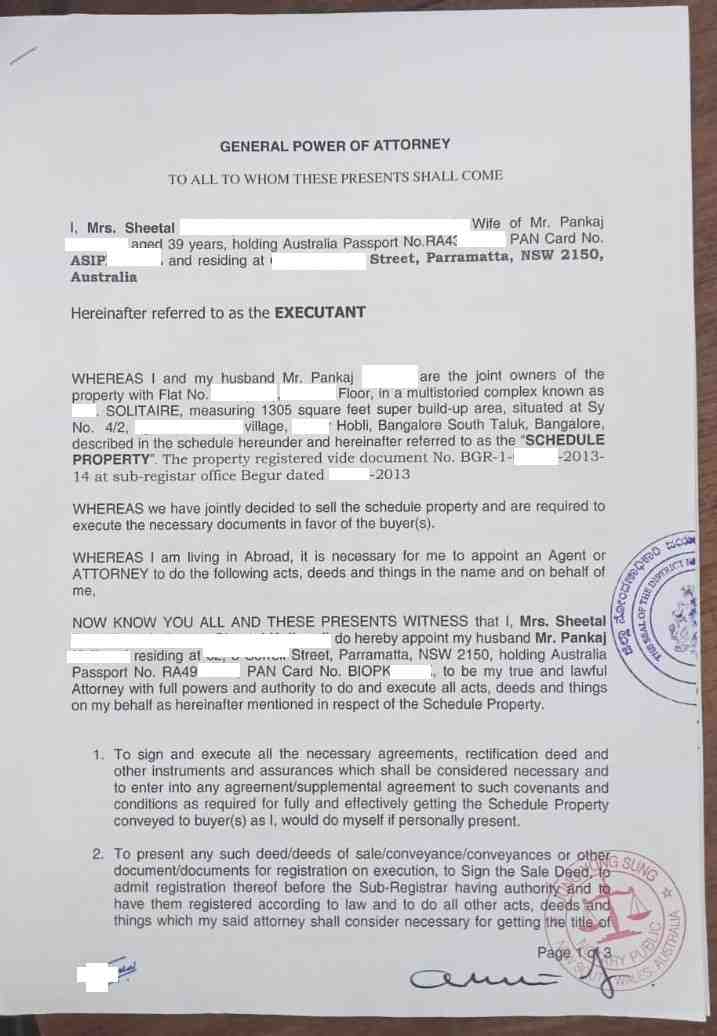
Since Mrs. Sheetal could not travel to India for registration, she granted a General Power of Attorney (GPA) to her husband to represent her during the sale deed registration.
Step-by-Step Procedure Followed:
Drafting the GPA
- We prepared the draft and emailed it to the client in Australia.
Execution Before Notary Public
- The client printed it on A4 paper.
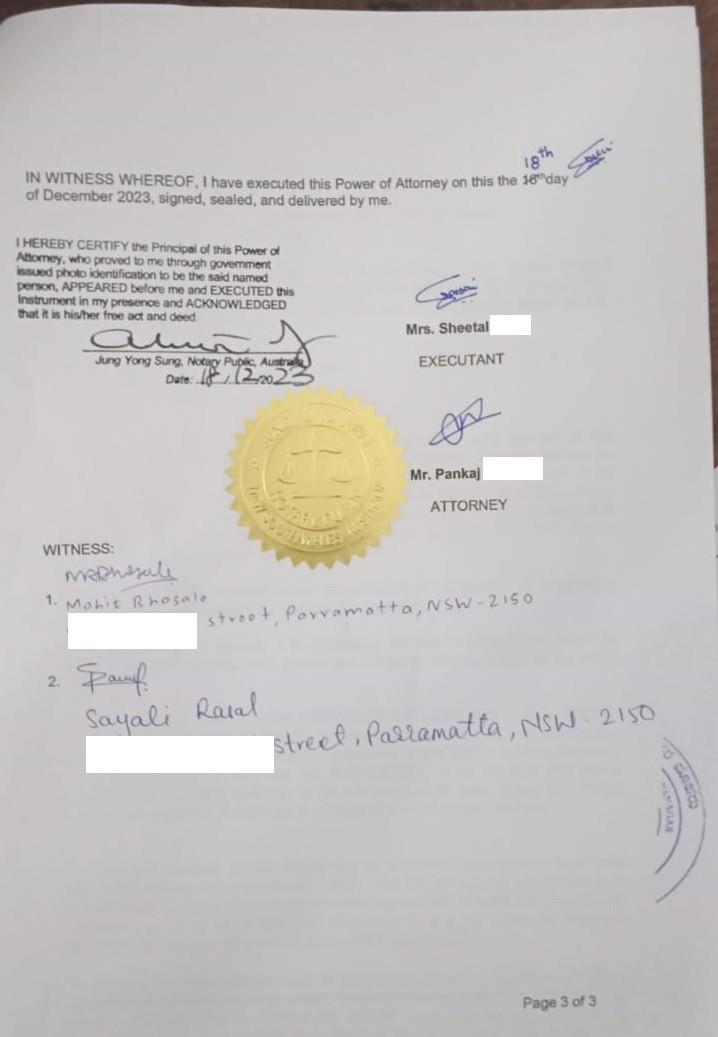
- Mrs. Sheetal and Mr. Pankaj signed the GPA before an Australian Notary Public.
- The Notary attested the document (fee: AUD $50).
Courier to India
- The attested GPA and self-attested ID proofs were couriered to us in India.
Adjudication in India
Once we received the attested GPA in India, we submitted it for adjudication at the District Registrar’s Office in Bangalore.
It is important to note that the presence of the agent (husband, in this case) was not required for adjudication. The process was completed based on the GPA document, self-attested ID proofs and consent letter provided by both husband and wife.
(Refer to the GPA image below for reference.)
Sale Deed Registration
We scheduled the sale deed registration slot 15 days in advance to allow sufficient time for travel and preparation.
Mr. Pankaj then traveled to India to complete the registration formalities.
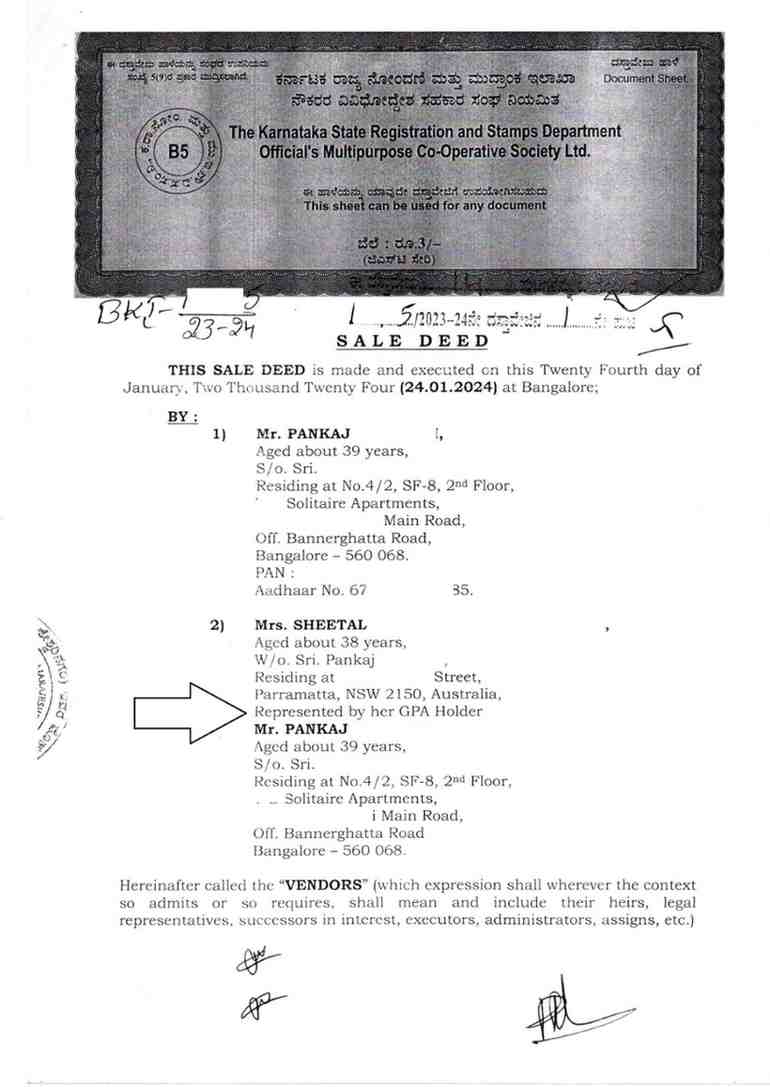
On the day of registration, he appeared before the Sub-Registrar’s Office, signed the sale deed as the lawful representative of his wife (under the GPA), and collected the final settlement cheque from the buyer.
The GPA representation was clearly highlighted in the registered sale deed for legal validity and record purposes.
(Refer to the registered GPA excerpt below for reference.)
FINAL THOUGHTS
Sending a Power of Attorney from abroad may initially seem overwhelming, but with the right planning, choosing a reliable agent, understanding the stamp duty, and selecting the most cost-effective attestation method - you can complete your property transaction smoothly.
At PGN Property, we assist clients across the globe in drafting, attesting, and adjudicating POAs for property transactions
- Email: pgnproperties@gmail.com
- WhatsApp: +91-97424-79020
FREQUENTLY ASKED QUESTIONS (FAQ)
1. Can I sell property in India without coming to India if I live abroad?
Yes, you can. By executing a legally valid Power of Attorney (POA) in favor of a trusted person in India, you can authorize them to complete the sale deed registration on your behalf.
2. Who can I appoint as my Power of Attorney holder in India?
You can appoint a family member, friend, lawyer, broker, or colleague. However, appointing a close family member is advisable because stamp duty is lower and they are generally more trustworthy.
3. How much is the stamp duty for POA in Karnataka?
- Rs. 500 if given to family members (father, mother, brother, sister, husband, wife, or children above 18 years).
- 5% of the sale consideration or guidance value (whichever is higher) if given to a non-family member.
4. What is the difference between a General Power of Attorney (GPA) and a Special Power of Attorney (SPA)?
- GPA gives broad powers to the agent for multiple property-related actions.
- SPA authorizes the agent for a specific purpose (e.g., selling one property).
If appointing a non-family member, SPA is recommended because the stamp duty is only Rs. 500, irrespective of relationship.
5. Is attestation of POA compulsory when executed abroad?
Yes. A POA executed abroad must be attested either by a Notary Public or the Consulate General of India, depending on your country of residence and Indian state requirements.
6. Which is better: Notary attestation or Consulate attestation?
- In USA, Canada, Europe, Australia, and New Zealand, Notary attestation is usually sufficient (and more convenient).
- In Singapore and Japan, Consulate attestation is cheaper and easier than Notary.
Always confirm with the state where your property is located, as requirements may vary.
7. What is POA adjudication in India?
Adjudication is the process of validating a foreign-executed POA at the District Registrar’s Office in India. This step makes the POA legally enforceable for property transactions in India.
8. Do I need to be present in India for POA adjudication?
No, the physical presence of the principal or agent is not required for adjudication. The process can be completed based on the attested POA, self-attested ID proofs, and a consent letter.
9. Can the agent collect the sale proceeds on my behalf?
Yes, if the POA specifically authorizes the agent to receive the consideration and sign the sale deed. Always ensure such powers are clearly mentioned in the document.
10. How long does it take to complete the entire process of selling property through POA?
On average:
- Drafting and execution abroad: 1–2 weeks.
- Courier to India: 5–10 days.
- Adjudication in India: 3–7 working days.
- Sale deed registration: depends on buyer readiness and Sub-Registrar slot availability.