
When buying an apartment, many homebuyers confuse the Occupancy Certificate (OC) with the Completion Certificate (CC). Although related, these two documents are different and serve distinct purposes.
COMPLETION CERTIFICATE (CC)
Once the construction of a building is finished, the builder or developer must apply for a Completion Certificate with the respective local authority (such as BBMP, BDA, CMC, or Panchayat).
The Completion Certificate confirms that:
- The building has been constructed according to the approved plan.
- It meets all prescribed norms, such as distance from the road, building height, compound wall structure, Sewage Treatment Plant (STP), rainwater harvesting, and other civic requirements.
Only after verifying compliance with these standards do the authorities issue a CC.
OCCUPANCY CERTIFICATE (OC)
After obtaining the Completion Certificate, the builder must apply for an Occupancy Certificate from the civic authorities.
The Occupancy Certificate certifies that:
- The building complies with the sanctioned building plan.
- It adheres to local laws and safety standards.
- The property is fit for human habitation and can be legally occupied.
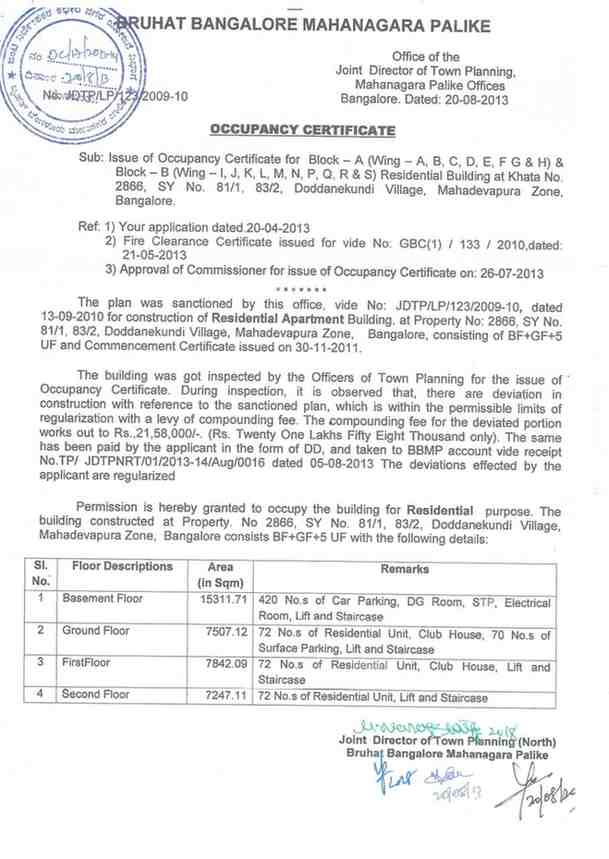
In simple terms, the OC serves as a no-objection certificate from municipal authorities, confirming that the building is safe and suitable for its intended purpose. An OC looks like image below
KEY DIFFERENCE BETWEEN COMPLETION CERTIFICATE AND OCCUPANCY CERTIFICATE
- Completion Certificate (CC): Confirms that the construction is completed as per the approved plan and applicable rules.
- Occupancy Certificate (OC): Issued after CC, it allows buyers to legally occupy and reside in their flats or apartments.
In practice, once the builder receives the CC, they must secure the OC before handing over possession to buyers.
WHY ARE THESE CERTIFICATES IMPORTANT?
Many buyers ignore collecting the CC and OC since they are not mandatory for property registration. However, they are crucial because:
- Without an OC, living in the apartment is technically illegal.
- Lack of these certificates can cause issues while applying for utilities, home loans, or during resale.
They serve as proof that the property is safe, legal, and constructed as per sanctioned norms.
FREQUENTLY ASKED QUESTIONS (FAQS)
1. Can I register a property without an Occupancy Certificate or Completion Certificate?
Yes, property registration can be done without OC or CC. However, this does not guarantee the property is legally fit for occupation.
2. Who issues the Completion Certificate and Occupancy Certificate?
Both CC and OC are issued by local municipal authorities such as BBMP, BDA, CMC, or Panchayat, depending on the jurisdiction of the property.
3. What happens if my apartment does not have an Occupancy Certificate?
Without an OC, living in the apartment is considered unauthorized. You may face difficulties in getting utilities like water, electricity, and sewage connections, and even in selling the property in the future.
4. Is the builder legally obligated to provide OC and CC?
Yes, the builder must obtain both CC and OC from the authorities and hand them over to buyers.
5. Can I apply for an Occupancy Certificate myself as a flat owner?
Generally, the builder or association applies for OC. However, if the builder has failed, a group of flat owners or the Resident Welfare Association (RWA) can approach the municipal authority for the same.