
- Sale Agreement: This is the initial agreement between the buyer and the seller (or builder) outlining the terms, conditions, and payment schedule of the transaction.
- MODT (Memorandum of Deposit of Title Deed) : Commonly known as a Mortgage Deed, this document is executed when the buyer avails a home loan and deposits the property’s title deeds with the lending bank as security.
- Sale Deed Registration: The final step in the property buying process, where legal ownership of the property is officially transferred and registered in the Sub-Registrar’s Office.
SINGLE GPA EXECUTED FOR A PROPERTY PURCHASE IN BANGALORE One of my NRI clients, Mr. Krishnan, and his spouse, both residing in Pennsylvania, USA, booked a 3BHK under-construction flat in Bangalore in January 2022. During their visit to India at that time, they toured the project site, finalized the apartment, paid the booking amount, and signed the Sale Agreement directly with the builder. Refer to Sale Agreement below
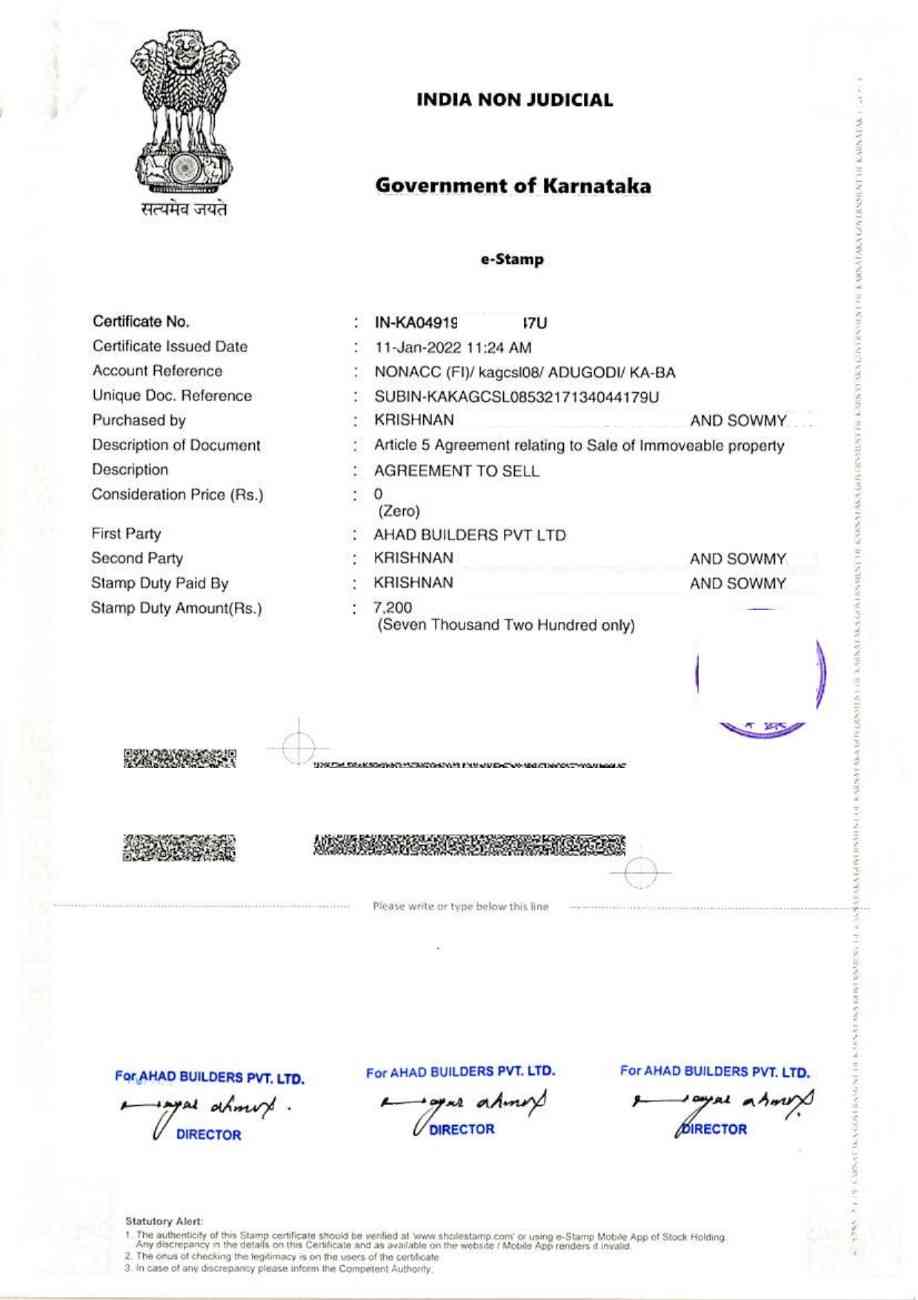
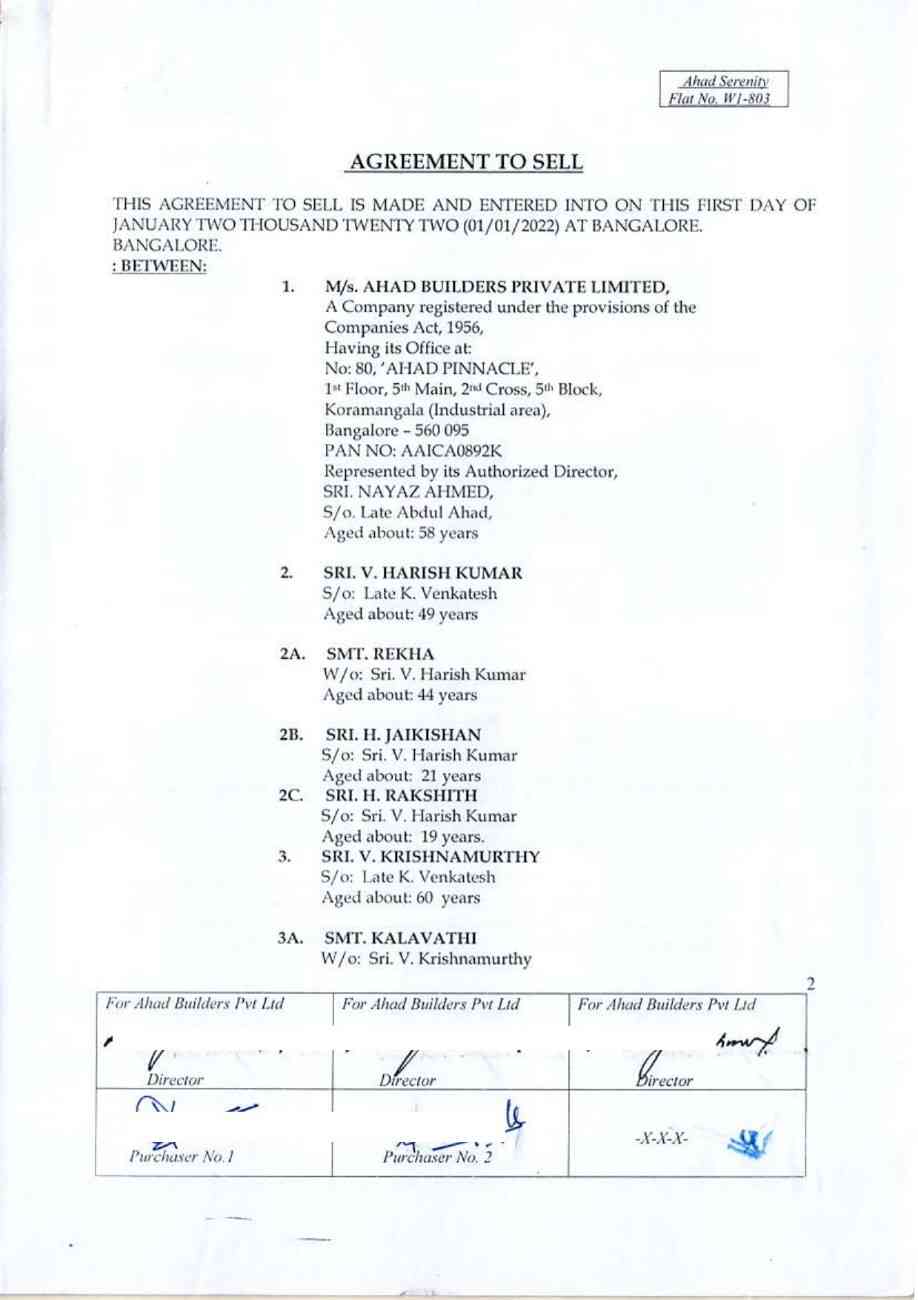 To finance the purchase, Mr. Krishnan applied for a home loan of Rs.64 lakhs from an Indian bank. This meant that he and his wife would need to execute and register the MODT (Mortgage Deed) with the lender once the property was ready for registration.
By 2025, the project was complete, and the builder was ready to initiate the sale deed registration process. However, since both Mr. Krishnan and his spouse were abroad, they decided to execute a General Power of Attorney (GPA) from the USA to authorize their family members in India to act on their behalf.
To finance the purchase, Mr. Krishnan applied for a home loan of Rs.64 lakhs from an Indian bank. This meant that he and his wife would need to execute and register the MODT (Mortgage Deed) with the lender once the property was ready for registration.
By 2025, the project was complete, and the builder was ready to initiate the sale deed registration process. However, since both Mr. Krishnan and his spouse were abroad, they decided to execute a General Power of Attorney (GPA) from the USA to authorize their family members in India to act on their behalf.
HOW THE SINGLE GPA WAS STRUCTURED Instead of issuing separate POAs for each stage, Mr. Krishnan and his wife executed one joint GPA authorizing:
- His father-in-law to represent Mr. Krishnan, and
- Her father to represent Mrs. Krishnan.
- The authority to execute and register the MODT (Memorandum of Deposit of Title Deed) with the lending bank.
- The authority to execute and register the Sale Deed at the Sub-Registrar’s Office in Bangalore.
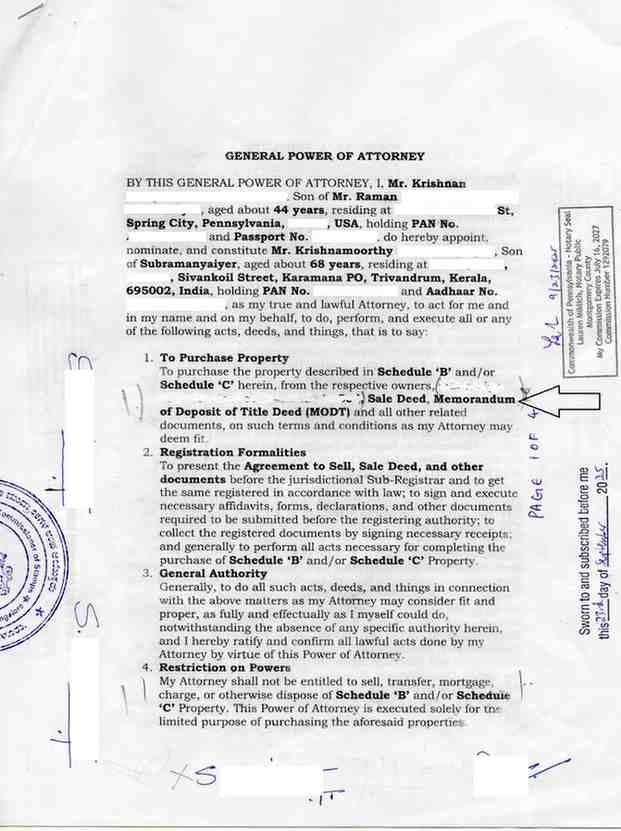 The GPA was notarized in the USA and adjudicated in India before use. Once the adjudication was complete, their authorized representatives successfully executed both the MODT and Sale Deed registration using this single GPA.
KEY TAKEAWAYS
- Yes, an NRI can execute one single GPA covering the Sale Agreement, MODT, and Sale Deed registration.
- The GPA must explicitly mention the powers for each stage to avoid rejection by the Sub-Registrar or the bank.
- It should be attested by the Indian Embassy/Consulate or notarized abroad and adjudicated in India before being used for registration purposes.
CONCLUSION Executing a single, well-drafted General Power of Attorney is a practical and valid option for NRIs purchasing property in India. It allows their trusted family members or representatives to complete the MODT and Sale Deed registration efficiently, without the need for multiple POAs.
NEED ASSISTANCE WITH DRAFTING OR ADJUDICATING YOUR POWER OF ATTORNEY (POA)? We assist NRIs and property buyers in drafting, attesting, and adjudicating legally compliant Power of Attorney documents for property transactions across Karnataka. Ensure your POA is accurately worded and accepted by banks and the Sub-Registrar’s Office — avoiding costly delays or rejections.
- Email: pgnproperties@gmail.com
- Call/WhatsApp: +91-97424 79020
WATCH: HOW NRIS CAN EXECUTE A SINGLE POWER OF ATTORNEY FOR PROPERTY TRANSACTIONS IN INDIA If you’re an NRI planning to buy property in India, this short video explains how a single Power of Attorney (POA) can simplify the entire process, from signing the Sale Agreement to completing the MODT and Sale Deed registration. Watch the video below to understand the step-by-step procedure and key legal requirements for executing a valid Power of Attorney from abroad.
FREQUENTLY ASKED QUESTIONS (FAQS) Single Power of Attorney (POA) for NRI Property Transactions in India
- Can an NRI execute a single Power of Attorney (POA) for Sale Agreement, MODT, and Sale Deed registration?
- Is it mandatory to execute separate POAs for each stage of the property transaction?
- What should a Power of Attorney include to be accepted by banks and the Sub-Registrar’s Office?
- Authority to execute and register the MODT (Memorandum of Deposit of Title Deed).
- Authority to execute and register the Sale Deed.
- Full details of the property and the parties involved.
- Specific authorization to represent the NRI before the bank and Sub-Registrar.
- How should an NRI execute a Power of Attorney abroad?
- Notarized in the foreign country and then adjudicated in India, or
- Attested by the Indian Embassy/Consulate, followed by adjudication in India before registration use.
- What is adjudication of a Power of Attorney?
- Can a joint Power of Attorney be executed by husband and wife together?
- Is a POA required for the Sale Agreement if the NRI signs it personally in India?
- Can the same GPA be used for multiple properties?
- How long is a Power of Attorney valid?
- Who can be appointed as Power of Attorney holder in India?