
No, an Apostille is not required for executing a Power of Attorney (PoA) for property registration in India. Instead, the PoA must be attested either by the Indian Consulate or a Notary Public in the country of residence of the Non-Resident Indian (NRI).
STEP-BY-STEP PROCESS TO EXECUTE A POWER OF ATTORNEY ABROAD FOR PROPERTY REGISTRATION IN INDIA
Step 1: Draft the Power of Attorney
- Prepare the PoA in Word format, clearly mentioning the authority being granted and the property details.
Step 2: Print the Document
- Print the drafted PoA on A4-sized plain paper.
Step 3: Sign and Attest the PoA
- The NRI must sign the PoA in the presence of an Indian Consulate Officer or a Notary Public in their country of residence.
- Sign at the bottom of every page, and ensure that witnesses sign in the appropriate section.
- Have the document formally attested by the Consulate or Notary.
Step 4: Send the PoA to India
- Courier the attested PoA to your designated attorney (representative) in India.
Step 5: Adjudication in India
- The attorney (PoA holder) must get the PoA adjudicated at the District Registrar’s Office within the jurisdiction where the property is located.
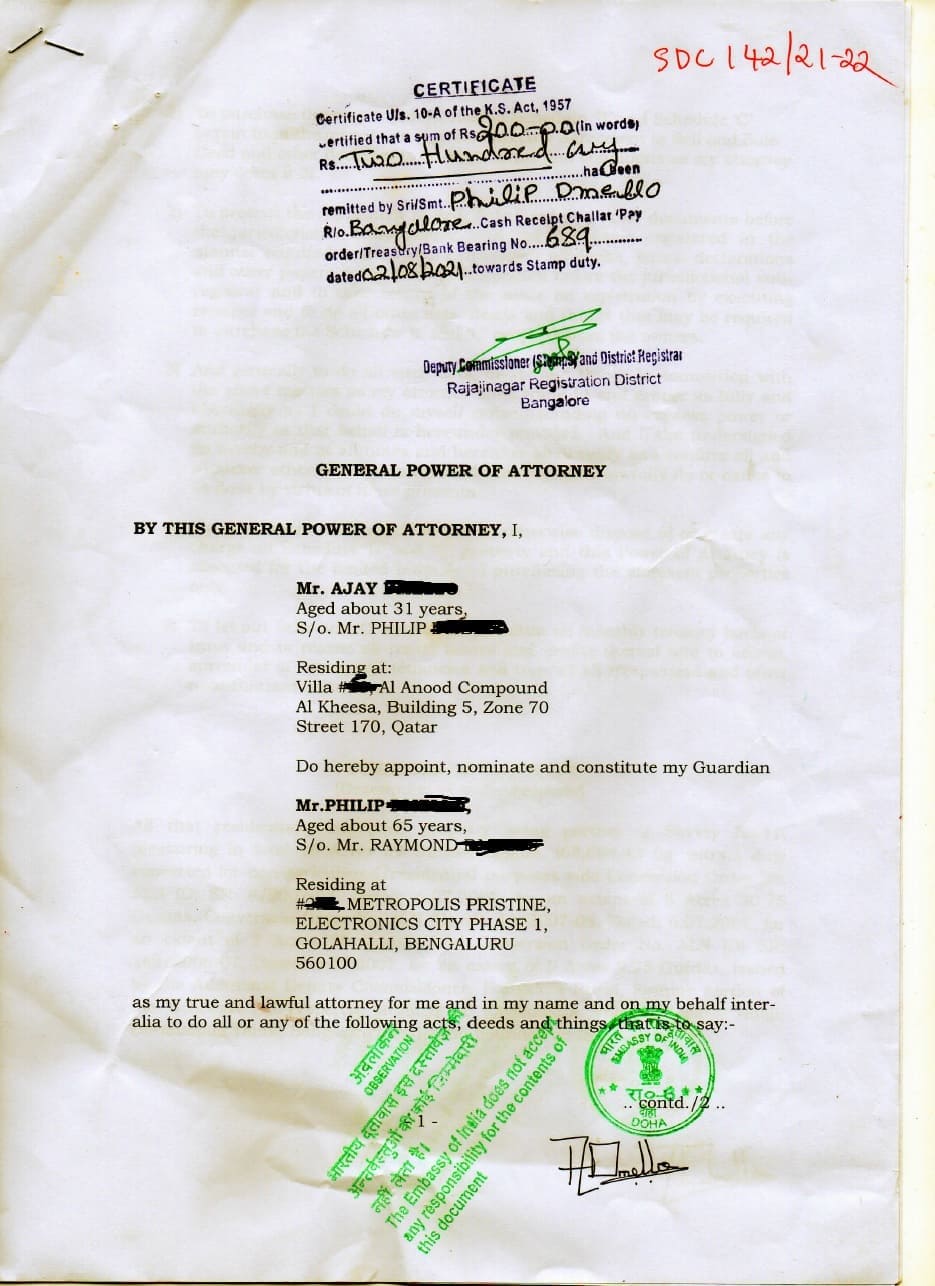
WHAT DOES A POWER OF ATTORNEY LOOK LIKE?
Here is an example of a Power of Attorney we successfully used for property registration in Bangalore, India.
NEED ASSISTANCE?
We provide end-to-end support for drafting, attesting, and adjudicating a Power of Attorney for property transactions in Bangalore, India.
- Email: pgnproperties@gmail.com
- WhatsApp: +91-9742479020
FREQUENTLY ASKED QUESTIONS (FAQS) ON POWER OF ATTORNEY FOR PROPERTY REGISTRATION IN INDIA
1. Is Apostille mandatory for a Power of Attorney in India?
No. Apostille is not required for executing a Power of Attorney for property transactions in India. Instead, the document must be attested by the Indian Consulate or a Notary Public in the NRI’s country of residence.
2. What happens if a Power of Attorney is not adjudicated in India?
If the PoA is not adjudicated, it will not be considered legally valid for property registration or any related transactions in India. Adjudication is a crucial step to give the PoA legal effect within India.
3. Can a Power of Attorney be revoked?
Yes. The person granting the PoA (the principal) can revoke it at any time, provided the revocation is made through a written document and is duly registered (if the original PoA was registered). Notice of revocation should also be given to the PoA holder and any third parties concerned.
4. How long is a Power of Attorney valid in India?
A PoA remains valid until it is either revoked by the principal, the purpose for which it was created is fulfilled, or if the principal passes away.
5. Can the same PoA be used for multiple properties in India?
Yes, if the PoA document specifically mentions details of multiple properties, the attorney can act on behalf of the principal for all such properties. Otherwise, a separate PoA may be required.
6. Is it compulsory to register a Power of Attorney in India?
Yes, for property-related transactions, the PoA must be adjudicated (and in some cases registered) at the District Registrar’s Office to be legally enforceable.