
The execution of a Power of Attorney (POA) varies depending on whether the person granting the authority (the executant) is an NRI (Non-Resident Indian) or a resident of India. This guide outlines the step-by-step procedures for both categories, ensuring that the POA is legally valid and enforceable in India.
POA EXECUTION BY NRIS (NON-RESIDENT INDIANS)
NRIs are not required to be physically present in India for registering a property or managing related transactions. Instead, they can execute a Power of Attorney in favor of a trusted individual, such as a family member, friend, colleague, or legal representative, to act on their behalf.
Steps for NRIs to Execute a Power of Attorney:
Step 1: Draft the POA in Word format, clearly stating the powers granted to the attorney.
Step 2: Print the draft on A4-size paper.
Step 3: The NRI must sign the POA in the presence of an Indian Consulate Officer or a Notary Public in the country of residence.
- The executant should sign at the bottom of each page.
- A witness must also sign in the designated witness section.
Step 4: Courier the original, signed POA to the attorney in India.
Step 5: The attorney in India must adjudicate the POA at the District Registrar’s Office in the jurisdiction where the property is located.
Note: While physical presence of the NRI is not required in India, attestation by the Indian Consulate or Notary Public abroad is mandatory for the POA to be recognized in India.
Below is the sample of an NRI-executed GPA


POA EXECUTION BY INDIAN RESIDENTS
Depending on whether the executant and the attorney live in different cities or the same location, the process has slight variations.
When Executant and Attorney Are in Different Locations
This scenario is common when, for example, the property owner resides in Karnataka and the attorney is based in Delhi.
Step 1: Draft the POA in Word format.
Step 2: Submit an application for POA registration at the Sub-Registrar Office (SRO) where the executant resides.
Application approval typically takes 2–3 working days.
Pay the applicable government charges:
- Stamp Duty: ₹1,000 per executant
- Registration Fee: ₹200
- Scanning Fee: ₹50 per page
Step 3: Print the draft on document paper.
Step 4: Carry the following documents to the SRO:
- Printed POA
- Application summary report and payment receipt
- Aadhaar or valid ID proof of the executant
Step 5: Executant signs the POA. Biometric verification (fingerprint and webcam photo) will be captured by the officer.
Step 6: Courier or personally hand over the registered POA to the attorney.
WHEN EXECUTANT AND ATTORNEY ARE IN THE SAME LOCATION
In this case, both parties can appear together at the Sub-Registrar Office.
Step 1: Draft the POA in Word format.
Step 2: Submit the registration application at the local SRO.
Approval within 2–3 working days
Pay the same fees as mentioned above:
- Stamp Duty: ₹1,000
- Registration Fee: ₹200
- Scanning Fee: ₹50 per page
Step 3: Print the POA on document paper.
Step 4: Both Executant and Attorney must carry:
- Printed POA
- Application summary report and payment receipt
- Aadhaar or valid ID proof of both parties
Step 5: Both parties sign the POA. Fingerprint and photograph will be recorded for both.
This completes the POA registration process when both parties reside in the same city.
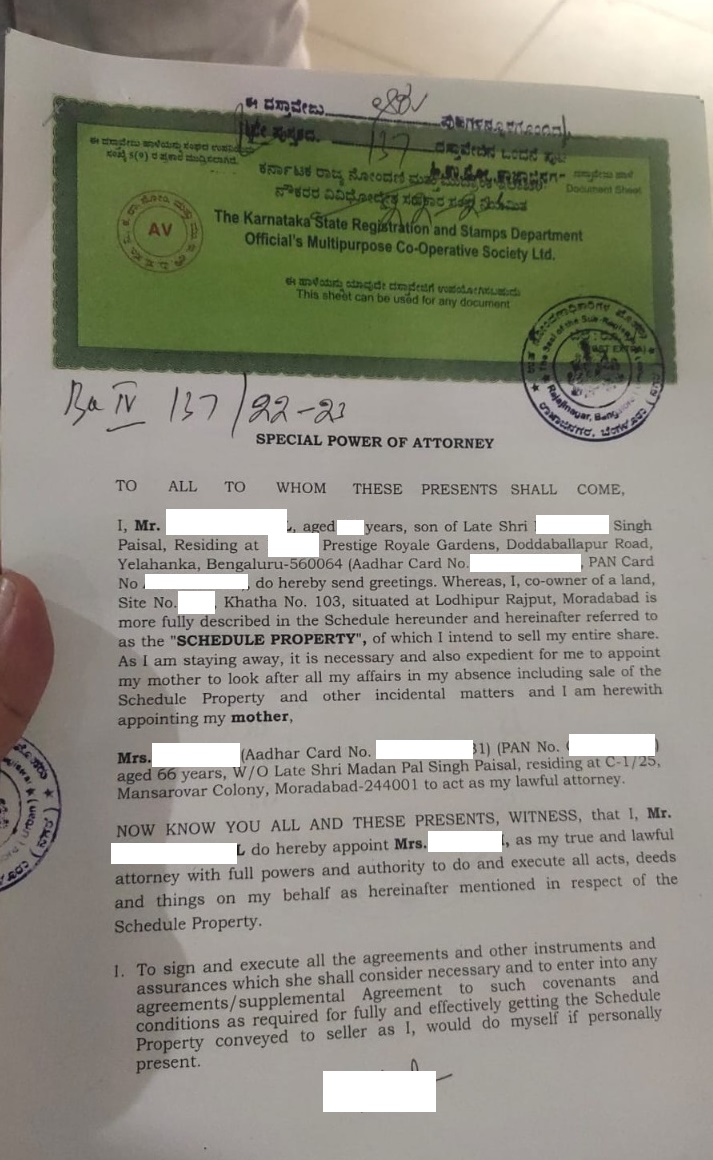
Sample of a Registered POA by Indian Resident


NEED ASSISTANCE?
For professional support in drafting, attesting, or registering a Power of Attorney in India or abroad, write to us:
- Email: pgnproperties@gmail.com
- WhatsApp: +91-9742479020