
Yes, immovable property in Karnataka (and across India) can be registered in two or more names. This practice is referred to as joint ownership or co-ownership, and it is increasingly common among families, couples, and even business partners.
When people think of co-ownership, they usually consider spouses or immediate family members like parents and children. However, property can also be jointly purchased with extended relatives, siblings, business associates, or even friends, provided that all parties mutually agree on the terms of ownership.
WHY CONSIDER CO-OWNERSHIP?
Buying property is one of the biggest financial commitments in a person’s life. Co-ownership can make this process more affordable, secure, and financially efficient. By registering a property jointly, buyers can:
- Reduce Financial Burden : The overall costs of property acquisition are shared between co-owners.
- Enhance Loan Eligibility : Multiple co-applicants can increase the combined loan eligibility, allowing buyers to purchase higher-value properties.
- Share Responsibilities : Costs such as property tax, maintenance, and renovation can be divided equally or in agreed proportions.
- Enjoy Tax Benefits : Each co-owner who is a co-borrower in the home loan can claim tax deductions on principal repayment
- Ensure Legal Security : Having both names on the Sale Deed ensures that each party has a clear legal right to the property, minimizing ownership disputes in the future.
KEY EXPENSES THAT CAN BE SHARED
- Down Payment : Initial contribution made at the time of purchase.
- Monthly EMI (Equated Monthly Installments) : Loan repayment responsibility divided between co-borrowers.
- Home Interiors and Renovation : Costs for furnishing or improving the property.
- Stamp Duty and Registration Charges : Fees for registering the property in government records.
- Property Tax and Maintenance Charges : Annual expenses associated with property upkeep.
REAL EXAMPLE
One of our clients, a husband and wife, purchased a residential property in Bangalore. Both names were included in the Sale Deed, reflecting an equal ownership ratio of 50:50. Refer to sale Deed below
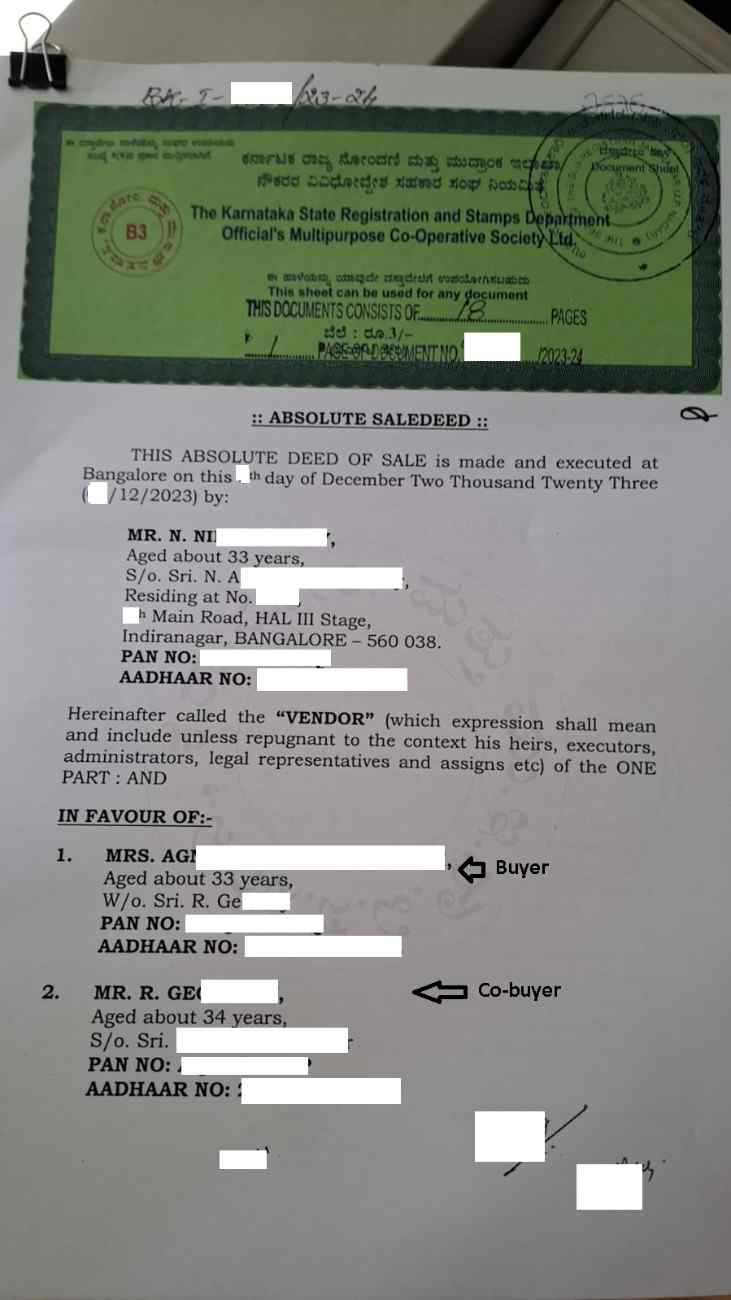
- The husband contributed 50% of the property value through direct payment (without taking a loan).
- The wife financed 50% through a home loan. The loan documents, including the disbursement cheque, listed only the wife as the applicant, while the Sale Deed reflected both as equal co-owners. Refer to below DD
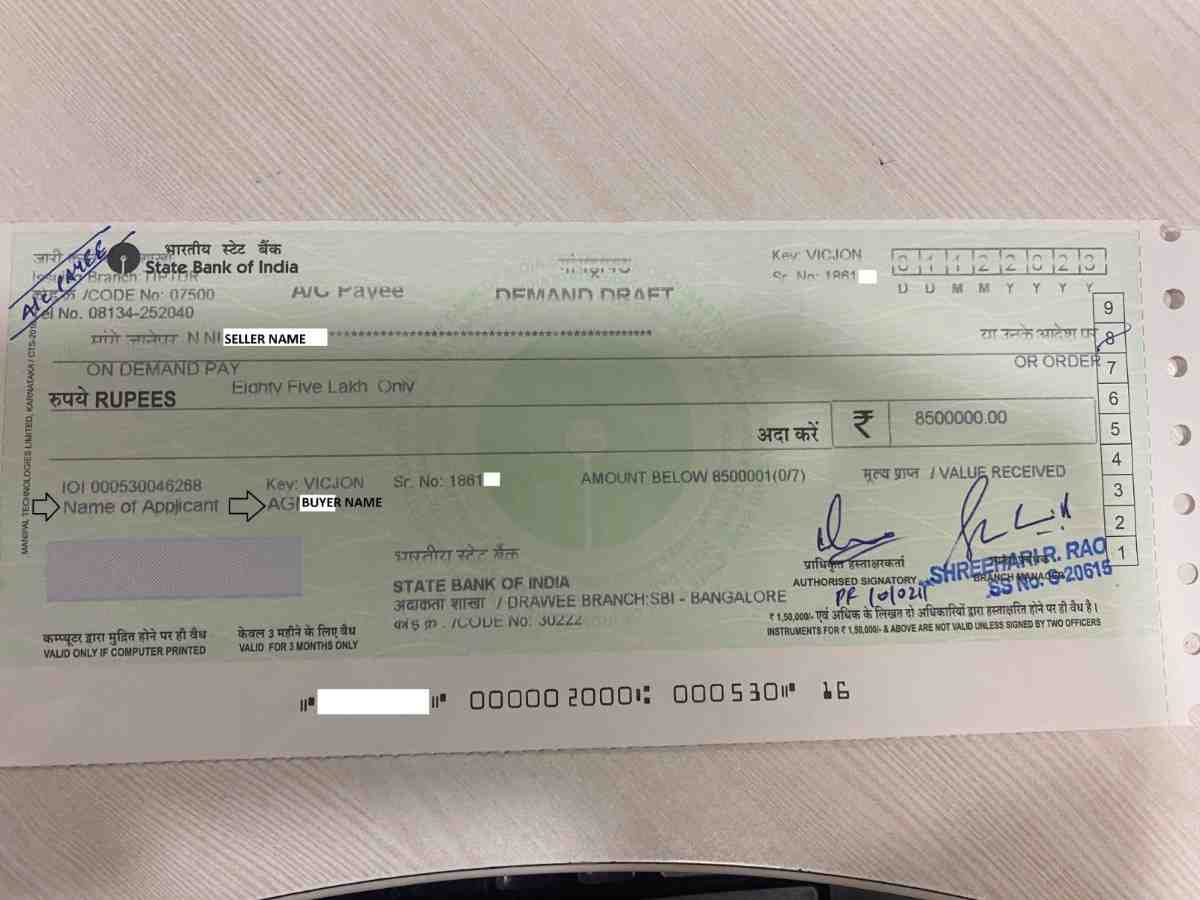
This approach not only allowed them to purchase their dream home but also gave them maximum financial advantages:
- Both qualified as first-time home buyers, opening doors to government benefits and incentives.
- The wife, being a salaried professional, was able to claim significant income tax deductions on her home loan repayments.
- Their 50:50 structure reflected a modern financial planning approach, where couples share responsibility and build assets together.
Such joint ownership arrangements are increasingly popular in today’s dual-income households, as they combine affordability with legal clarity.
IMPORTANT POINTS TO REMEMBER
- The Sale Deed must clearly mention all co-owners’ names and their respective ownership shares.
- In case of unequal contributions, ownership ratios should be specified (e.g., 70:30). If not specified, ownership is generally presumed to be equal.
- Ideally, all co-owners should also be co-borrowers if the property is financed through a home loan to enjoy tax benefits.
- Future sale, transfer, or mortgage of the property will require the consent and signatures of all co-owners.
NEED ASSISTANCE WITH JOINT PROPERTY REGISTRATION?
At PGN Property, we provide complete end-to-end support for property registrations involving single or multiple owners. From Sale Deed drafting to registration at the Sub-Registrar’s Office:
- Email us: pgnproperties@gmail.com
- WhatsApp us: +91-97424-79020
FREQUENTLY ASKED QUESTIONS (FAQ) ON JOINT PROPERTY REGISTRATION
1. Can immovable property be registered in two names?
Yes, property can be registered in two or more names. This is called joint ownership or co-ownership.
2. Who can be a co-owner of a property?
Co-owners can be spouses, parents, children, siblings, extended relatives, business partners, or even friends. There is no legal restriction, as long as all parties are willing and eligible.
3. Is it necessary for all co-owners to take the home loan together?
Not always. One person can take the home loan while both names appear in the Sale Deed. However, if both become co-borrowers, they can each claim tax benefits on loan repayment.
4. What if the ownership shares are unequal?
If the investment ratio is unequal (e.g., 70:30), it should be clearly mentioned in the Sale Deed. Otherwise, ownership is generally assumed to be equal.
5. Can friends jointly buy a property in Karnataka?
Yes, friends can jointly buy and register property, provided they meet eligibility requirements and agree on the ownership ratio. However, clear documentation is crucial to avoid disputes later.
6. What happens if one of the co-owners passes away?
The deceased co-owner’s share will pass to their legal heirs, unless the property is held under joint tenancy with right of survivorship. In India, most properties are held as tenancy-in-common, where each co-owner’s share can be inherited separately.
7. Can joint property be sold without all co-owners’ consent?
No. The sale or transfer of a jointly owned property requires the consent and signature of all co-owners. Without unanimous agreement, the transaction cannot be registered.
8. Are there tax benefits in co-ownership?
Yes. If co-owners are also co-borrowers of a home loan, each can claim tax deductions under Section 80C (principal repayment) and Section 24(b) (interest repayment), subject to limits.
9. Can I add a co-owner’s name later after registration?
No. A co-owner’s name cannot be added later to the existing Sale Deed. Instead, ownership can be shared by way of a gift deed, sale deed, or re-registration.
10. Is joint ownership recommended for investment purposes?
Yes. Joint ownership reduces financial burden, ensures legal security, and helps in better estate planning. However, it is advisable to draft a written agreement defining each person’s rights, responsibilities, and ownership ratio.