
The guidance value (also known as circle rate) is the minimum amount for which a property can be registered in Karnataka. You can sell a property below the guidance value, but please note:
- Registration charges will always be calculated on the higher of guidance value or selling price.
Costs Involved in Property Registration
Property registration in Karnataka typically incurs the following charges:
- Stamp Duty & Surcharge
- Registration Fee
- Cess
- Scanning Fee
- TDS (Tax Deducted at Source, applicable in certain cases, especially for NRI sellers)
REAL EXAMPLE: SELLING A PROPERTY BELOW GUIDANCE VALUE
One of my clients, an NRI based in Texas, USA, wanted to sell his flat in Bangalore and use the funds to purchase a property in the USA. The challenge: he had very limited time to complete the transaction.
The guidance value of the property was Rs.80.45 lakh, while our listed price was Rs.85 lakh. We set a target of 30 days to secure a buyer. Despite our best efforts, most offers we received were in the range of Rs.50–60 lakh.
Finally, we decided to proceed with an offer of Rs.60 lakh. Although this was significantly lower than our listed price, it was the most viable option for two main reasons:
The buyer was self-financing (without a home loan), which meant we could complete the transaction quickly. A home loan would have delayed the process by an additional 1–2 months.
The buyer was willing to close the deal immediately, which was important since the seller (an NRI) had very limited time to complete the sale.
To expedite the process, we skipped the sale agreement and decided to move directly to registering the Sale Deed within two weeks.
We collected an advance of Rs.1 lakh from the buyer as confirmation and shared the property documents for verification.
Since the sale price of Rs.60 lakh was below the guidance value of Rs.80.45 lakh, additional compliance requirements came into play. The seller being an NRI, the buyer was required to deduct TDS at 22.88% (including surcharge and cess) and deposit the same on the Income Tax Department’s e-filing portal.
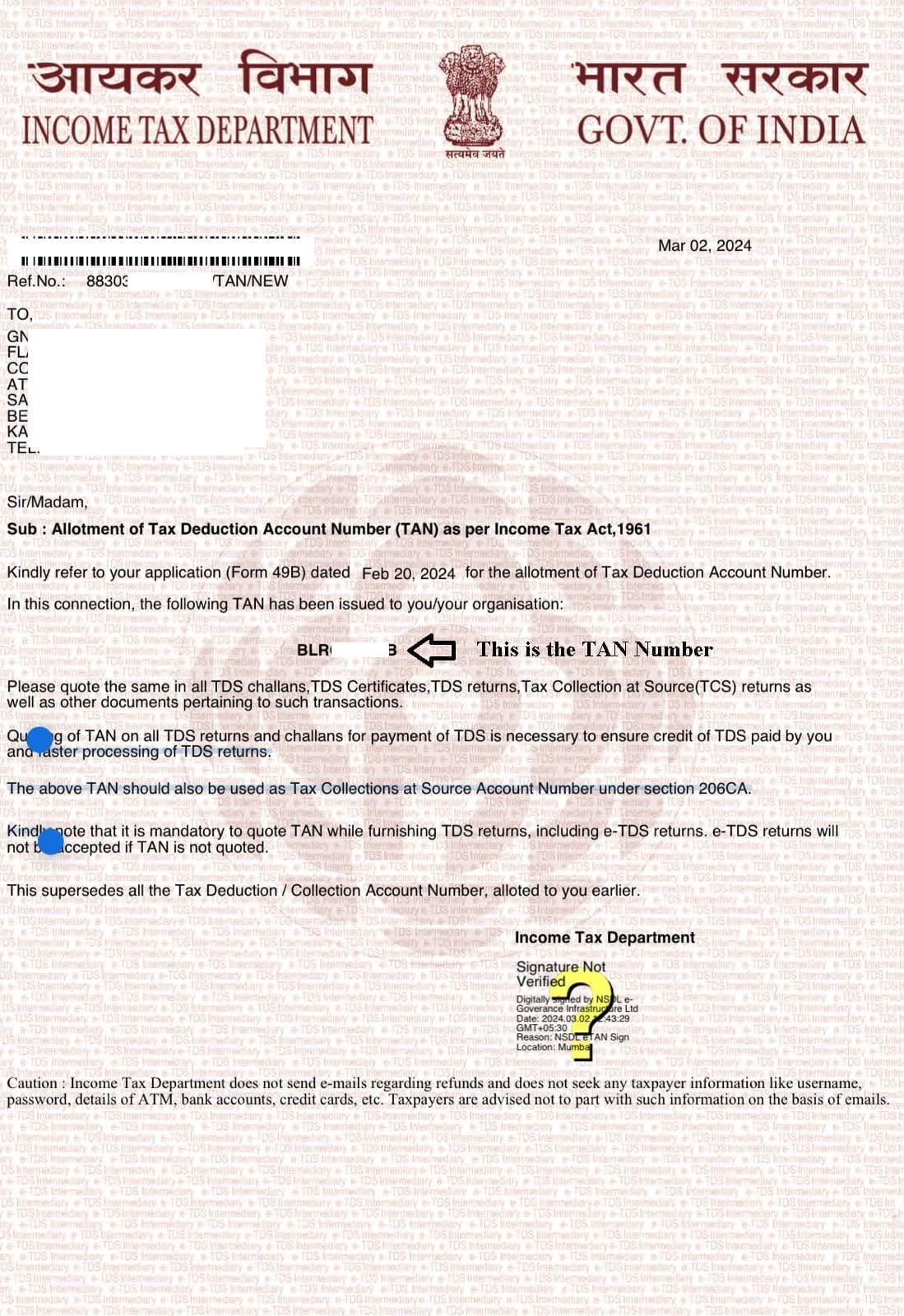
For this, the buyer needed a TAN (Tax Deduction and Collection Account Number). We assisted in applying for the TAN, which cost Rs.150 and took seven working days. Once approved, we downloaded the TAN (screenshot below).
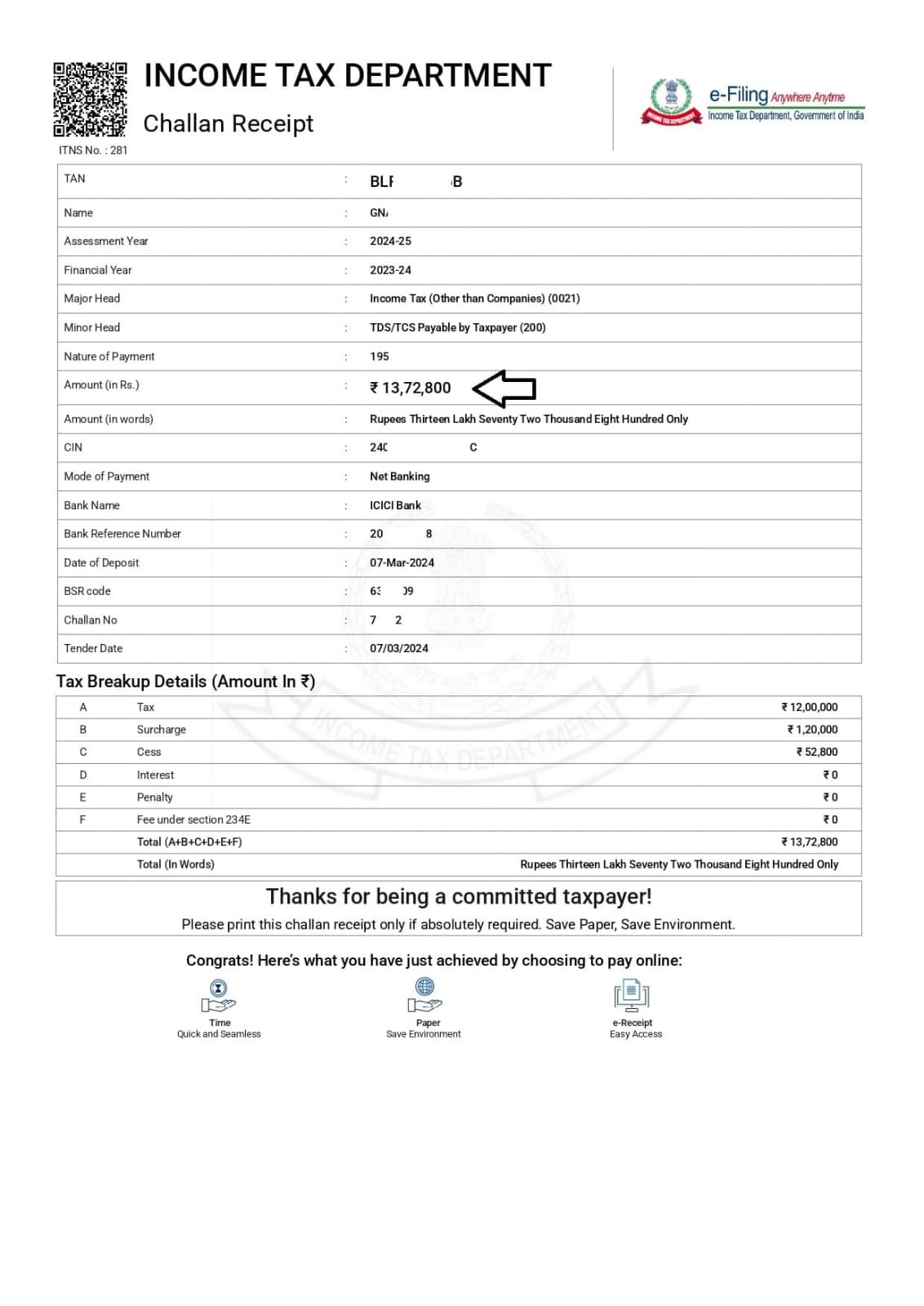
The buyer was unaware of the concept of “Guidance Value.” Since the selling price was lower than the guidance value, the TDS was required to be calculated on the guidance value. However, the buyer mistakenly calculated it on the sale price.
- TDS Paid (on sale price Rs.60 lakh): Rs.60,00,000 × 22.88% = Rs.13,72,800
- TDS Required (on guidance value Rs.80.45 lakh): Rs.80,45,000 × 22.88% = Rs.18,40,696
- Shortfall: Rs.4,67,896
(Refer to the highlighted TDS challan below)
For the property registration in Bangalore, we submitted the application online through the Kaveri Online Services portal. The application process required uploading supporting documents, including:
- Draft Sale Deed
- Identity Proofs
- Latest Tax Receipt
- Khata Certificate/Extract
- TDS Challan
The application was verified and approved within three working days.
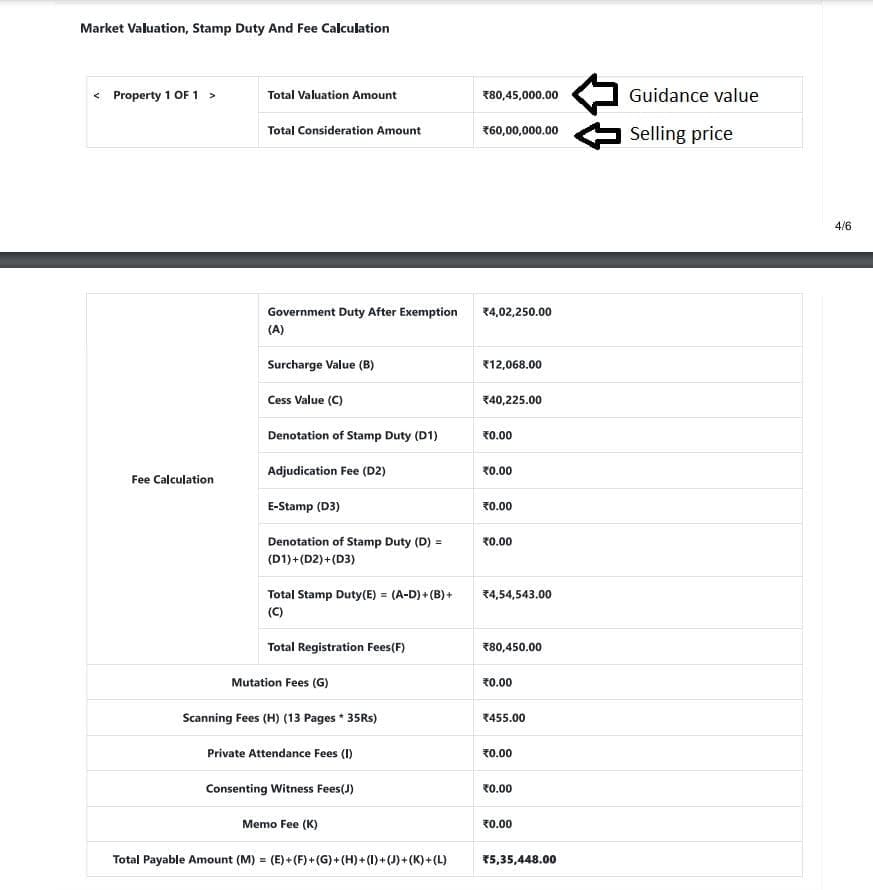
Once approved, the next step was to pay the registration charges online. On the Kaveri portal, the registration cost is auto-calculated based on the guidance value or the sale price, whichever is higher. Importantly, there is no option to modify or reduce the amount payable.
In our case, the system automatically calculated the charges based on the guidance value (Rs.80.45 lakh), even though the sale price was Rs.60 lakh. We proceeded by clicking on the “Make Payment” button and completed the payment securely through internet banking.
(Refer to the auto-calculation screenshot below, where both the guidance value and sale price are highlighted.)
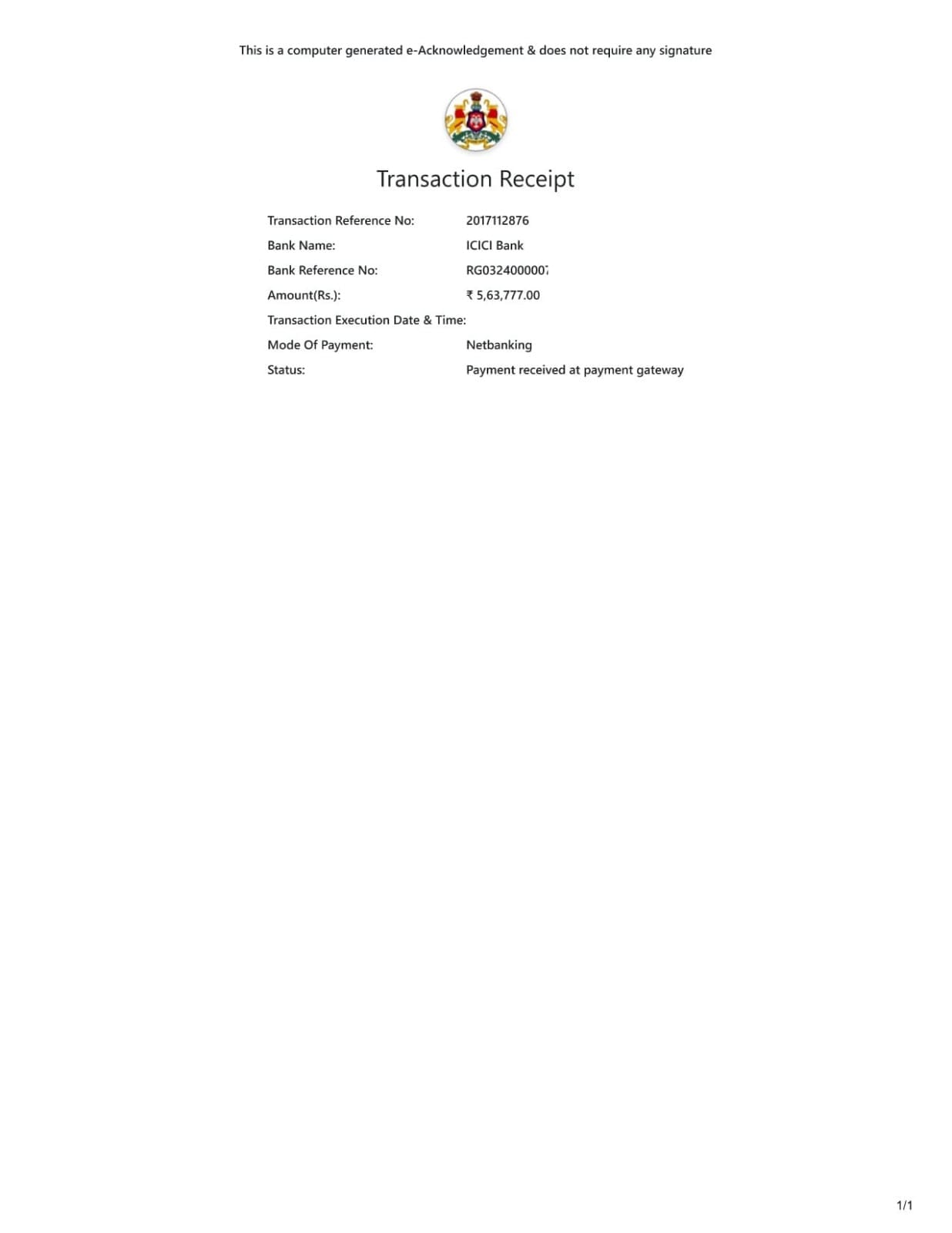
We successfully completed the online payment, and the transaction receipt was generated as confirmation. (Refer to the receipt image below.)
During the registration process at the Sub-Registrar’s office, the staff at the registration counter identified that the buyer had short-paid the TDS while cross-checking the summary report.
The registration was put on hold, and the buyer was instructed to immediately pay the TDS shortfall of Rs.4,67,896. The buyer promptly made the payment and submitted the challan at the counter.
(Refer to the debit transaction screenshot below.)
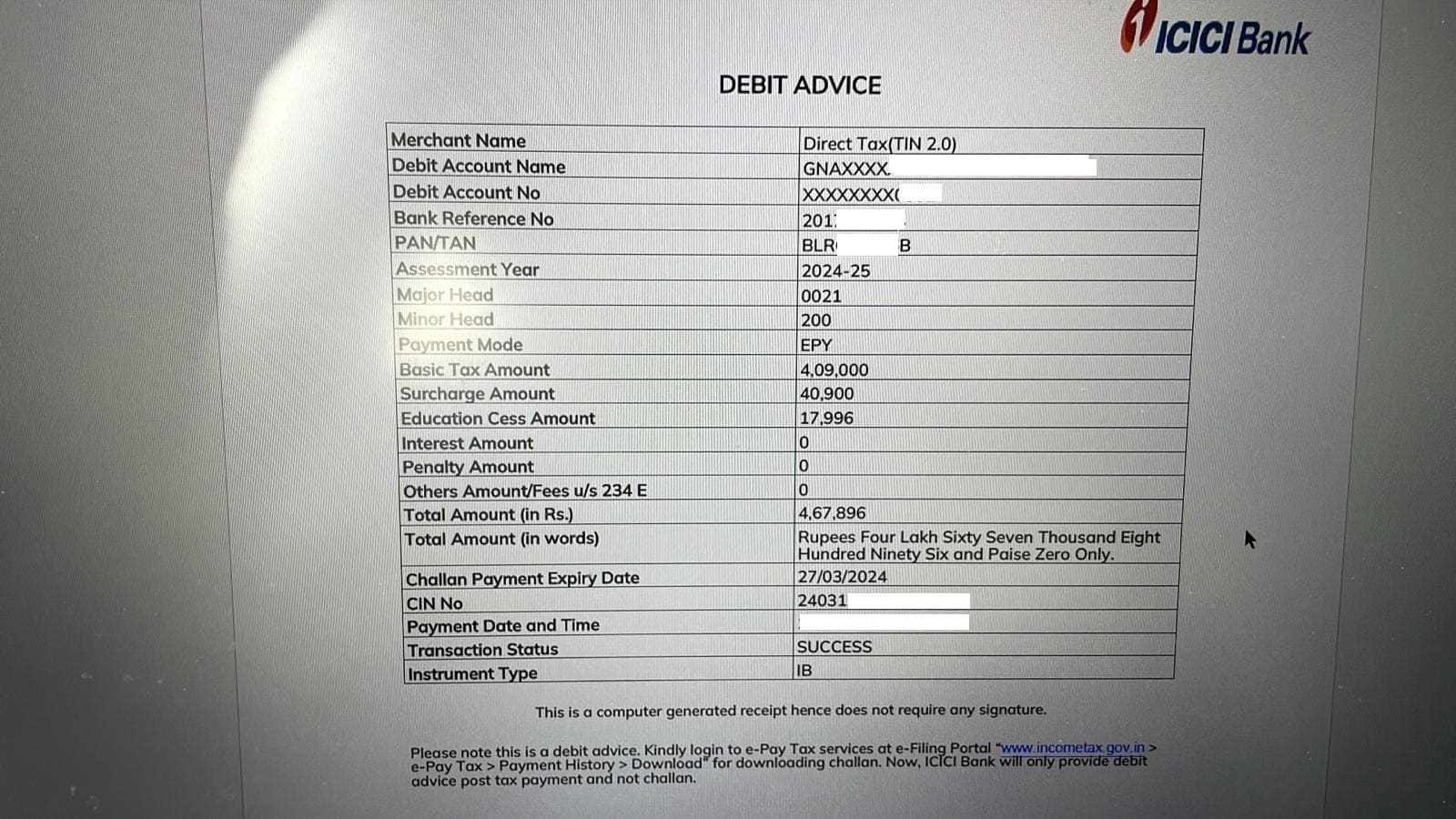
Once the payment was verified, the staff resumed our registration. I must acknowledge their diligence, by pointing out the short payment, they saved the buyer from receiving a future tax notice with heavy penalty and interest charges.
Since the seller was residing in the USA, he executed a Special Power of Attorney (SPOA) and sent it along with the signed Sale Deed. The SPOA holder, acting on behalf of the seller, presented the documents at the Sub-Registrar’s office and successfully completed the registration process.
(Refer to the transaction page from the registered Sale Deed below.)
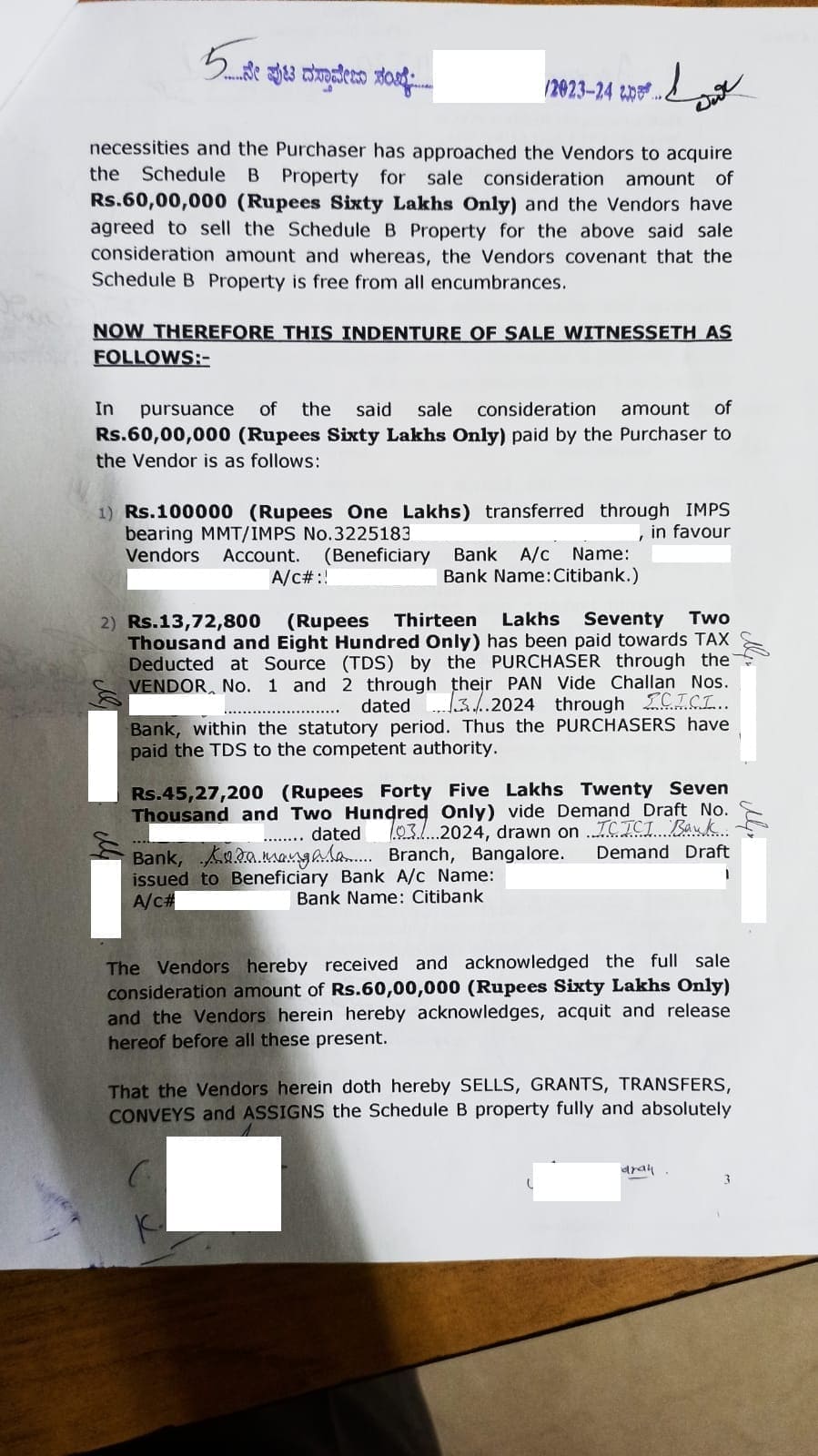
The TDS rate can be reduced by applying for a Nil/Lower Tax Deduction Certificate from the Income Tax Department. However, this process requires a Sale Agreement and takes approximately 30 working days.
Since we did not have a sale agreement and were working within a very tight timeline, we proceeded by paying TDS at the standard rate. The seller may claim refund through Income Tax Return (ITR) filing.
In summary, while it is possible to sell a property below the guidance value, both buyers and sellers must be aware of the implications:
- TDS for NRI sellers will always be calculated on the guidance value (if higher than the sale price).
- Registration charges will also be based on the higher of guidance value or sale price.
At PGN Property, we assist with:
- Property Registration in Karnataka
- NRI Transactions & SPOA Handling
- TDS Compliance & Refund Support
Email: pgnproperties@gmail.com
WhatsApp: +91-97424-79020
FAQs
Q1: Can I sell a property below the guidance value in Karnataka?
A: Yes, you can sell a property below the guidance value, but the registration charges and TDS (for NRI sellers) will be calculated based on the higher of the guidance value or the sale price.
Q2: What is guidance value (circle rate) in Karnataka?
A: Guidance value is the minimum value set by the government for property registration. It is used to calculate stamp duty, registration charges, and TDS.
Q3: How is TDS calculated for an NRI seller if property is sold below guidance value?
A: TDS is calculated on the higher of the sale price or guidance value at the applicable NRI rate
Q4: Can TDS be reduced or avoided?
A: Yes, by applying for a Nil/Lower Tax Deduction Certificate from the Income Tax Department. This requires a Sale Agreement
Q5: What documents are required for property registration in Bangalore online?
A: Key documents include: Draft Sale Deed, ID proofs, Tax Receipt, Khata certificate/extract, and TDS challan.
Q6: Can an NRI seller complete property registration remotely?
A: Yes, via Special Power of Attorney (SPOA). A representative can present the documents at the Sub-Registrar’s office to complete registration.
Q7: Will the buyer save on stamp duty if the property is sold below guidance value?
A: Buyers may save stamp duty up to the level of the guidance value, but registration charges are automatically calculated on the higher of the guidance value or sale price.