
Property payments involve lakhs, sometimes crores, of rupees changing hands between people who often haven't dealt with each other before. If something goes wrong — a payment that can't be traced, a cheque that bounces after the sale deed is registered, a seller who claims they never received the money — there's no easy fix.
So which payment mode is the safest?
The honest answer: there isn't one single safest mode. Safety depends on which stage of the transaction you're in. In this post, we'll walk through the common payment modes, match them to the right stage, and then show you exactly how we paid ₹64,00,000 for a resale flat in Bengaluru — with the actual transaction references from our registered sale deed.
Prefer to watch instead? Here's our full video guide:
The Six Common Payment Modes
| Mode | Best used for |
| UPI | Small amounts, instant, low-cost |
| Cheque | A conditional commitment — not an instant transfer |
| Internet Banking (IMPS/NEFT/RTGS) | Fast, low-cost, convenient for larger amounts |
| Demand Draft (DD) | A prepaid instrument guaranteed by the bank |
| Banker's Cheque | Common when a bank is disbursing a home loan directly to the seller |
| Cash | Preferred by some for privacy, but very hard to prove later |
Matching the Mode to the Stage
A typical property purchase has three payment stages: booking, sale agreement, and registration.
1. Booking — use UPI
The token or booking amount is usually small (₹1,000 to ₹1 lakh) and simply reserves the property while paperwork is prepared. UPI is instant, free, and automatically leaves a transaction reference in your bank statement. Cash is common here too, but even for a small amount, UPI gives you a far better trail.
2. Sale Agreement — use a cheque
The sale agreement typically involves 10–20% of the total price, paid at signing. A cheque works well for two reasons: the cheque number can be written directly into the agreement, and because a cheque is a conditional commitment rather than an instant transfer, you retain some ability to stop payment if the signing doesn't go as expected. If a seller insists on payment before signing, an NEFT/IMPS/RTGS transfer with the transaction number handwritten into the agreement is a reasonable alternative.
3. Registration — use a banker's cheque, DD, or internet banking transfer
This is the final and largest payment. If you're taking a home loan, your bank pays the seller directly, usually by banker's cheque — the bank's involvement is your security. If you're self-financing, a Demand Draft is preferred: it's guaranteed by the bank, and the DD number can be quoted in the sale deed itself, just like the cheque number in the agreement.
You might wonder why not just use a personal cheque and save the DD-making charges. The reason is simple: most sellers will refuse. A personal cheque can bounce after the sale deed is registered, leaving the seller with a registered document but no money. That's why sellers ask for a guaranteed instrument — a DD, banker's cheque, or an instant transfer like RTGS.
How We Actually Paid ₹64,00,000 for a Resale Flat
We recently registered a sale deed for a ready-to-move-in resale flat in Bengaluru. This is the 1st page of registered Sale Deed
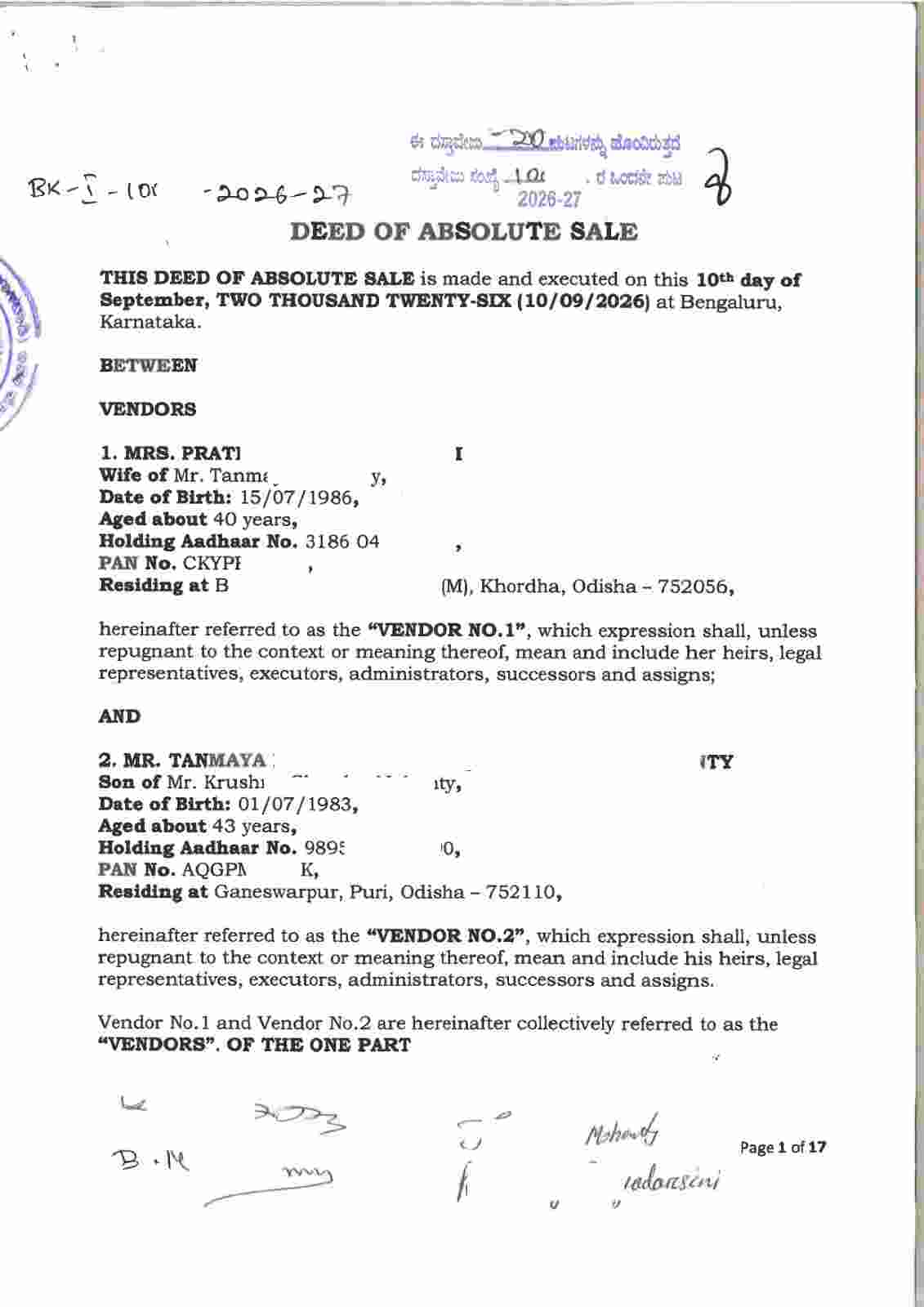
Here's how the numbers broke down:
- Total consideration: ₹64,00,000
- Financing: Fully self-financed, no home loan
- Sellers: Two co-owners, so the amount was split ₹32,00,000 each
- Since there was no loan involved, we skipped the formal sale agreement stage and went straight to sale deed registration — a common and valid approach for self-financed resale deals.
Here's the actual sequence of payments, in chronological order:
- Booking advance — ₹1,00,000 by IMPS
- RTGS transfer — ₹14,30,348
- Demand Drafts — ₹48,00,000
- TDS — ₹69,652 deducted and deposited to the government on the sellers' behalf, through separate challans for each seller, ahead of registration
Every rupee moved through a traceable, documented channel, and every instrument's reference number is recorded in the registered sale deed itself.
The Bottom Line
- Booking → UPI. Small, instant, auto-documented.
- Sale agreement → Cheque. Cheap, and conditional until you're satisfied.
- Registration → Banker's cheque (with a home loan) or DD/internet banking transfer (self-financed). Guaranteed, immediate, and quotable in the deed.
- Cash → Avoid at every stage. It's almost impossible to prove later.
If you're planning a property purchase, matching your payment mode to the right stage isn't just about convenience — it's your paper trail if anything is ever disputed.
Watch the full walkthrough with the actual sale deed on screen:
This post is based on our personal experience and is meant for general awareness, not legal advice.
Contact
PGN Property
+91-9742479020
pgnproperties@gmail.com