
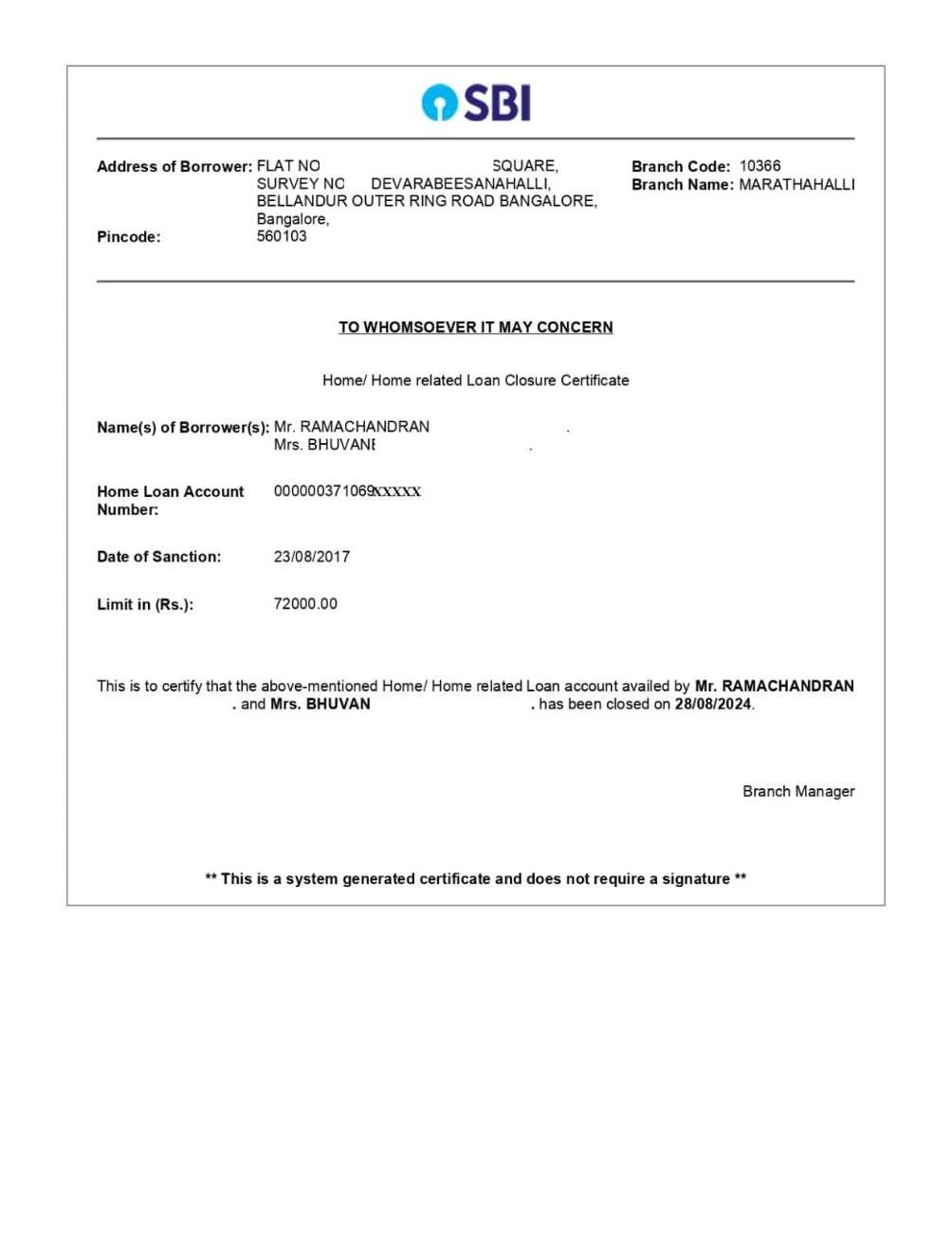
STEP 1: DOWNLOAD OR COLLECT YOUR LOAN CLOSURE CERTIFICATE Once your SBI home loan is fully repaid, you can download the loan closure certificate from your internet banking account under the loan section. This certificate is digitally signed by SBI, as shown in the image below.
 If the digital version is not available online, you can visit your SBI branch and collect a manual loan closure certificate, which will look like the sample shown below.
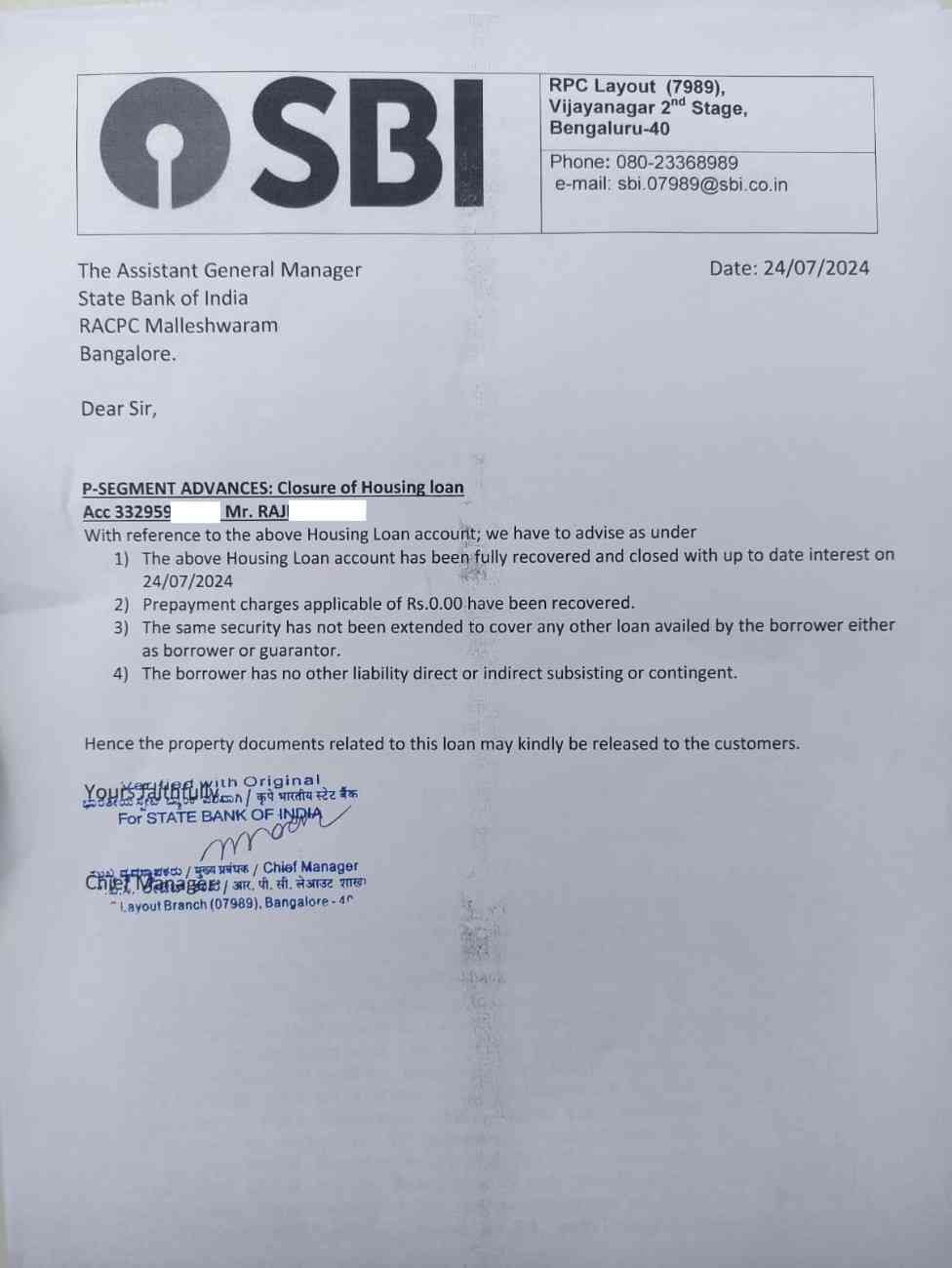
STEP 2: COLLECT PROPERTY DOCUMENTS FROM RACPC After issuing the loan closure certificate, your SBI branch will share the Regional Asset Central Processing Centre (RACPC) address and the date for collecting your property documents. On the scheduled date, visit the RACPC and collect your original property documents. Along with them, SBI will issue the Discharge Deed (also known as a “Reconveyance Deed”). This document must be registered at the Sub-Registrar's Office to remove the lien from the official property records.
STEP 3: IMPORTANCE OF E-KHATA FOR DISCHARGE DEED REGISTRATION The e-Khata is mandatory for registering the Discharge Deed at the Sub-Registrar's Office. If you do not have an e-Khata, you must apply for it first. Let me share two real examples from my clients, Mr. Praveen and Mr. Vasanth, to help you understand the challenges and solutions.
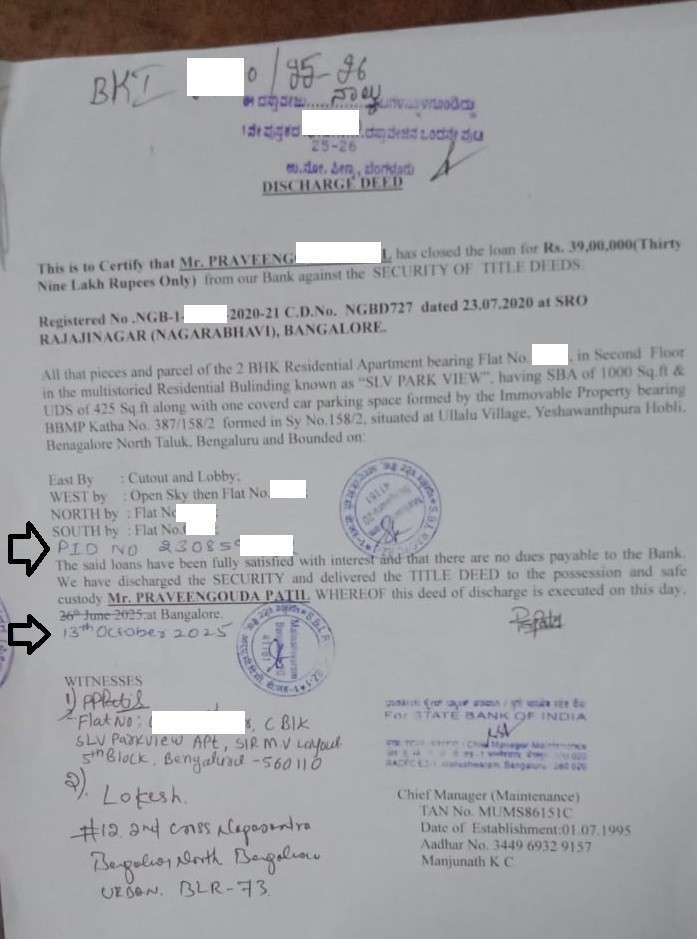
CASE 1: MR. PRAVEEN’S EXPERIENCE (WITHOUT E-KHATA) Mr. Praveen repaid his Rs. 39 lakh SBI home loan and collected the Discharge Deed on 26th June 2025. We have highlighted the date in the Discharge Deed below for your reference.
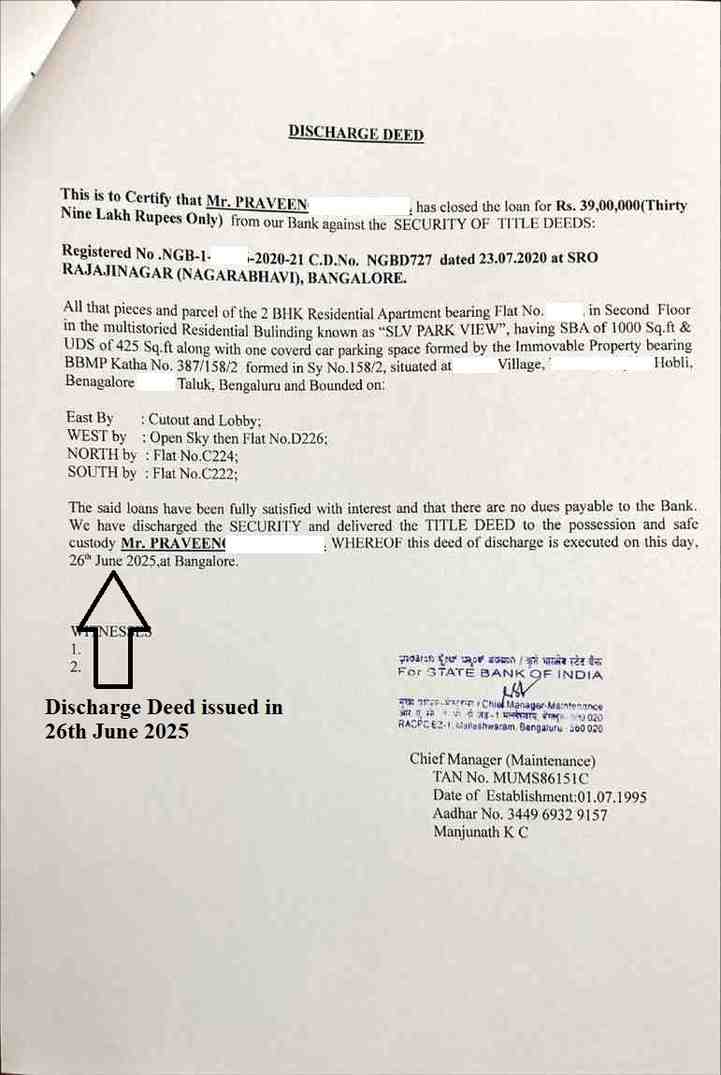 However, when he tried to submit the Discharge Deed application through Kaveri Online Services, the process could not be completed because the property did not have an e-Khata.
He then applied for the e-Khata, but the process took over three months, and he finally received it on 10th October 2025. Refer to the below e-Khata
However, when he tried to submit the Discharge Deed application through Kaveri Online Services, the process could not be completed because the property did not have an e-Khata.
He then applied for the e-Khata, but the process took over three months, and he finally received it on 10th October 2025. Refer to the below e-Khata
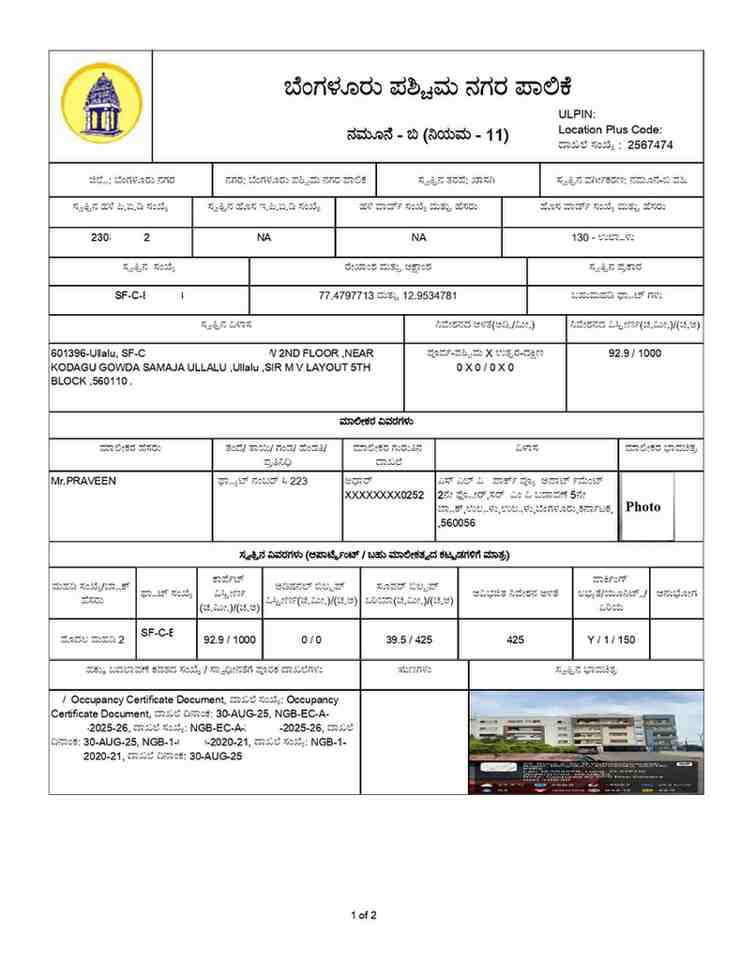 Once we received the above e-Khata, we immediately submitted the Discharge Deed application on 10th October 2025. However, our application was rejected for the following two reasons:
- The e-Khata number was not mentioned in the Discharge Deed.
- The date in the Discharge Deed had expired (a Discharge Deed is valid for only three months).
 Note: Even if your Discharge Deed is older than three months, you can still register it by paying a delayed fee of approximately Rs. 1,200. We have shared a screenshot from the Kaveri Online Services website below for your reference
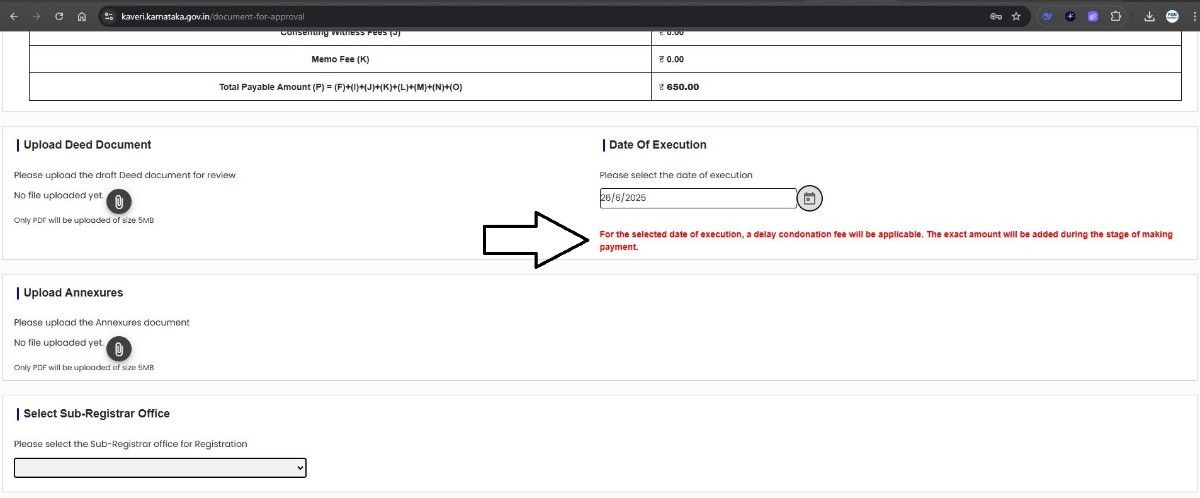 However, in our case, since we had to add the e-Khata number anyway, we decided to update the date instead of paying the delayed fee.
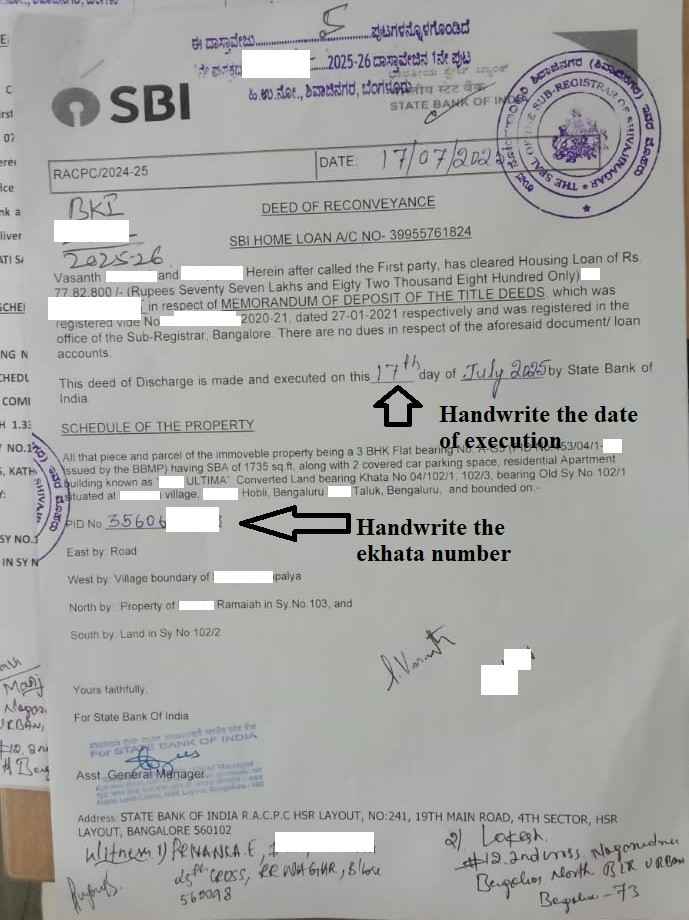
CASE 2: MR. VASANTH’S EXPERIENCE (FASTER PROCESS) Another client, Mr. Vasanth, repaid his SBI home loan of Rs.72,82,800. He did not have an e-Khata at the time of collecting his property documents, but he smartly requested the bank to issue the Discharge Deed without filling in the e-Khata number and date. After receiving his e-Khata within two days, he simply hand-wrote the e-Khata number and the latest date in the Discharge Deed and proceeded with registration at the Sub-Registrar Office. This approach saved him multiple visits to the bank and the Sub-Registrar’s Office and helped him complete the registration efficiently. We have highlighted the handwritten portions in the registered Deed below for your reference.
PRACTICAL GUIDANCE AND RECOMMENDATIONS
- Apply for your e-Khata before collecting documents from the bank.
- In most cases, the e-Khata process takes about one week.
- Once you receive it, book an appointment with your SBI branch for document collection.
- Especially if you are out stationed, apply for your e-Khata online from the comfort of your location.
- Once your e-Khata is generated, plan to collect your property documents and register the Discharge Deed on the same day or the very next morning.
- This ensures that the date in the Discharge Deed remains valid and avoids any delay
- Check your Discharge Deed before leaving the bank.
- Ensure the name, address, village name, e-Khata number and date are mentioned correctly.
- If these details are missing or wrong, request the bank to fill them in before you proceed to registration.
- Understand branch policies.
- Some SBI branches (like the one handling Mr. Vasanth’s case) allow customers to fill in the e-Khata number and date themselves.
- However, most branches require the e-Khata to be furnished before they incorporate the details officially.
- Failing to provide the e-Khata initially means you may need to revisit the RACPC for corrections, as in Mr. Praveen’s case.
FINAL THOUGHTS Removing a home loan lien with SBI involves several formal steps, but with proper preparation, especially obtaining your e-Khata in advance, you can complete the Discharge Deed registration smoothly and avoid unnecessary delays or repeated visits. If you’re unsure about the lien removal or registration process in Bangalore or Karnataka, consider consulting PGN Property to ensure compliance with all requirements.
NEED HELP WITH LIEN REMOVAL OR DISCHARGE DEED REGISTRATION? Contact PGN Property for expert assistance in preparing and registering your property documents, whether you’re in Bangalore or residing abroad.
- Call or WhatsApp: +91 9742479020
- Email: pgnproperties@gmail.com