
Ownership Check Using the Sale Deed
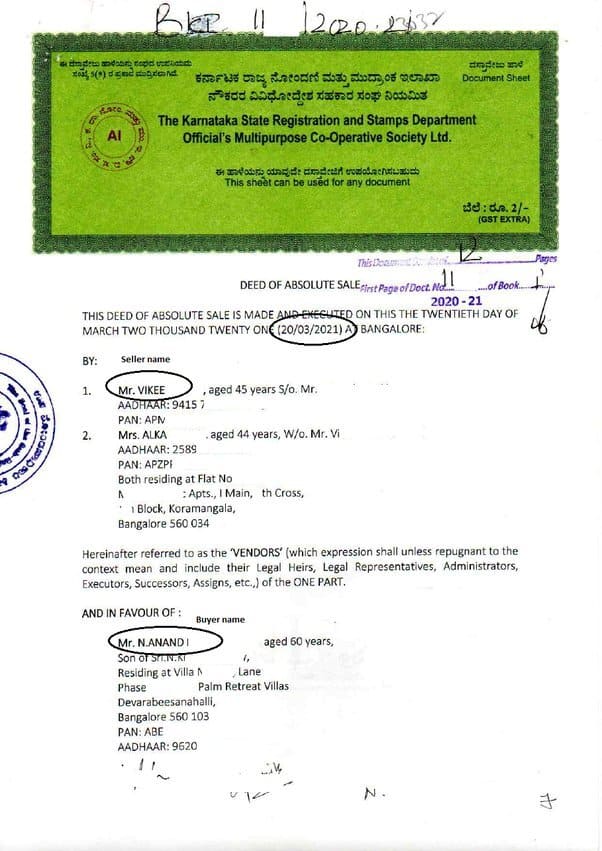
The registered sale deed provides key details to confirm property ownership. In the images below, we have highlighted the following:
- Date of Registration
- Seller’s Name
- Buyer’s Name
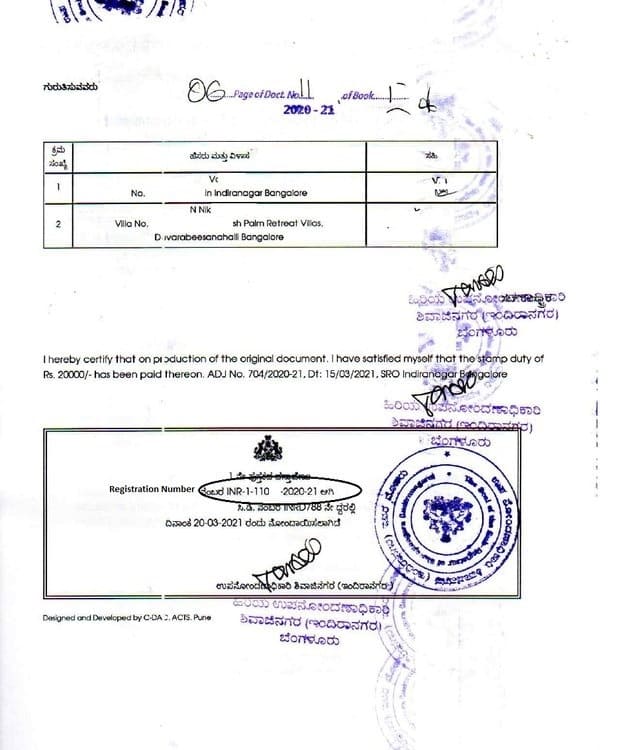
Another page of the sale deed shows the registration number, which is also highlighted for reference.
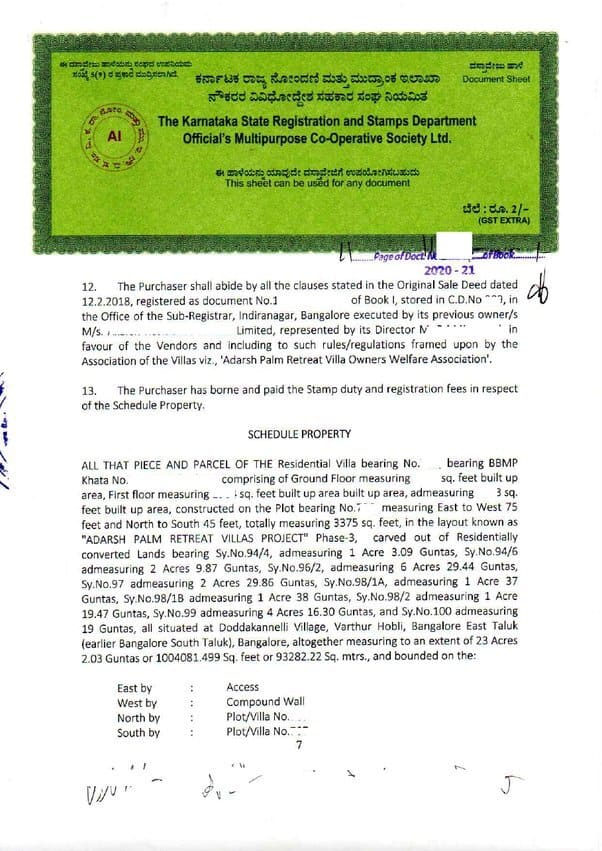
Additionally, the property schedule in the sale deed specifies the exact property details.
Ownership Check Using the Encumbrance Certificate (EC)
We extracted the encumbrance certificate online via Kaveri Online Services to cross-check the property ownership. The EC verifies the details recorded in the sale deed.
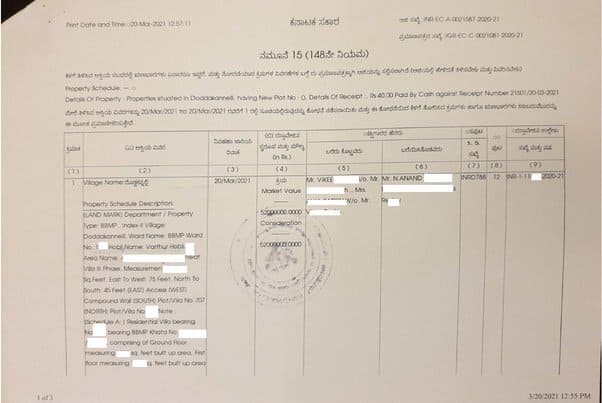
In the EC:
- Column 3: Date of registration. The sale deed was registered on 20th March 2021, which matches the date in the EC.
- Column 5: Seller’s name. The seller listed in the sale deed, Mr. VIKEE, appears identically in the EC.
- Column 6: Buyer’s name. The buyer, Mr. ANAND, also matches the EC record.
- Column 9: Registration number. The 5-digit registration number in the sale deed corresponds exactly with the EC.
This cross-verification ensures the property ownership is accurate and legally recorded.
FAQs: Verifying Property Ownership Using Sale Deed and EC
1. What is a Sale Deed?
A Sale Deed is a legal document that records the transfer of ownership of a property from the seller to the buyer. It contains details such as the date of registration, seller and buyer names, registration number, and property schedule.
2. What is an Encumbrance Certificate (EC)?
An Encumbrance Certificate (EC) is an official document issued by the Sub-Registrar’s office or online via Kaveri Services that shows all registered transactions on a property. It helps verify ownership and check if the property has any legal liabilities.
3. How can I verify property ownership using a Sale Deed and EC?
You can cross-check the ownership details recorded in the Sale Deed with the EC by comparing:
- Date of registration (Column 3 in EC)
- Seller’s name (Column 5)
- Buyer’s name (Column 6)
- Registration number (Column 9)
4. Can I extract an EC online in India?
Yes, ECs can be obtained online through state portals such as Kaveri Online Services (for Karnataka) or the respective state’s e-Registration portals.
5. Why is it important to verify property ownership?
Verifying ownership helps prevent fraud, ensures the property is free from disputes or encumbrances, and confirms that the property transaction is legally valid.
6. Can your service help in extracting Sale Deeds and ECs?
Yes, we assist clients in obtaining both Sale Deeds and Encumbrance Certificates efficiently and securely. Contact us via pgnproperties@gmail.com or WhatsApp +91-9742479020 to avail our services.