
Before buying or verifying any property in India, it is essential to check whether the property has an active mortgage or loan. The most reliable way to confirm this is by reviewing the Encumbrance Certificate (EC) of the property.
STEP 1: CHECK THE ENCUMBRANCE CERTIFICATE (EC)
The Encumbrance Certificate is an official document issued by the Sub-Registrar’s Office that records all registered transactions made on a property, such as sale deeds, gift deeds, and mortgage deeds (MODT).
If a property is mortgaged through a registered Memorandum of Deposit of Title Deed (MODT), the loan details and bank name will be reflected in the EC.
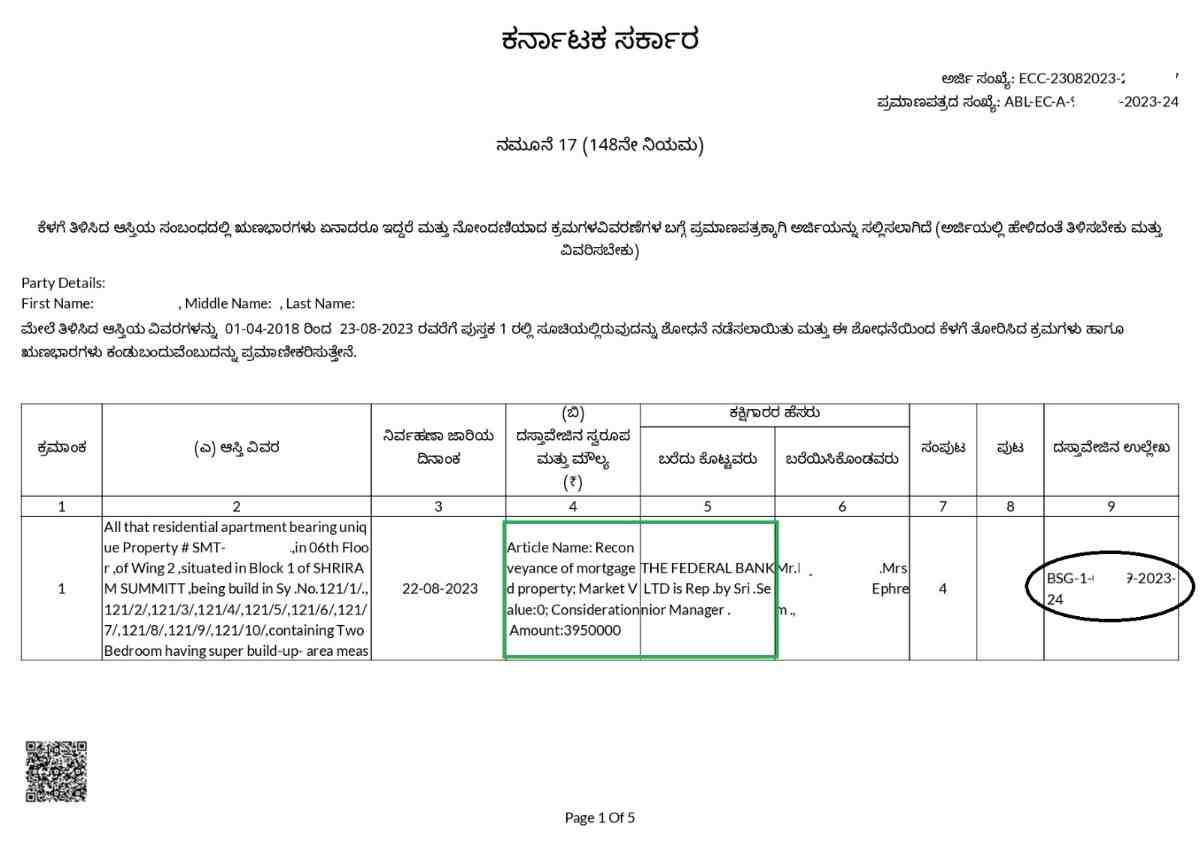
Example:
If you have taken a home loan from Federal Bank, the EC will show an entry indicating that a MODT is registered in favor of Federal Bank. (Refer to the highlighted section in the sample EC below, in green color.)
IMPORTANT NOTES
- Mortgage details appear in the EC only if the MODT is registered at the Sub-Registrar’s Office.
- Some banks, housing finance companies, and private lenders do not register the MODT. Instead, they retain the property’s original title deed (such as the registered sale deed) as security for the loan.
- Therefore, even if the EC shows no encumbrance, the property may still be mortgaged if the lender has not registered the MODT.
STEP 2: VERIFY THE ORIGINAL REGISTERED DEED
If the EC does not show any loan or mortgage entry:
- Request the property owner to show the original registered deed.
- If the owner cannot produce the original sale deed, it may indicate that the document is deposited with a bank or lender as part of a mortgage arrangement.
HOW TO CHECK THE EC ONLINE IN KARNATAKA
In Karnataka, you can easily obtain the Encumbrance Certificate (Form 15) online through the official government portal:
You will need the following details:
- Property details : such as the property schedule or ownership name,
- Duration period : the range of years for which you want to check the encumbrance (for example, the last 10 or 15 years)
Once you submit the application, you can download the EC instantly in PDF format for review.
ASSISTANCE FOR EC EXTRACTION IN KARNATAKA
If you need help extracting or interpreting your Encumbrance Certificate (Form 15) for property verification, our team can assist you.
- Write to us at: pgnproperties@gmail.com
- WhatsApp: +91 97424 79020
FREQUENTLY ASKED QUESTIONS (FAQ) – HOW TO CHECK IF A PROPERTY HAS A MORTGAGE IN INDIA ONLINE
1. What is an Encumbrance Certificate (EC)?
An Encumbrance Certificate (EC) is an official document issued by the Sub-Registrar’s Office that records all registered transactions related to a property. It includes sale deeds, gift deeds, lease deeds, and mortgage deeds (MODT). It serves as legal proof that a property is free from monetary or legal liabilities.
2. How can I find out if a property is mortgaged?
To check if a property is mortgaged, obtain the Encumbrance Certificate (EC) through the Kaveri Online Services portal (for properties in Karnataka).
If the property has a registered MODT (Memorandum of Deposit of Title Deed), the bank or lender’s name will appear in the EC.
3. Will a mortgage always appear in the Encumbrance Certificate?
No. Mortgage details appear only if the MODT is registered with the Sub-Registrar’s Office.
Some banks and private lenders do not register the MODT. Instead, they hold the original title deed as security. Therefore, even if the EC shows no encumbrance, the property may still be mortgaged.
4. What should I do if the EC shows no encumbrance, but I still have doubts?
If the EC shows no encumbrance, ask the property owner to produce the original registered sale deed.
If the owner cannot provide it, the document may be withheld by a bank or lender, indicating that the property is under mortgage.
5. What details are required to extract an EC online in Karnataka?
To obtain an EC through Kaveri Online Services, you need the following information:
- Property details (such as the schedule or ownership name)
- Duration period (for example, the last 10 or 15 years for which encumbrance is to be checked)
6. How long does it take to get an Encumbrance Certificate online?
In most cases, the EC can be downloaded from the Kaveri Online Services portal once the search is complete and payment is made.
7. What is a Memorandum of Deposit of Title Deed (MODT)?
A MODT is a legal document registered at the Sub-Registrar’s Office when a borrower deposits property title deeds with a bank to secure a loan. It is proof that the property has been mortgaged and gives the lender the right to claim the property in case of default.
8. Can I check mortgage details for properties outside Karnataka online?
The online process differs by state. Some states provide EC or land record search facilities online through their respective registration department portals. For other states, you may need to visit the local Sub-Registrar’s Office to obtain the EC.
9. Can someone verify a property’s mortgage status without the owner’s consent?
Yes, anyone can apply for an Encumbrance Certificate as it is a public record. Including certified sale deed can be accessed through online portal
10. Does the Encumbrance Certificate show the loan amount or repayment status?
Yes. The Encumbrance Certificate (EC) reflects the existence of a registered mortgage, including details such as the lender’s name and the loan amount mentioned in the registered Memorandum of Deposit of Title Deed (MODT).
However, the EC does not display repayment status, EMIs, or outstanding loan balance, it only records the transaction as registered in the Sub-Registrar’s Office.