
Yes, it is possible to register a Sale Deed without executing a prior Sale Agreement. This route is often ideal in scenarios where the buyer is self-financing the purchase
Let me share a real-life case study that illustrates how we bypassed the Sale Agreement and directly proceeded with the Sale Deed registration.
CASE STUDY: RESALE FLAT PURCHASE WITHOUT A SALE AGREEMENT
One of my clients was interested in purchasing a resale 2BHK flat in Bangalore. The seller initially quoted Rs.67 lakhs, but after negotiation, we agreed on a final price of Rs.60 lakhs. As the buyer opted for self-financing, without availing of a home loan, we chose not to enter into a formal Sale Agreement in order to expedite the process and facilitate quicker possession
Had this been a loan-based transaction, the bank’s legal team would have conducted due diligence. However, in a self-financed scenario, we proposed a three-layer verification approach:
- Certified Document Verification
- AI-based Document Analysis
- Legal Verification by an Advocate
STEP 1: CERTIFIED DOCUMENT VERIFICATION
The seller is a gentleman because he shared the property documents without even collecting the token advance, shared all property documents in a single, well-organized PDF. The documents included:
- Sale Agreement with builder (2004)
- Sale Deed registered with builder (2006)
- Current year Property Tax receipt
- Ekhata and Manual Khata
- No Due Certificate from Indian Bank (Mortgage cleared in 2015)
- BESCOM Bill
- Aadhaar Card
We conducted the following checks:
- Downloaded the certified copy of the Sale Deed and the Encumbrance Certificate (EC) via Kaveri Online Services to validate the sale deed and transaction history in EC.
- Retrieved the latest Property Tax receipt to verify payment status, ownership name, and address.
- Downloaded the E-Khata via the eAasthi portal to validate the property dimensions, usage type, and survey number.
- Verified ownership and address details through the BESCOM website using the Customer ID on the bill.
Cost Incurred:
| Document | Fee (Rs.) |
| Certified Sale Deed Copy | 260 |
| EC (Certified) | 250 (free to download the information copy) |
| Property Tax Receipt | Free |
| Ekhata Download | 125 |
| BESCOM Name Verification | Free |
| Total is just | 635 |
STEP 2: AI-BASED DOCUMENT VERIFICATION
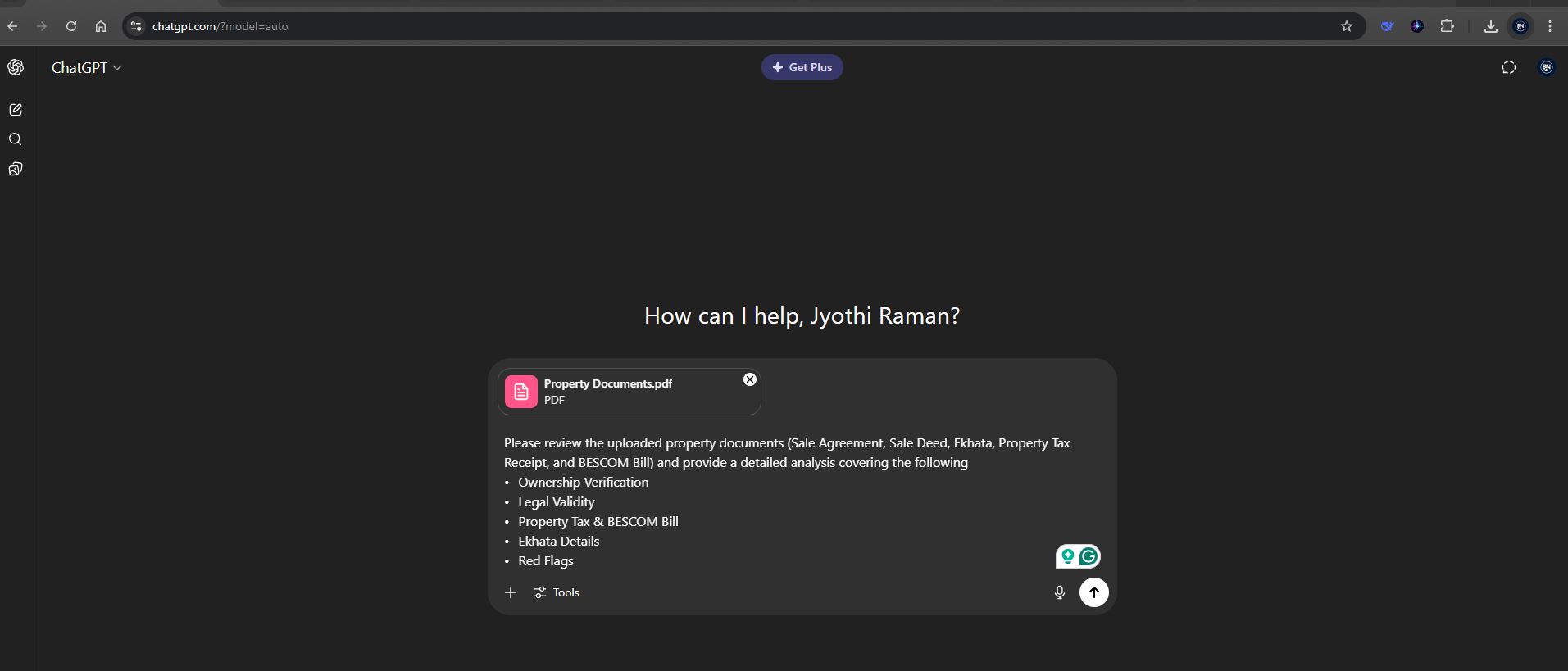
We utilized AI tools such as ChatGPT and DeepSeek to perform a thorough analysis of the property documents. It is important to tailor your prompt based on the specific aspects you wish to verify. Below is the prompt I used for our review
"Please review the uploaded property documents (Sale Agreement, Sale Deed, Ekhata, Property Tax Receipt, and BESCOM Bill) and provide a detailed analysis covering Ownership Verification, Legal Validity, Property Tax & BESCOM Bill, Ekhata Details, and any Red Flags."
Refer to our Upload and Prompt screenshot below:
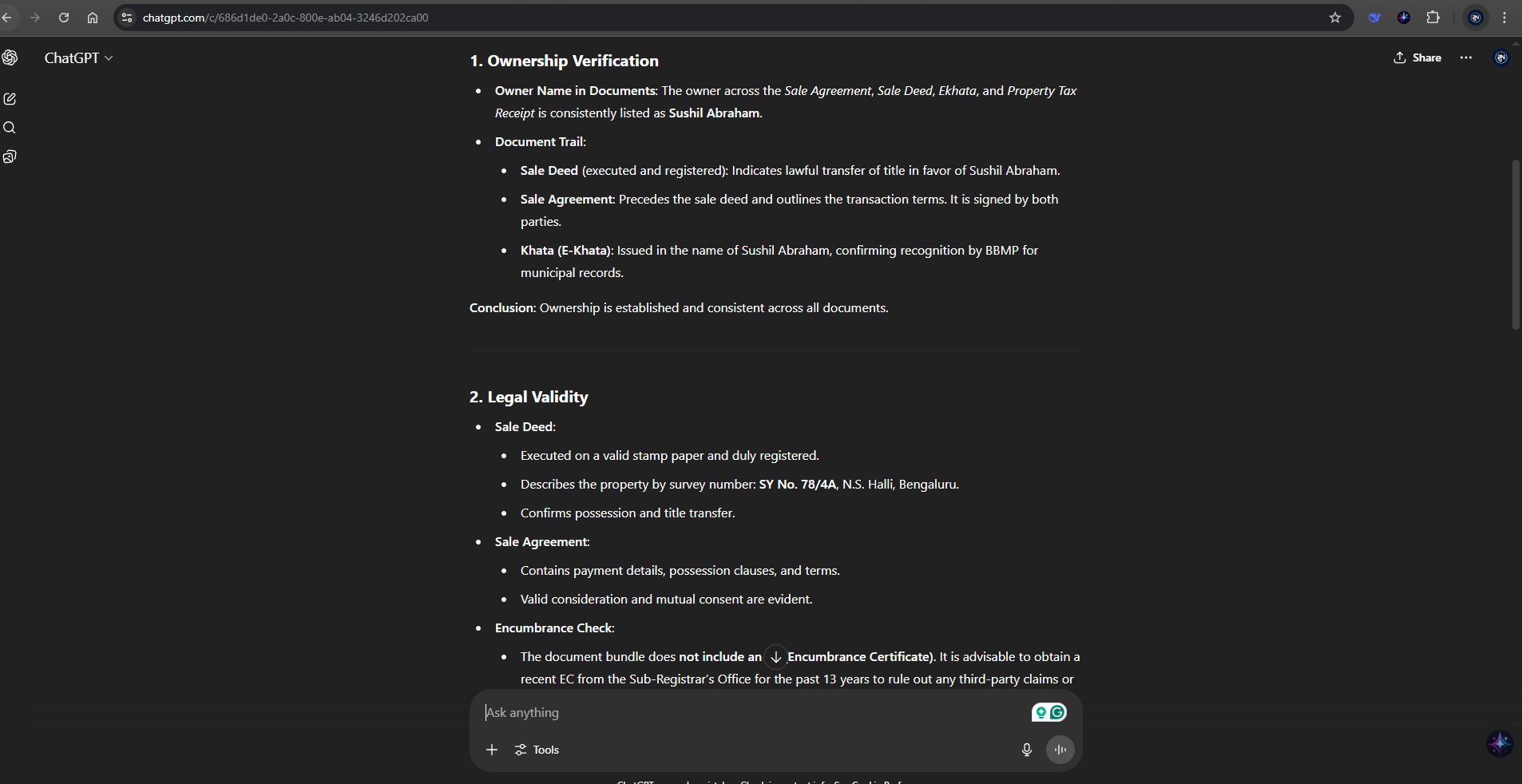
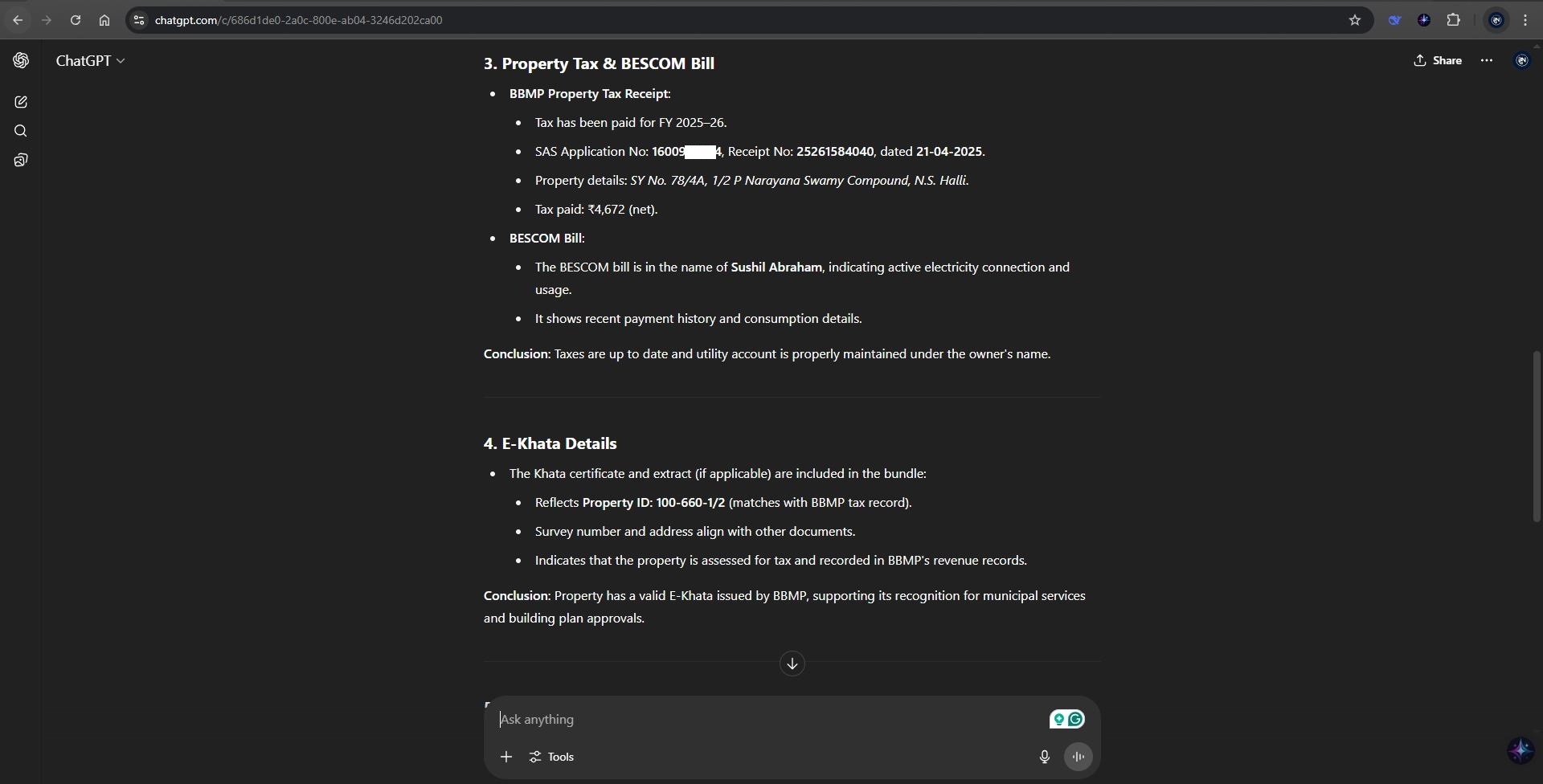
The AI generated a concise two-page report, featuring bullet points and tables for easy visualization. Refer to the below report
Reflags:
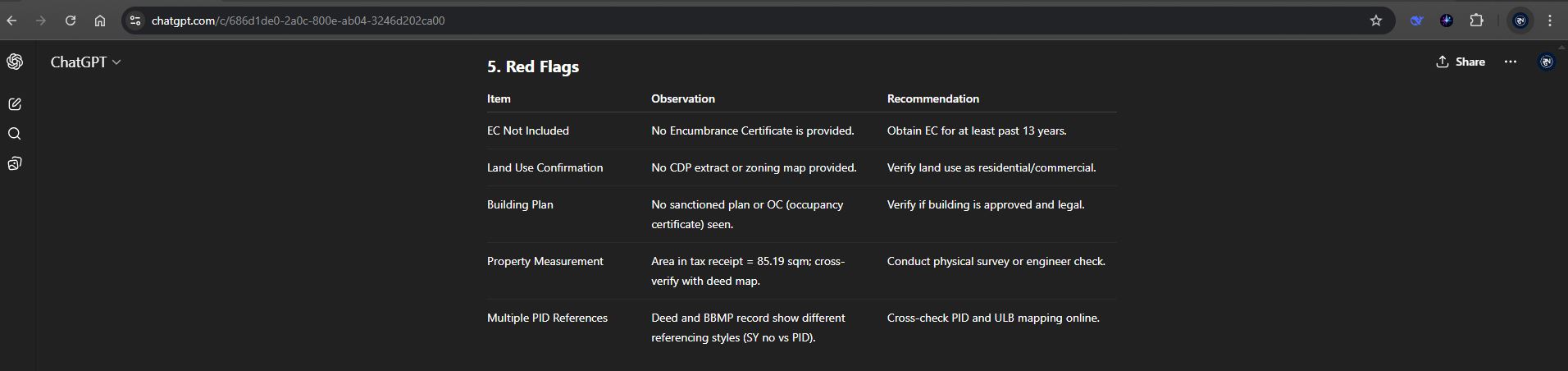
The report summarized the following:
- Verified the owner's name across all property documents to identify any discrepancies or missing links in the chain of ownership.
- Examined all documents for signs of encumbrances or potential legal disputes, such as minor claims or legal heirs
- Confirmed that the property tax payments are up to date and that the address on the BESCOM bill and tax receipt matches the property location.
- Reviewed the E-Khata to validate the survey number, property dimensions, and usage classification (residential or commercial).
The insights provided were accurate and valuable. We also used follow-up questions to better understand the report, which was instrumental in our decision-making process
STEP 3: ADVOCATE VERIFICATION
We consulted a reputable real estate lawyer, who conducted an in-depth legal review and issued a 15-page verification report in 3 working days, at a fee of Rs. 5,000. We shared the 1st page of the report below for your reference
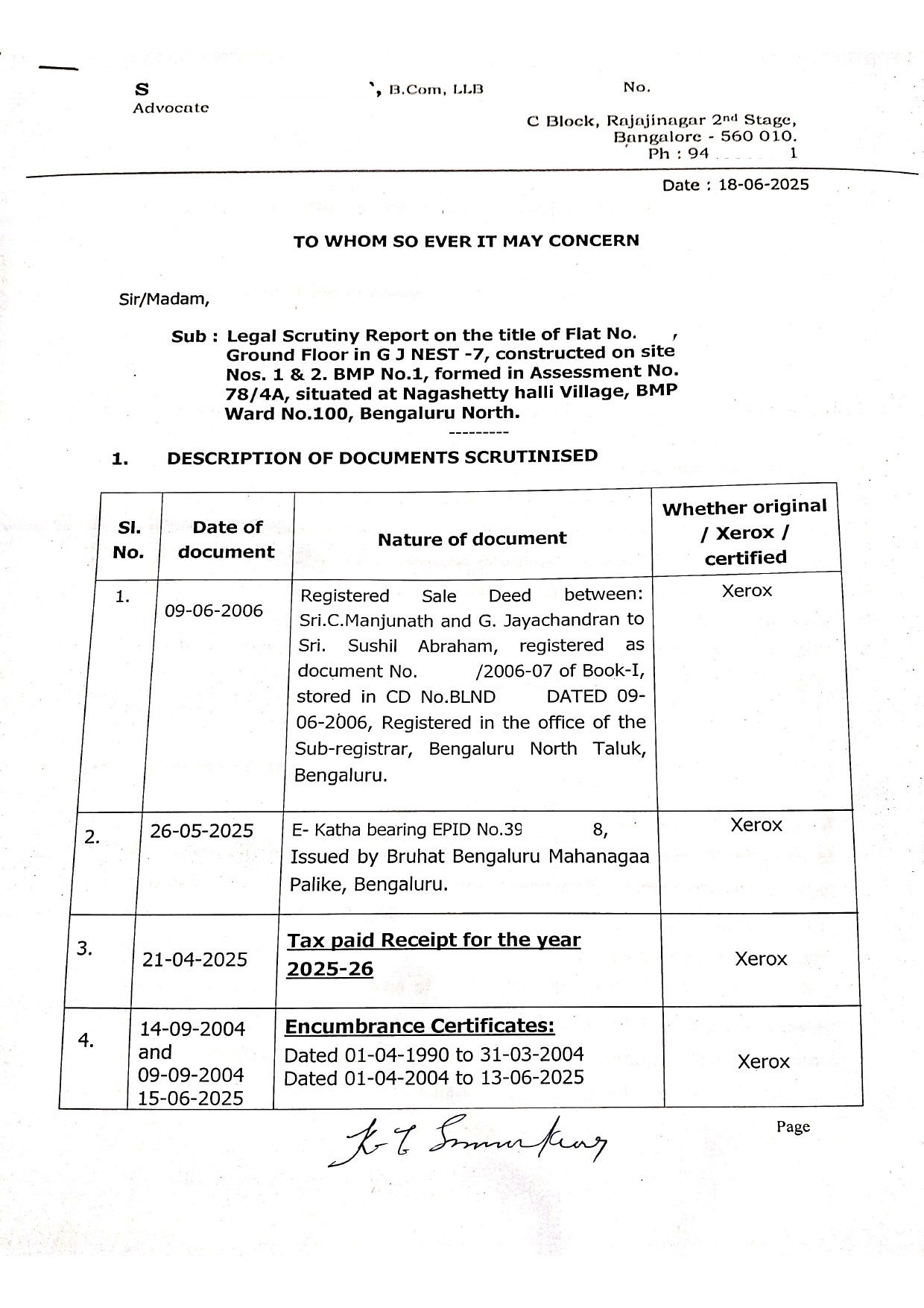
The legal opinion aligned with our initial certified copy extract and AI-based findings, providing additional assurance and confidence, so we decided to proceed with the sale.
PROCEEDING WITHOUT A SALE AGREEMENT
Since the property was ready for possession and the buyer was self-financing, we chose to skip the Sale Agreement to expedite the process and enable quicker possession. Another advantage is that my client avoided the drafting fee, e-stamp, or registration cost.
Below is the structured approach we followed for Sale Deed registration:
- Drafting: Prepared the Sale Deed and reviewed it using AI tools for clarity, formatting and structure
- Review: Shared the draft with the seller, buyer, and advocate for final comments.
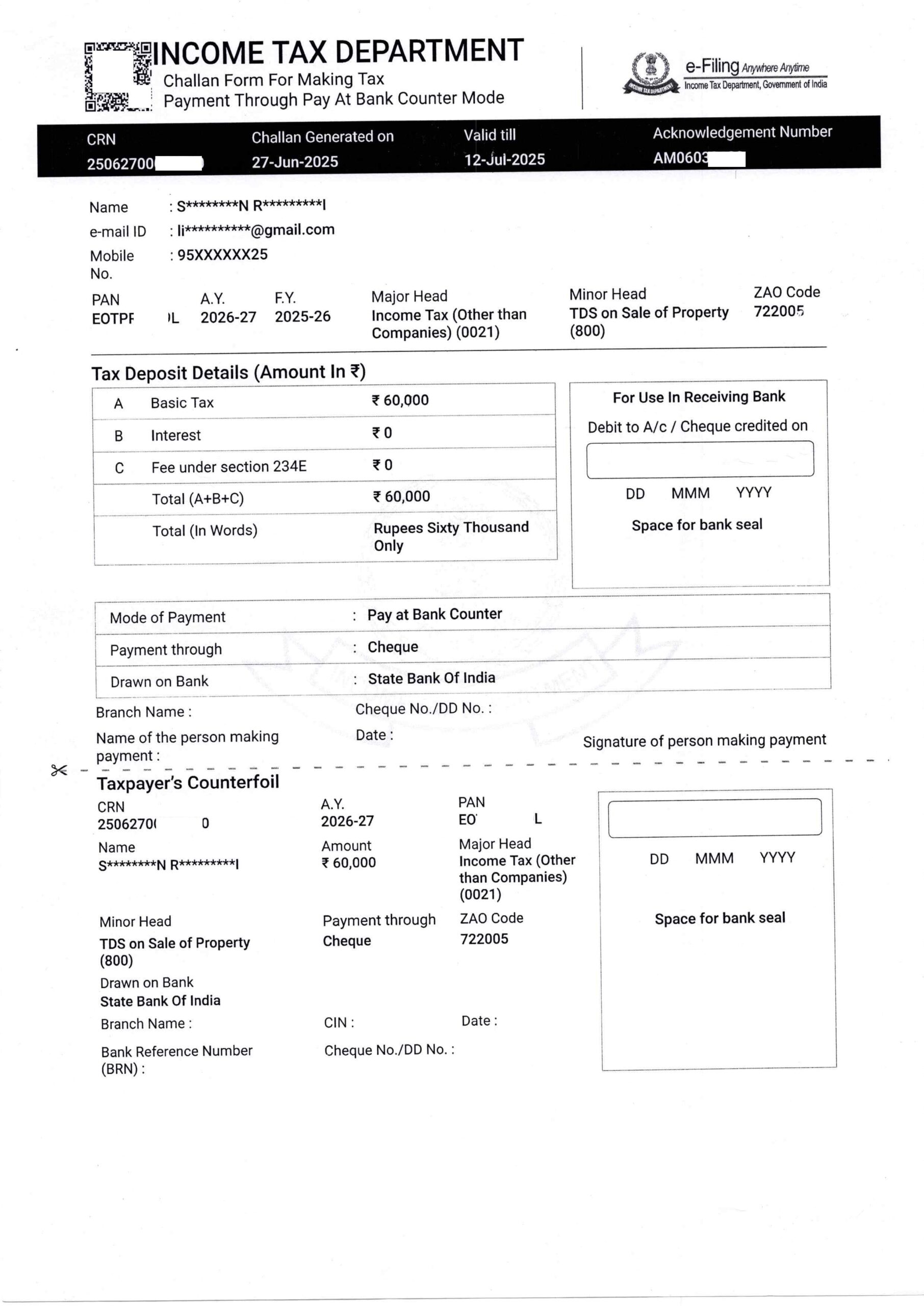
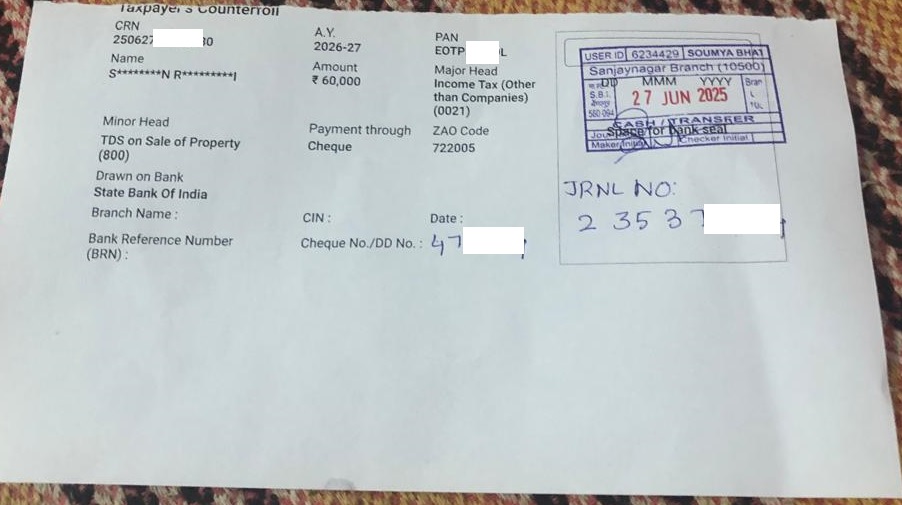
- TDS Payment: Paid Rs.60,000 TDS through an offline process using a bank representative, incurring an additional ₹400 service charge. (TDS can also be paid online for convenience, but our buyer was not aware of the online procedure, hence decided to opt offline) Refer to the below TDS
Document Preparation: Uploaded and submitted the following documents online for the Application of Sale Deed Registration:
- Seller’s original Sale Deed
- Current year’s Property Tax Receipt
- Ekhata
- TDS Challan
- Aadhaar of both parties
- Sale Deed (To be registered)
- Two witnesses details
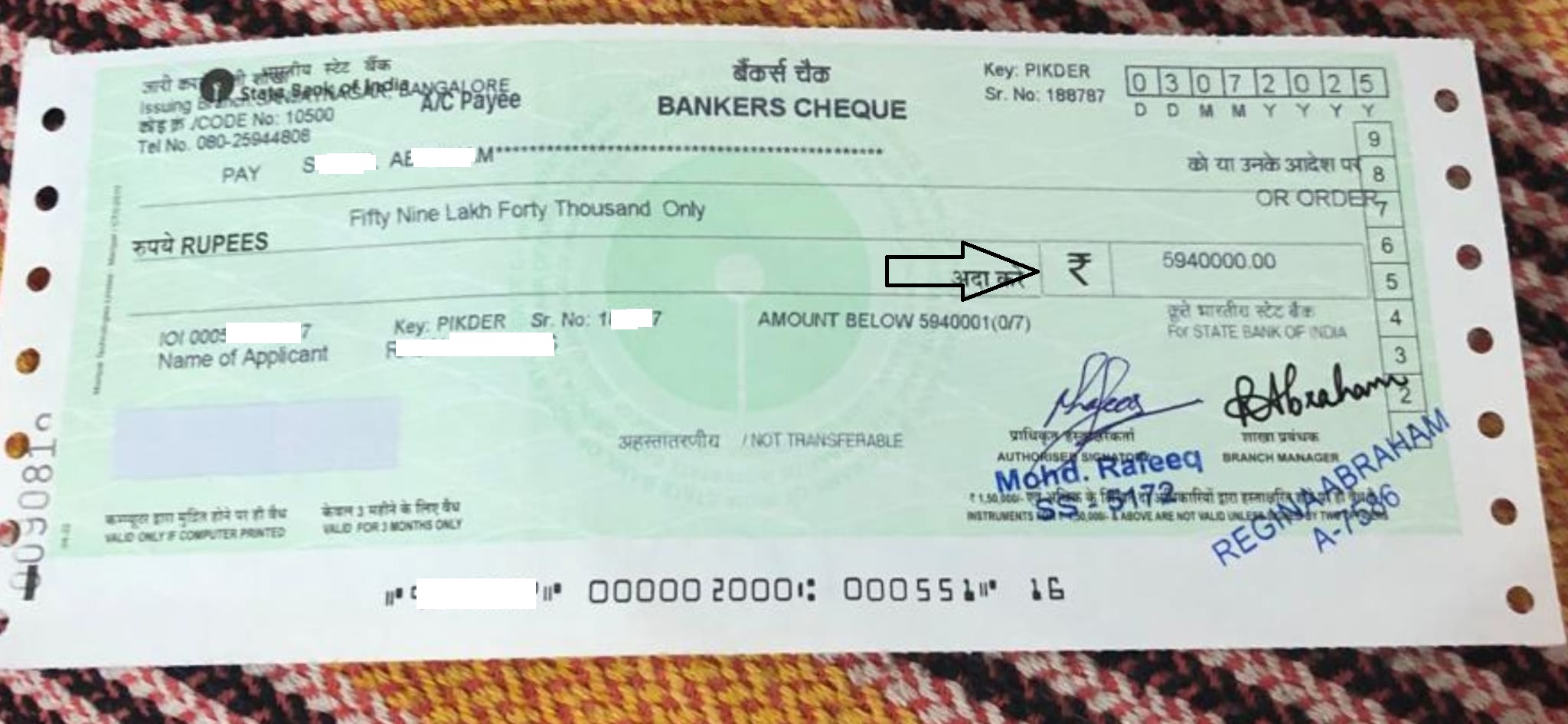
Once approved, the buyer prepared the DD of Rs.59.40 lakhs for the settlement to seller. We share the DD image with seller to get the date confirmation.
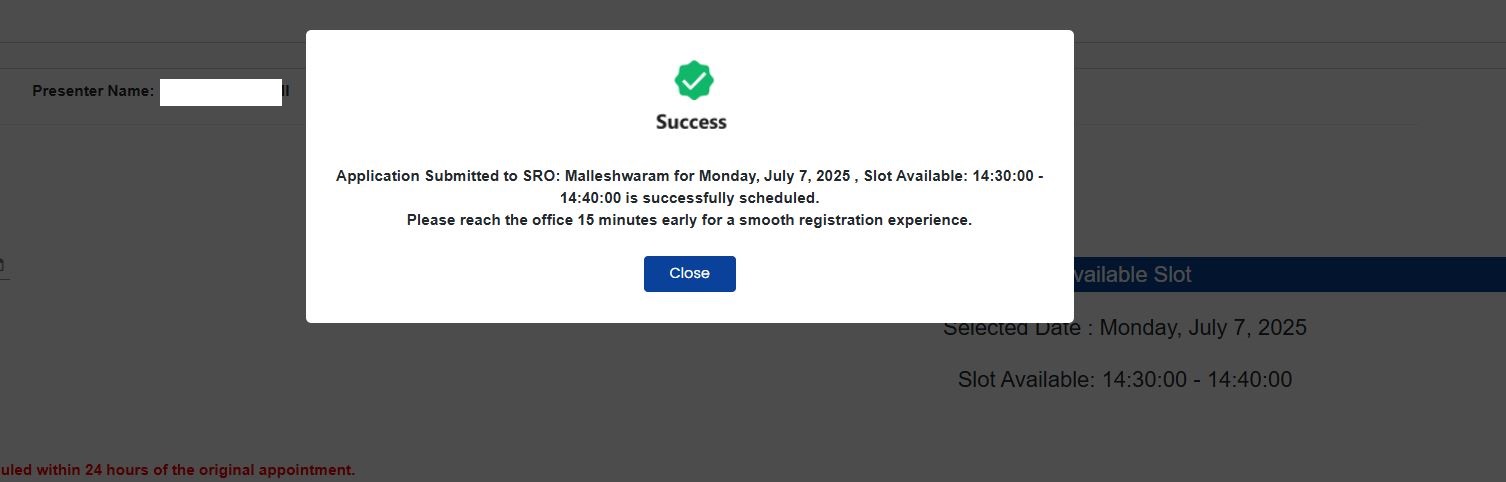
The seller confirmed the date for registration. We paid the stamp duty and booked the registration slot date 07-07-2025. Refer to the below slot confirmation
REGISTRATION DAY CHECKLIST
One day before the scheduled registration, we ensured the following were ready:
- Application Summary Report
- Final Sale Deed printed on document paper (to be registered)
- Aadhaar of buyer, seller, and two witnesses
- Original property documents and keys from the seller
- Demand Draft from Buyer
- Two witnesses present with Aadhaar copies
Final Check: Just before the registration, we retrieved a fresh information copy of the Encumbrance Certificate (EC) to verify whether any mortgage or charge had been created on the property during the interim period. Our previous EC extract was dated 15-06-2025 for verification, and the registration was scheduled for 07-07-2025, resulting in a 22-day gap. Since the transaction was self-financed, it was crucial to ensure that no new encumbrance had been recorded in gap between verification and the Scheduled Registration date.
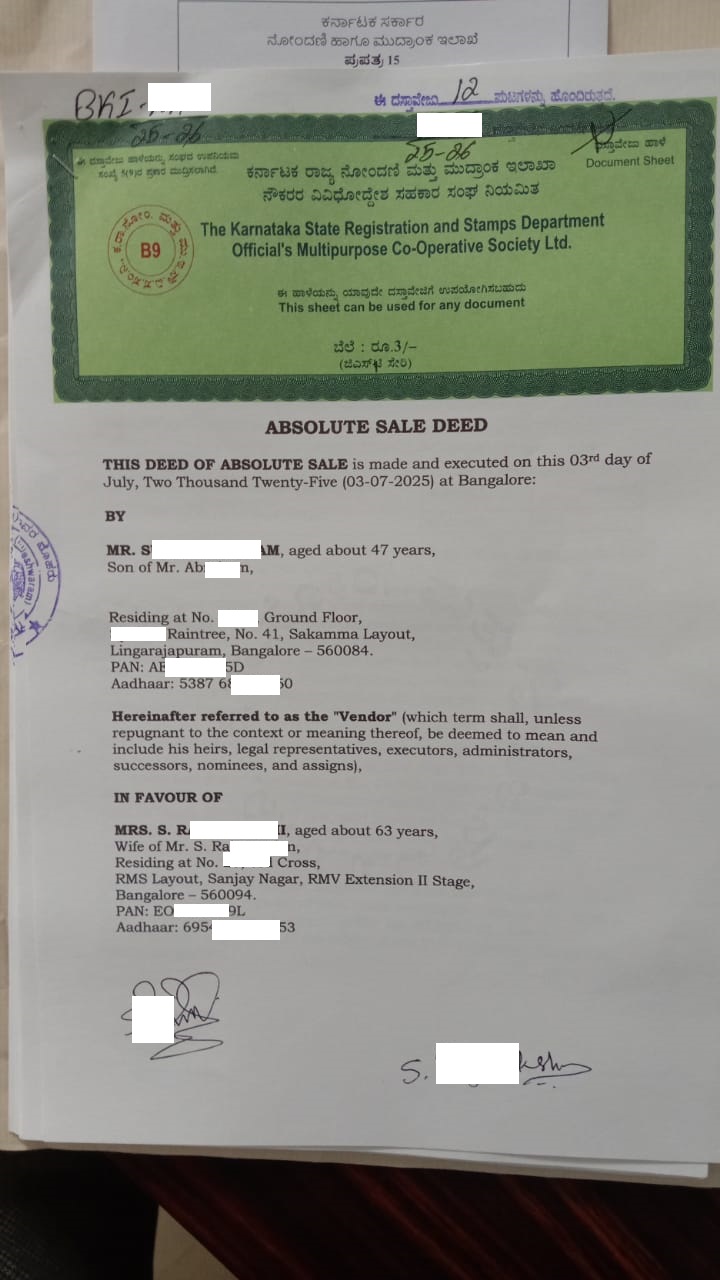
Once confirmed, we proceeded with the registration. Refer to the Sale Deed below for reference.
OUTCOME
We completed the entire transaction, including registration and possession, within 22 days. The only delay occurred during the offline TDS payment process, which took 7 days for buyer to explore the CA, DD preparation and payment in Bank, this delay could have avoidable if TDS paid online.
This was an outright transaction, settled entirely in one go after deducting TDS. Below is a snapshot of the Demand Draft handed over to the seller.
CONCLUSION
Skipping a Sale Agreement is a practical option when:
- The property is ready for immediate possession.
- The transaction is self-financed.
- Both parties are aligned and transparent.
However, this approach requires meticulous verification and coordination. With certified checks, AI analysis, and professional legal review, it is entirely feasible to proceed directly with a Sale Deed.
PLANNING TO SELF-FINANCE YOUR PROPERTY PURCHASE?
Connect with us for comprehensive support from document verification to Sale Deed registration, ensuring a safe, seamless, and legally compliant transaction
- PGN Property, Bangalore
- Email: pgnproperties@gmail.com
- WhatsApp: +91-97424 79020