
When buying property in Bangalore, one of the most important costs you need to plan for is stamp duty on the sale agreement.
Stamp Duty for a Sale Agreement (without possession): 0.5% of the consideration amount.
Example Calculation
- If the property value (consideration amount) is Rs.95,00,000
- Stamp Duty = 95,00,000 × 0.5% = Rs.47,500
My Real Case Study – Paying Stamp Duty for a Sale Agreement
Recently, one of my clients booked a resale flat in Bangalore priced at Rs.95 lakhs.
- We paid an advance of Rs.11 lakhs to the seller.
- To proceed with the home loan application, we executed a sale agreement on a non-judicial e-stamp paper.
Here’s the step-by-step process we followed:
Step 1 – Drafting the Sale Agreement
We prepared the agreement in Word format.
Step 2 – Buying Non-Judicial e-Stamp Paper
e-Stamp papers are available at co-operative banks, near court premises, and at registration office premises.
Stamp vendors usually provide a questionnaire form, which includes:
- Seller’s Name
- Buyer’s Name
- Stamp Paper Purchaser (usually the buyer)
- Contact Number of Purchaser
- Consideration Amount (property price)
Step 3 – Cross-Verification
The vendor generates a preview copy of the e-stamp. Carefully check for:
- Document Description
- Property Description
- Seller’s Name
- Buyer’s Name
- Consideration Amount
Tip: Once printed, errors cannot be corrected easily. Claiming a refund is cumbersome and stamp vendors may resist processing it.
Step 4 – Payment of Stamp Duty
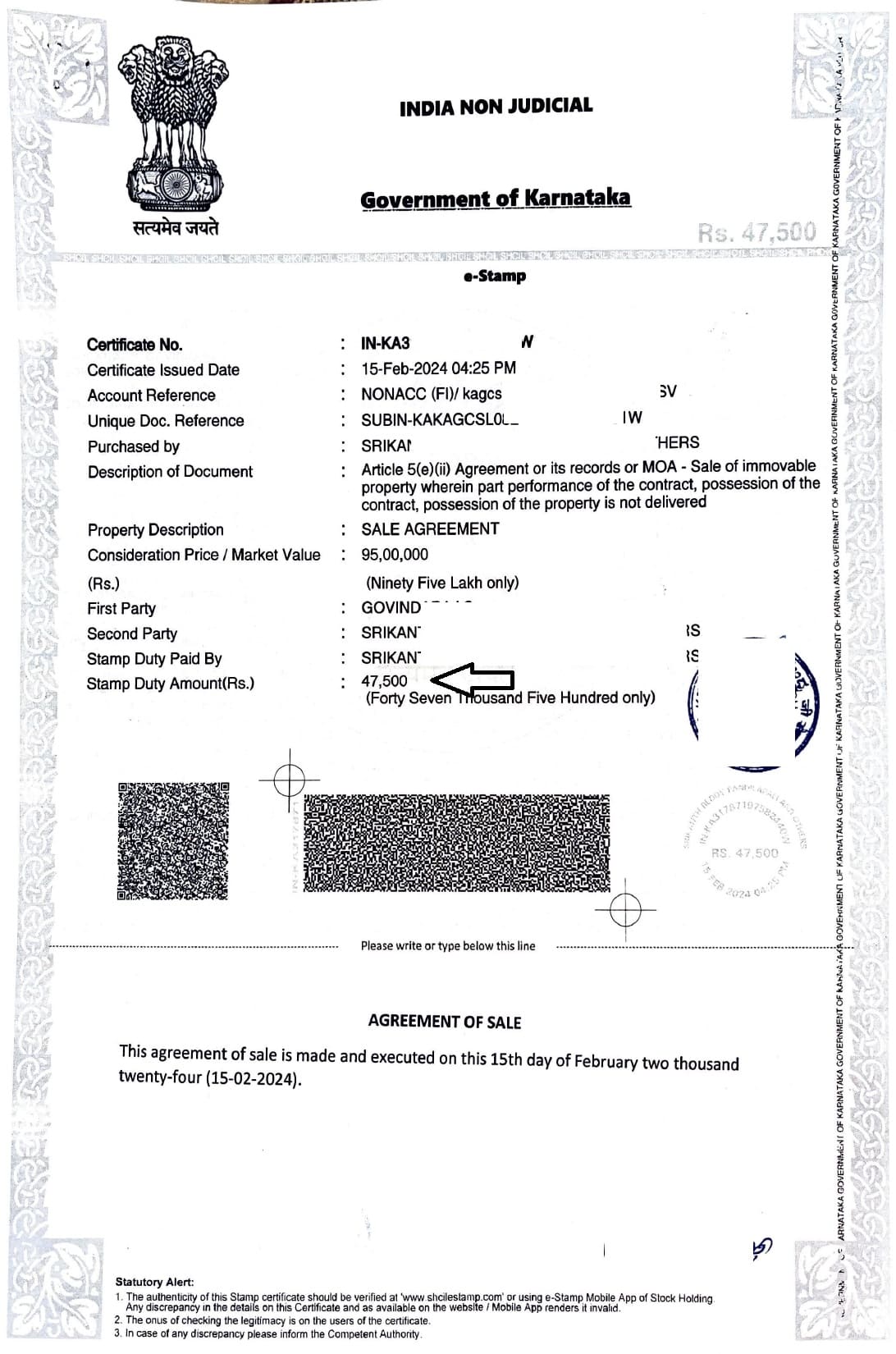
- For Rs.95 lakhs, the stamp duty came to Rs.47,500.
- We paid the vendor through UPI.
- The vendor then printed the e-stamp on bond paper and handed it to us.
Step 5 – Executing the Agreement
We printed the draft sale agreement on the e-stamp paper.
The buyer, seller, and two witnesses signed the document.
We highlighted the stamp duty payment in the agreement (see reference image below).
Advantages of Executing a Sale Agreement on e-Stamp Paper
- Time-Saving – You can complete the process in 30 minutes, whereas registering at the sub-registrar’s office takes 2–3 days (application, appointment, and registration).
- No Middlemen Needed – The process is simple; buy e-stamp paper and print the draft. No need to depend on agents or brokers.
- Easy Availability – e-Stamp papers are available with vendors near most residential areas.
Disadvantages of Using e-Stamp Paper
High Processing Fees – Vendors charge variable service fees.
- If stamp duty is above ₹10,000, many vendors charge a fixed fee (Rs.1,000–2,000) or even 5–10% of the stamp duty amount.
- In my case, I paid Rs.1,500 as processing charges for a Rs.47,500 stamp duty.
Higher Cost Compared to Registration – Registering the sale agreement at the Sub-Registrar’s Office costs only:
- 200 (registration fee) + ~Rs.200 (scanning fee).
That means, instead of paying Rs.1,500 in processing fees, I could have registered the agreement officially at just Rs.400.
IMPORTANT NOTE
- The stamp duty paid for a sale agreement can be adjusted against the stamp duty for the final sale deed registration.
- In my client’s case, the Rs.47,500 already paid will be deducted from the sale deed stamp duty at the time of registration.
CONCLUSION
Paying stamp duty for a sale agreement in Bangalore is straightforward if you follow the right process. However, be aware of the hidden vendor charges when opting for e-stamp paper.
If you want professional assistance in drafting or executing a sale agreement, write to us:
- pgnproperties@gmail.com
- +91-97424-79020 (WhatsApp)