
Transferring property ownership after the death of a family member is a common yet sensitive legal process in India. In Karnataka, the procedure varies depending on whether the deceased left behind a registered Will or passed away intestate (without a Will). This guide explains the practical steps involved, supported by a real case we recently handled in Bangalore.
CASE STUDY: PROPERTY TRANSFER FOR AN NRI CLIENT
One of our NRI clients approached us to transfer properties inherited from his late father. The father owned two properties in Bangalore — one in Shivajinagar jurisdiction and another in Basavangudi.
Since he passed away without leaving a Will, the legal heirs included his wife, son, and daughter. The family agreed on the following distribution:
- One property solely in the wife’s name
- Another property to be shared equally between the son and daughter
We successfully completed the transfer by following a structured process:
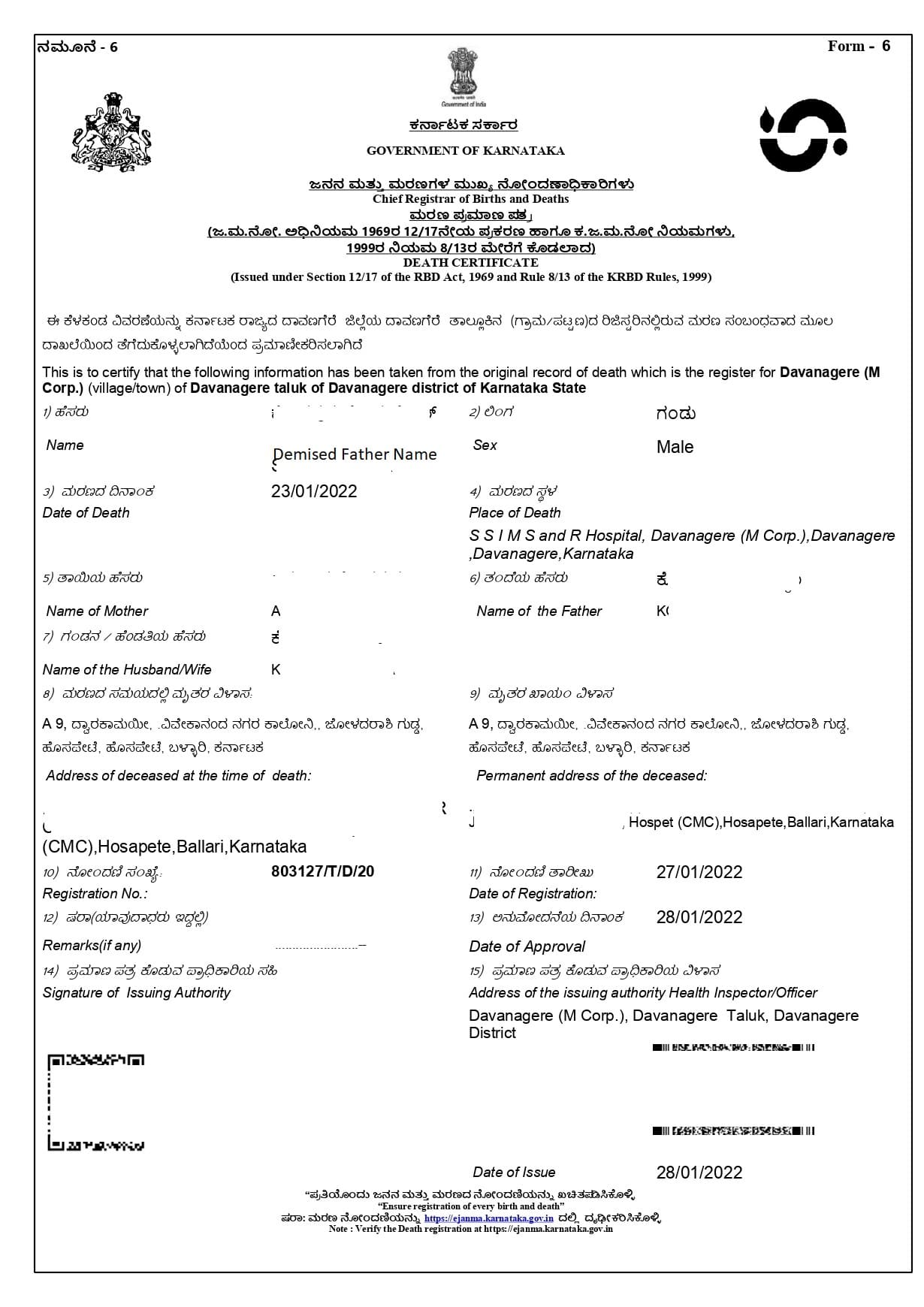
STEP 1: OBTAIN THE DEATH CERTIFICATE
The death certificate is the foundation of any succession process.
- Where to Apply: Municipal Office / Hospital (through hospital facilitation)
- Application Fee: Rs.5
- Processing Time: Same day (in this case, issued via hospital)
STEP 2: APPLY FOR THE FAMILY TREE CERTIFICATE
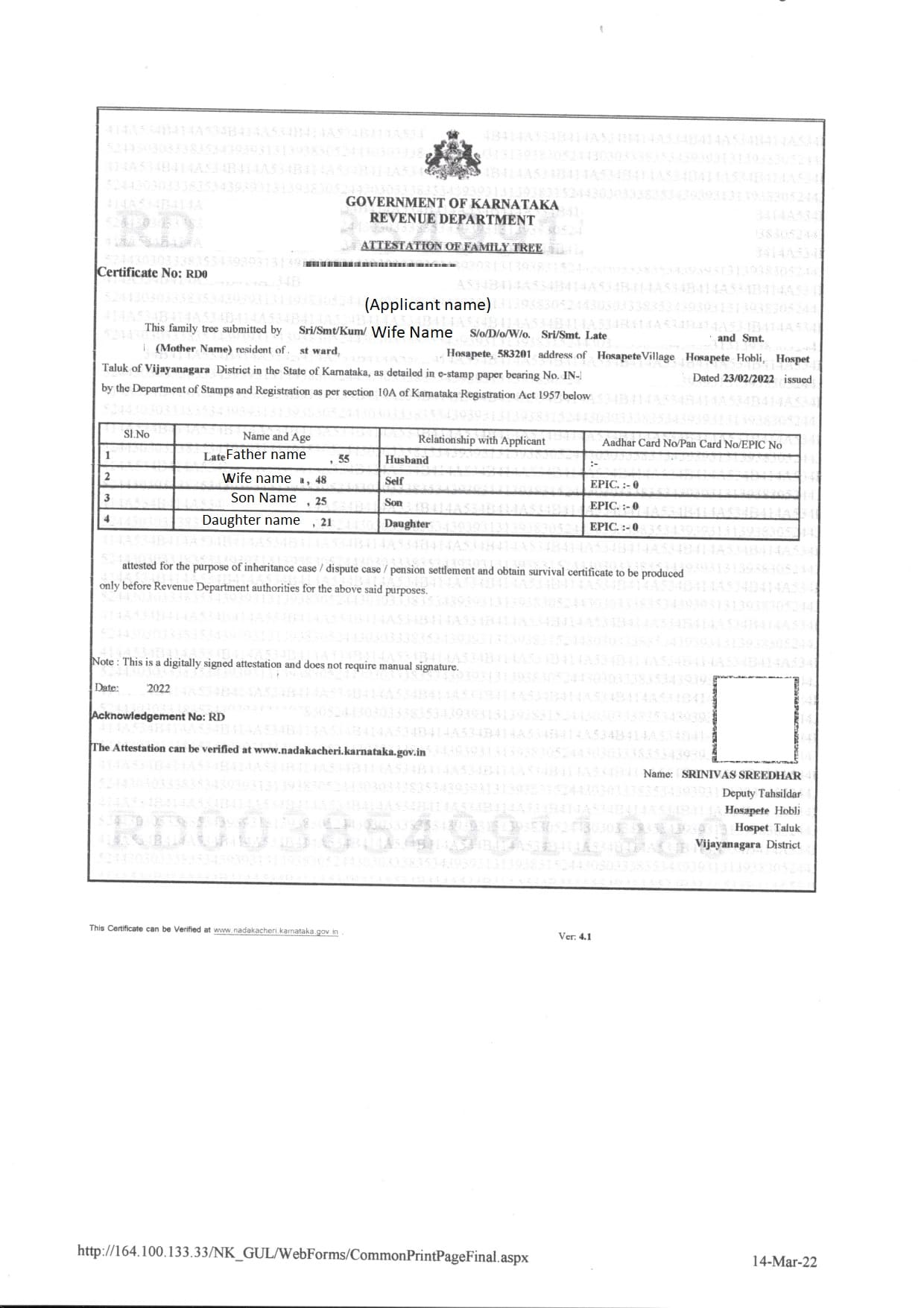
Also known as the Legal Heir Certificate, this document is issued by the Revenue Department and lists all surviving legal heirs of the deceased.
Documents Required:
- Aadhaar, Passport, or Driving License of the applicant and heirs
- Passport-size photo of the applicant
- Affidavit describing family structure (attested by a Notary)
- Death certificate of the deceased
- Property tax receipt in the deceased’s name
Application Details:
- Where to Apply: Nadakacheri (Atalji Janasnehi Kendra)
- Application Fee: ₹40
- Processing Time: ~4 working days
- Download: nadakacheri.karnataka.gov.in
STEP 3: DRAFT AND REGISTER A PARTITION DEED
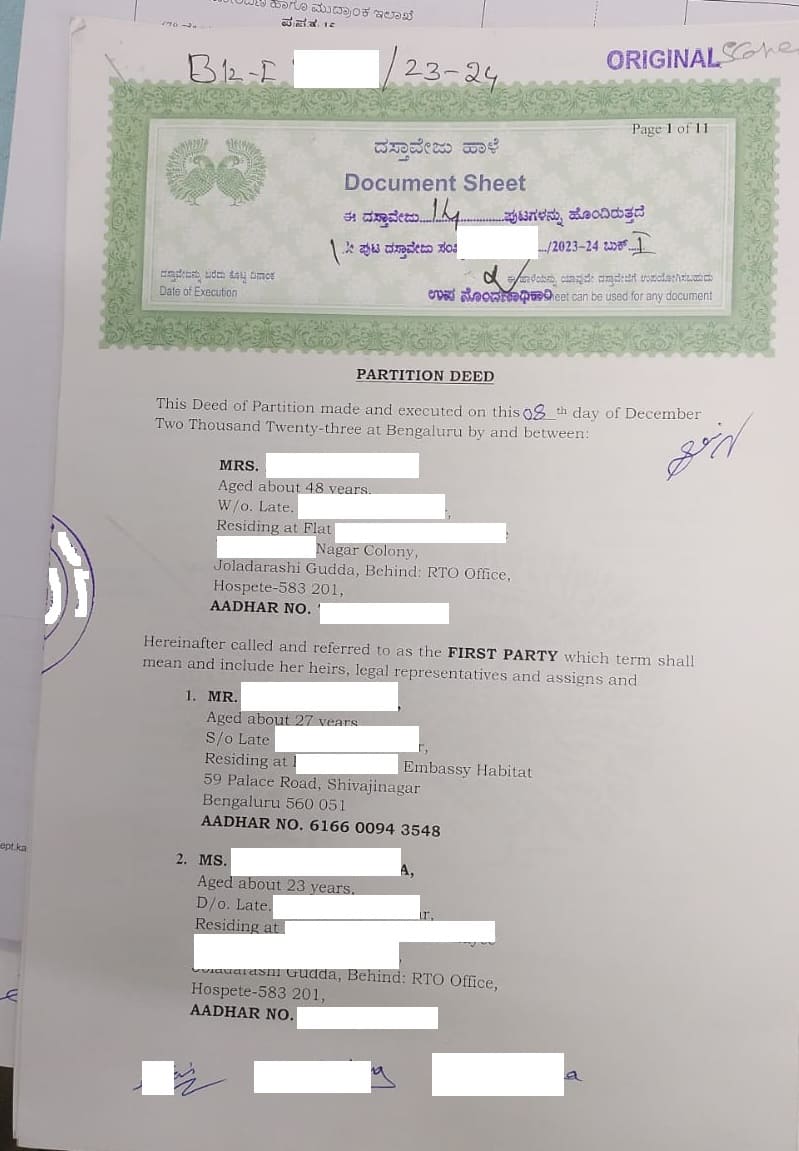
A Partition Deed legally divides the deceased’s property among legal heirs.
Documents Required:
- Parent deed (document showing how the deceased acquired the property)
- e-Khata & property tax receipt (still in the deceased’s name)
- Death certificate
- Family Tree Certificate
- Draft Partition Deed
Government Charges:
- Approx. Rs.7,255 (includes stamp duty, registration fee & one certified copy)
Registration Jurisdiction:
Although the properties were in two different sub-registrar jurisdictions (Shivajinagar & Basavangudi), the Partition Deed was registered at the Basavangudi Sub-Registrar Office.
Note: The Partition Deed can be registered at any sub-registrar office governing the concerned properties.
KEY NOTES ON LEGAL PROPERTY TRANSFER
Once you have the Death Certificate and Family Tree Certificate, property can be transferred through different legal instruments:
- Single Legal Heir: Direct Khata Transfer (no deed required)
- Multiple Legal Heirs (division): Partition Deed or Settlement Deed
- One or more heirs relinquishing rights: Release Deed or Relinquishment Deed
NEED ASSISTANCE?
We specialize in property transfer services for NRIs and residents in Bangalore. From documentation to registration, our team ensures a smooth process.
- Email: pgnproperties@gmail.com
- WhatsApp: +91-97424-79020
FREQUENTLY ASKED QUESTIONS (FAQ)
1. Is it mandatory to register a Partition Deed in Karnataka?
Yes. Registration of a Partition Deed is mandatory. Without registration, it has no legal validity.
2. What is the cost of transferring property from a deceased parent in Bangalore?
- Death Certificate: Rs.5
- Family Tree Certificate: Rs.40
- Partition Deed Registration: Around Rs.7,255 (varies based on property and office)
Additional lawyer or facilitation charges may apply.
3. Can property be transferred without a Partition Deed if there is only one heir?
Yes. If there is only one legal heir, property ownership can be updated directly through a Khata Transfer with BBMP/Revenue Office, without registering a deed.
4. What if there is a registered Will?
If a valid Will exists, property transfer is done through Probate of Will (in some cases) or direct Khata Transfer, depending on the circumstances.
5. How long does the entire process take?
On average, 3–6 weeks, depending on document availability, sub-registrar appointments, and any objections raised during verification.
6. Can NRIs complete this process without traveling to India?
Yes. With a properly executed Power of Attorney, NRIs can authorize a trusted representative to complete the process in Karnataka.